Ramsay Mechanical Test Score: What Is Good?
Ramsay publishes no pass mark, but it does publish the average. What your Ramsay mechanical test score means, who sees it and what score to aim for.
If you have been asked to sit the Ramsay mechanical test, or have just sat it, the question is usually the same: what score is good enough? Ramsay does not publish a pass mark, and you will probably never see your own result. What Ramsay does publish is the average score for every test, which is the best guide there is to where a good mark sits. Here is how the score works and what to aim for.
Your score is the number you get right
Every Ramsay test is scored the same simple way: one mark for each right answer. A wrong answer and a blank both score nothing, and there is no deduction for guessing. So the Mechanical Aptitude Test gives a raw score out of 36, and the MultiCraft Aptitude Test a raw score out of 40. There is no speed bonus either: finishing early earns nothing, and a question you never reach is simply a mark you did not collect.
Batteries work part by part. Combined Basic Skills and the Measurement, Reading and Arithmetic test each run as separately timed tests, and each part gets its own raw score. Ramsay does not add the parts together, so there is no single total to chase.
The employer sees it, you usually do not
Results go to the organisation that bought the test. It receives your raw score, the score on each part, a percentile against other candidates and a list of the questions you got wrong. Candidates are not sent their results, so if you want to know how you did, ask the employer. Some will tell you whether you passed; few will give you the number.
There is no Ramsay pass mark
Ramsay writes and norms the tests, but every buyer sets its own cut score for the job it is filling, either through a formal validation study or a job profile built for the role. That is why figures quoted online disagree: they come from different employers and different jobs. Ramsay's own example of a job profile uses a cut of 24 on the mechanical test, but it is an illustration of how cuts are set, not a standard anyone has to use.
One public example: the Wisconsin Operating Engineers apprenticeship lists "Ramsay Test: 70" among the entry scores it accepts, alongside the ACT and Accuplacer. It does not say which Ramsay test that is or how the 70 is counted, so if you are applying there, ask the committee before you prepare.
What a good score looks like
Ramsay publishes the average and the spread of scores for each test, taken from hundreds or thousands of real candidates. The usual range below is the average plus or minus one standard deviation, where roughly two candidates in three land. A mark above the top of that range is a strong score on any of these tests.
- Length
- 36 questions, 20 minutes
- Average right
- 24.9
- Usual range
- 20 to 30
- Length
- 36 questions, 18 minutes
- Average right
- 23.5
- Usual range
- 19 to 28
- Length
- 40 questions, 24 minutes
- Average right
- 27.0
- Usual range
- 21 to 33
On the mechanical test the average is 24.9 of 36 from more than 10,000 candidates, about 69%. A score of 30 or more puts you above the usual range; 20 or fewer puts you below it. Because you will not know the cut, aim for 28 or more in practice, so that a bad day still leaves you comfortably above the average.
The batteries are read part by part, against each part's own range:
- Length
- 16 questions, 16 minutes
- Average right
- 11.0
- Usual range
- 8 to 14
- Length
- 14 questions, 10 minutes
- Average right
- 9.9
- Usual range
- 7 to 13
- Length
- 10 questions, 8 minutes
- Average right
- 6.7
- Usual range
- 4 to 9
- Length
- 12 questions, 14 minutes
- Average right
- 7.7
- Usual range
- 5 to 10
- Length
- 20 questions, 15 minutes
- Average right
- 18.1
- Usual range
- 15 to 20
- Length
- 40 questions, 40 minutes
- Average right
- 34.6
- Usual range
- 30 to 40
- Length
- 40 questions, 30 minutes
- Average right
- 30.5
- Usual range
- 23 to 38
The measurement and reading parts of the Measurement, Reading and Arithmetic test have high averages, so on those parts most candidates score well and a few careless slips can drop you below the range. Arithmetic is where scores spread out the most.
What the mechanical test asks
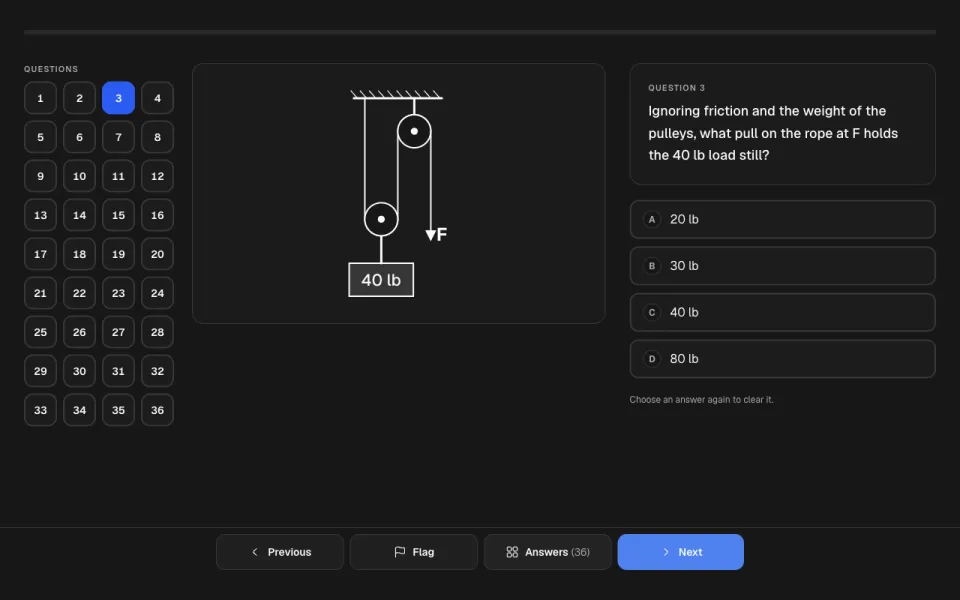
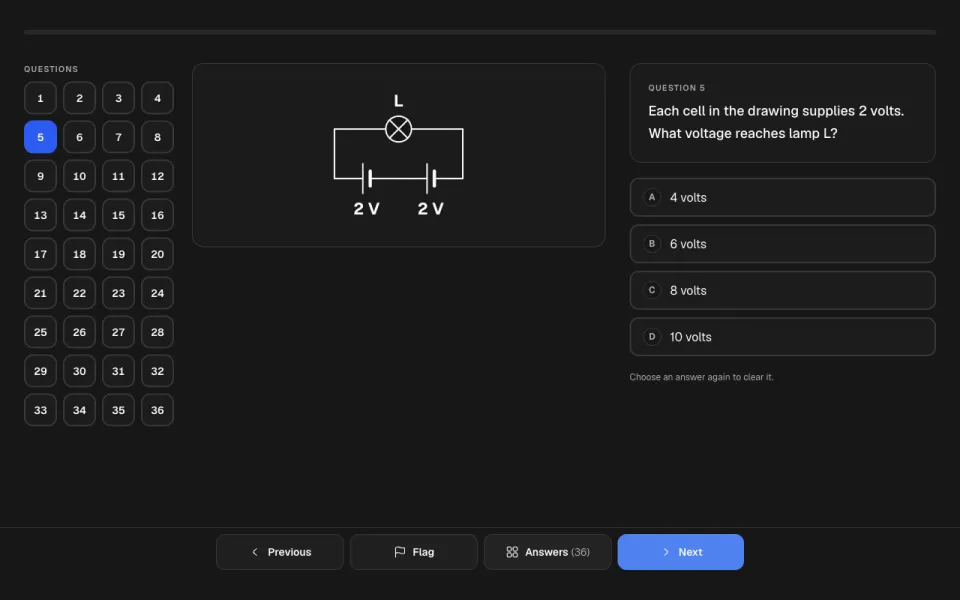
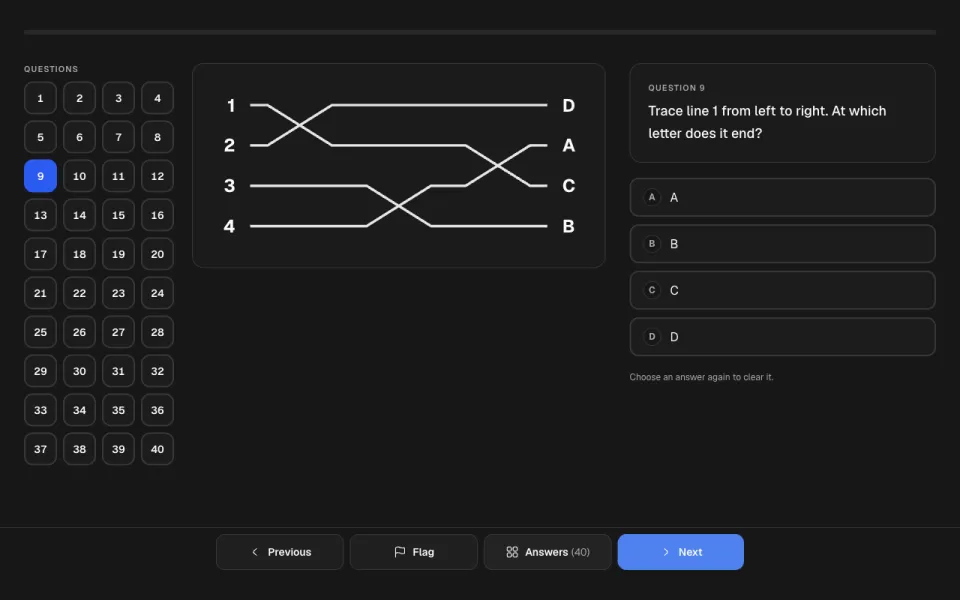
The Mechanical Aptitude Test covers four areas: household objects, production and maintenance work, school science and physics, and hand and power tools. It was built around everyday items and common knowledge rather than trade experience, so you do not need to have worked in a plant. The physics questions come as drawings of gears, belts, pulleys, levers and liquids, and a handful of rules answer most of them:
- Two meshing gears turn in opposite directions; a gear between them makes the outer two match.
- A smaller gear or pulley turns faster than the larger one driving it.
- A crossed belt reverses the direction; an open belt keeps it.
- A lever balances when weight times distance from the pivot is equal on both sides.
- More rope supporting a moving pulley means less force and more rope to pull.
How to prepare
With 36 questions in 20 minutes you have about 33 seconds a question, so the aim is to recognise each kind of question on sight. Learn the rules above until you do not have to think about them, walk through a hardware shop or catalogue and say what each tool is for, and then practise full tests on the clock. After each practice, look at which area cost you the most marks and work on that one first.
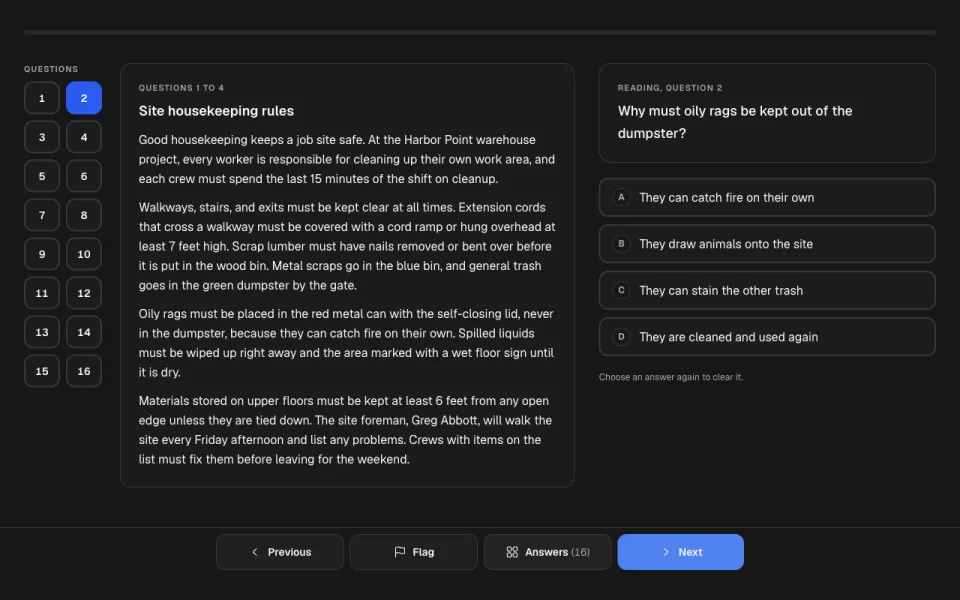
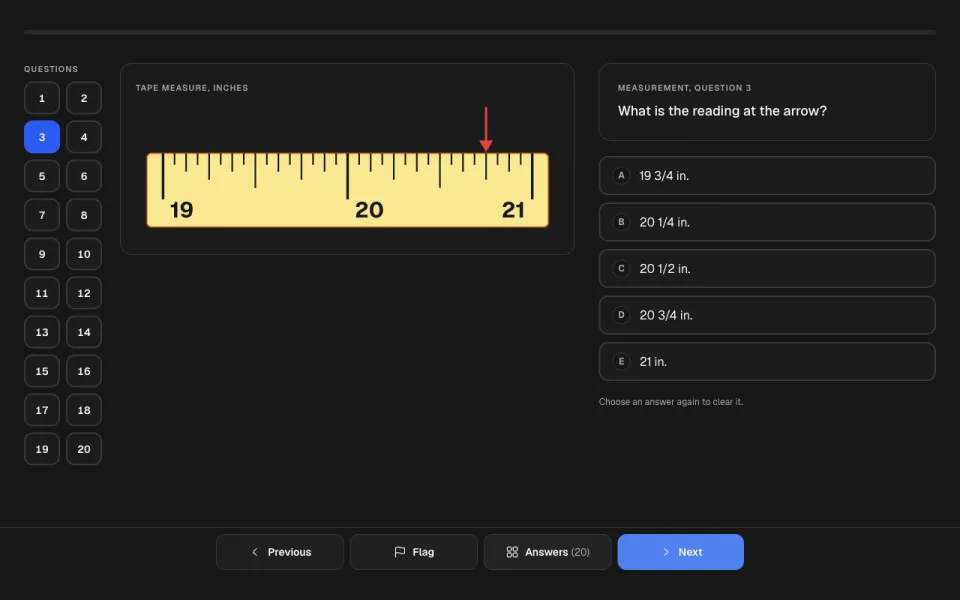
If your employer uses Combined Basic Skills or the Measurement, Reading and Arithmetic test instead, practise reading a tape measure to the sixteenth of an inch, working fractions and percentages on paper, and answering questions about a short workplace text using only what the text says.
Practise the Ramsay tests
Our Ramsay practice testsfollow the published counts and timings for the mechanical, electrical and MultiCraft aptitude tests and both basic skills batteries, and show your mark beside Ramsay's own average and usual range. The Mechanical Aptitude Test is free to start. If you are tempted by a shortcut, read why there is none on a Ramsay test first.