EIAT Pass Mark, Tool Assessment and Interview: How the Hiring List Works
The EIAT is pass or fail at 70%. What comes next: the Tool Assessment, the committee interview, how the hiring list is ranked and when you can re-apply.
Most guides to the Elevator Industry Aptitude Test treat it as a score to maximise. It is not. The EIAT decides one thing, whether you are interviewed, and something else decides where you land on your local’s hiring list. Knowing which part of the process does what tells you where to spend your preparation.
What the 70% pass mark means
NEIEP, the National Elevator Industry Educational Program, runs the EIAT for the International Union of Elevator Constructors. Its FAQ is direct: the EIAT "is scored on a pass/fail basis, with 70% correct being the minimum passing grade." The paper is 100 multiple-choice questions, so that is 70 right.
Because the line is counted over the whole paper, a strong section can carry a weak one. It also means the 30 maths questions matter as much, question for question, as the other 70: losing half the maths leaves very little room in the rest.
Three things about the paper are not published: the time limit, whether a calculator is allowed, and whether a wrong answer costs marks. Your local’s recruitment sets the time; prep sites report up to about 60 minutes. Prepare to work by hand and answer every question.
A pass earns an interview, and nothing more
"Applicants who receive a score of 70% or higher on the aptitude test will be scheduled for an interview," NEIEP says. You are told pass or fail, and if you pass you get the instructions for the next step. There is no published table that turns 85% into a better position than 72%, because the EIAT score is not what ranks you.
The Tool Assessment: the step most people forget
Alongside the EIAT there is a Tool Assessment. IUEC Local 126’s 2025 recruitment notice describes it as "designed to assess knowledge of basic tools and their use, as well as basic measuring skills", and lists it separately from the aptitude exam. NEIEP’s FAQ adds the part that matters: "Correct responses on the tool assessment will count toward the final score on the interview."
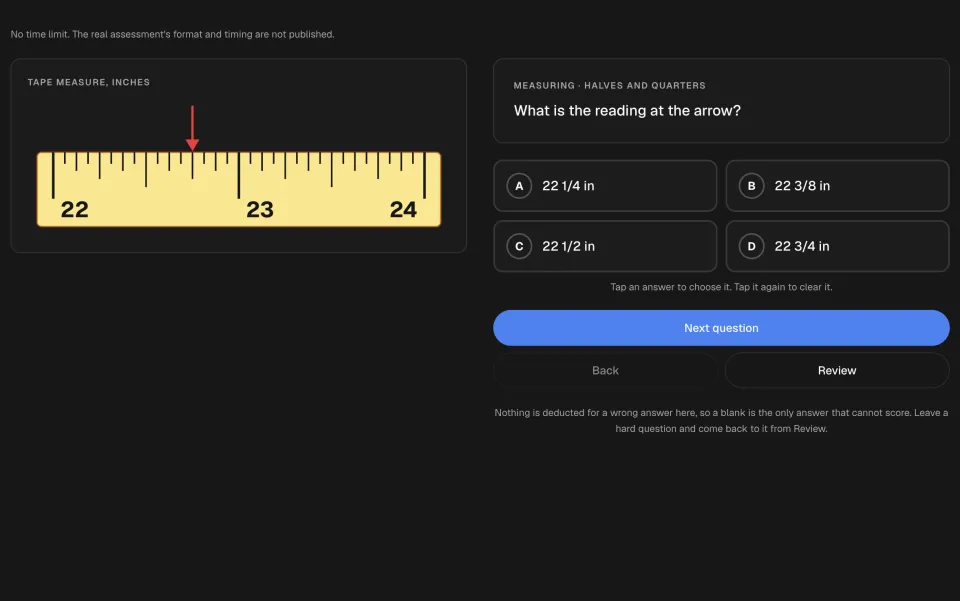
Its format and length are not published. What you can do is make the measuring part automatic, reading a tape measure to a sixteenth of an inch and working out the distance between two marks, and learn the names and uses of everyday hand tools. Our guide to the EIAT Tool Assessment walks through tape reading with worked examples.
The interview, and how the list is ranked
Interviews are run by two members of the local’s Joint Apprenticeship Committee, one from the IUEC and one from the employer side. NEIEP says every applicant is asked the same series of questions and that interviews run 15 to 20 minutes on average. The process is standardised across the country.
Your interview score is the average of the two interviewers’ scores, with your Tool Assessment points counted in. The interview is also pass or fail: you need 70% to be ranked on the local’s hiring list at all. Above that, the list is in score order.
NEIEP’s advice for the interview is to give detailed answers with examples from your work or other experience. It suggests mentioning relevant training or mechanical experience, says an OSHA 10 or 30 card can help but does not guarantee a higher rank, and mentions describing something you have built or fixed and how you worked out the problem. Our guide to answering behavioural interview questions covers how to shape those examples.
If you fail the EIAT
"Applicants who fail the EIAT will not be interviewed and will be removed from the pool of applicants." You may re-apply during the next or a later recruitment period. The catch is timing. Each local recruits for its own needs, when everyone on its list has been hired or when the list expires, and lists expire every two years. A fail can cost you a full cycle, which is why the first attempt is the one to prepare for.
Before you apply
NEIEP’s FAQ and the Local 126 notice set out the basics:
- A high school diploma or GED, with proof uploaded when you apply.
- At least 17 to apply and 18 to be registered as an apprentice.
- Authorisation to work in the United States.
- A $25 testing fee, and photo ID during the application process at Local 126.
Recruitments are advertised on NEIEP’s Apprenticeship Opportunities page, and each advertisement gives its own deadline. Local 126’s 2025 recruitment closed after three weeks or at the 300th application, whichever came first, so watch for your local’s notice and apply early.
How to split your preparation
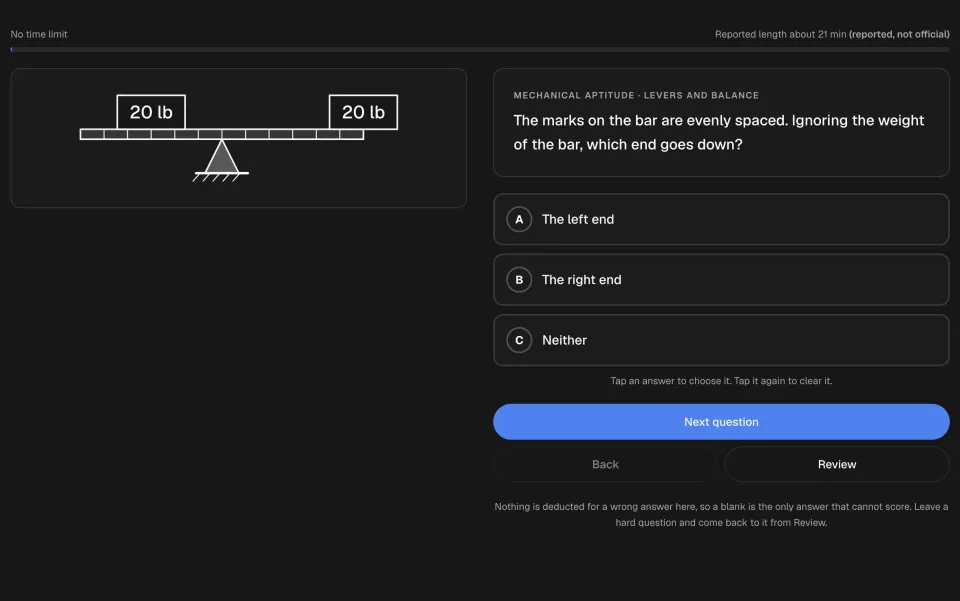
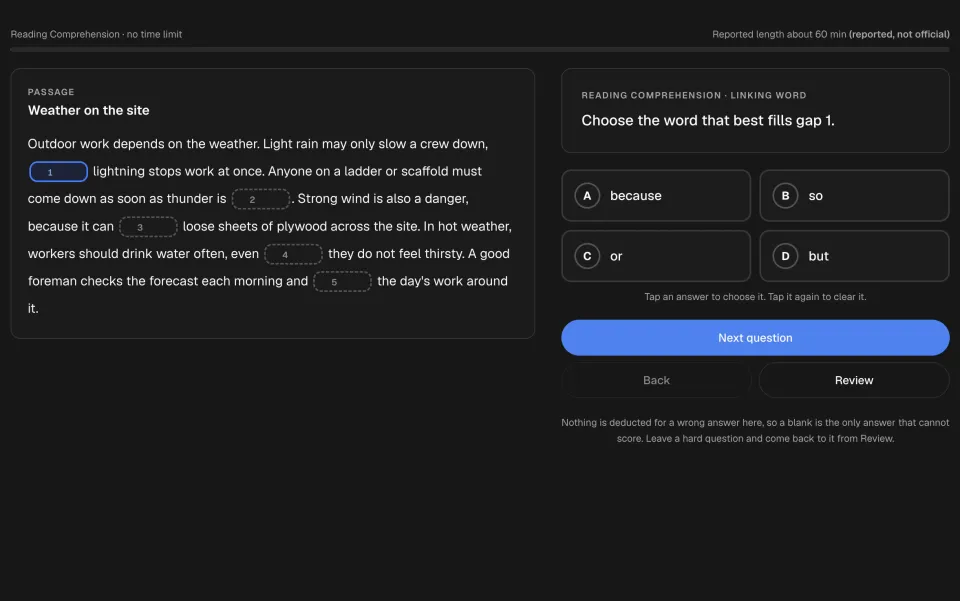
Start with NEIEP’s EIAT study guide, the only material it approves, and its sample questions. Then practise each section in its real format until you are reliably over 70%: the gap-fill reading section, the mechanical drawings and the maths with its "No answer" choice. After that, move your time to tools, measuring and interview examples, because that is where the ranking is decided. NEIEP’s apprenticeship FAQ answers most other questions in its own words, and our page on cheating the EIAT explains why a shortcut would gain you nothing.