
TestGorilla Cognitive Ability Test Practice
Practise 17 of TestGorilla's cognitive tests at their real clocks and in its one-way format: one question per screen, no going back, a skip marked wrong, and one clock for the whole test. Find the test names on your invitation below, then practise exactly those.
Free Tests
Free with a free account. Unlock TestGorilla for every test and unlimited practice.
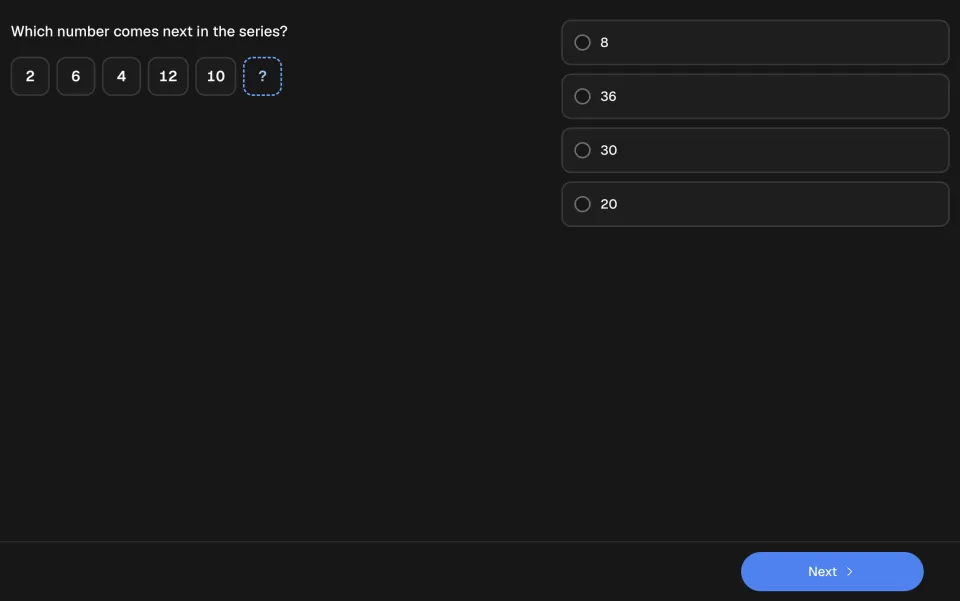
TestGorilla Numerical Reasoning
Twelve questions in 10 minutes across TestGorilla's four skill areas: number patterns, fractions and percentages, text and tables, and charts and graphs. One question per screen, no going back, and a skip counts as wrong. Four options each and no penalty for a wrong answer, so always guess.
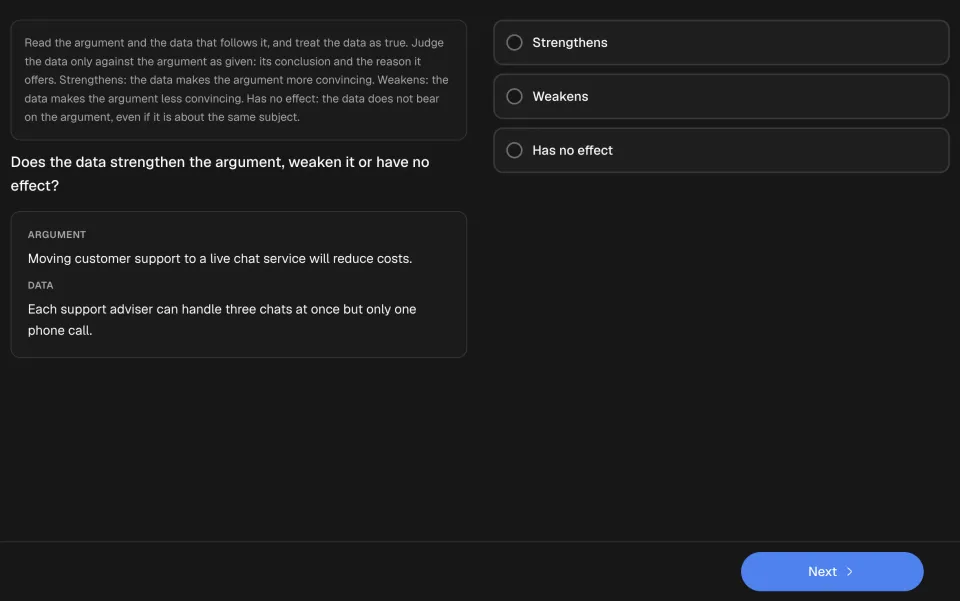
TestGorilla Critical Thinking
Syllogisms, statement relationships, assumptions and strengthen or weaken items, each opened by the long definitions TestGorilla puts on every question. 12 questions in 12 minutes (TestGorilla does not publish the count, so 12 is ours). The only cognitive test TestGorilla rates Advanced.
Premium Tests
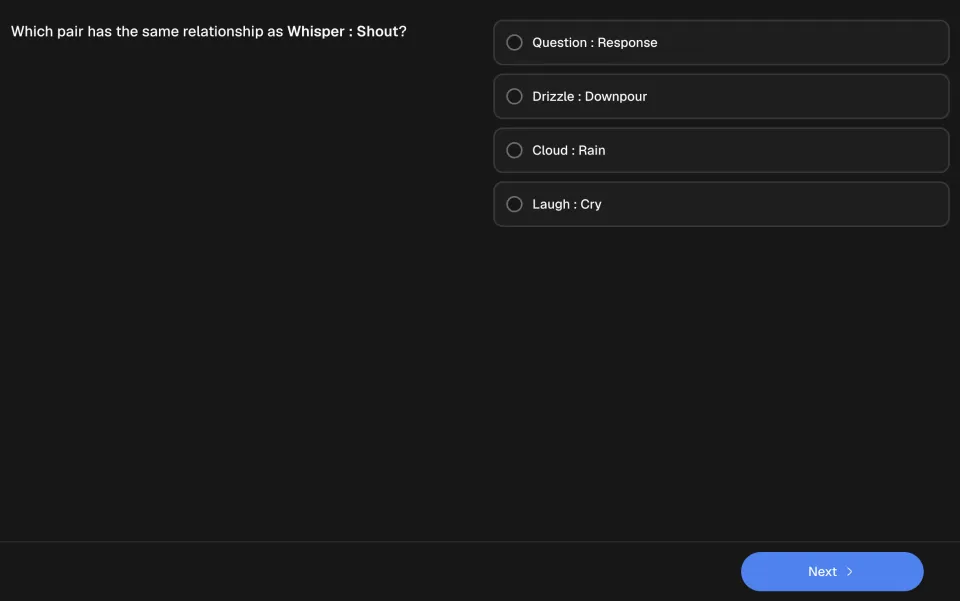
TestGorilla Verbal Reasoning
Word analogies first, then short texts with a statement to mark True, False or Cannot be determined on the text alone. 15 questions in 10 minutes, one per screen, with no way back to a question once you press Next.
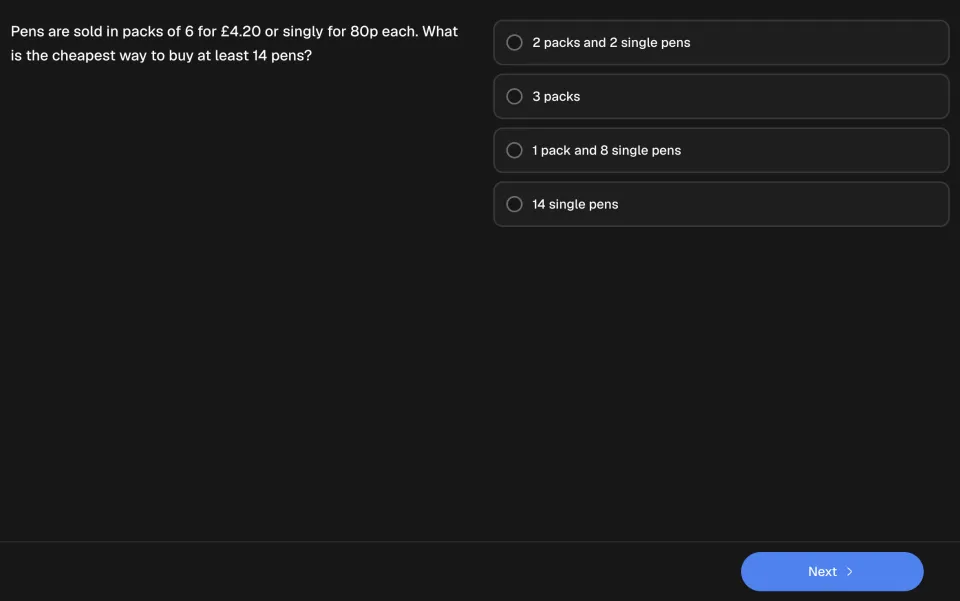
TestGorilla Problem Solving
Scheduling and rate problems, six-slot ordering puzzles with rules, and tables to filter against a customer's requirements. 12 questions in 9 minutes, the shortest clock in TestGorilla's cognitive library, with the ordering puzzles generated fresh each sitting.
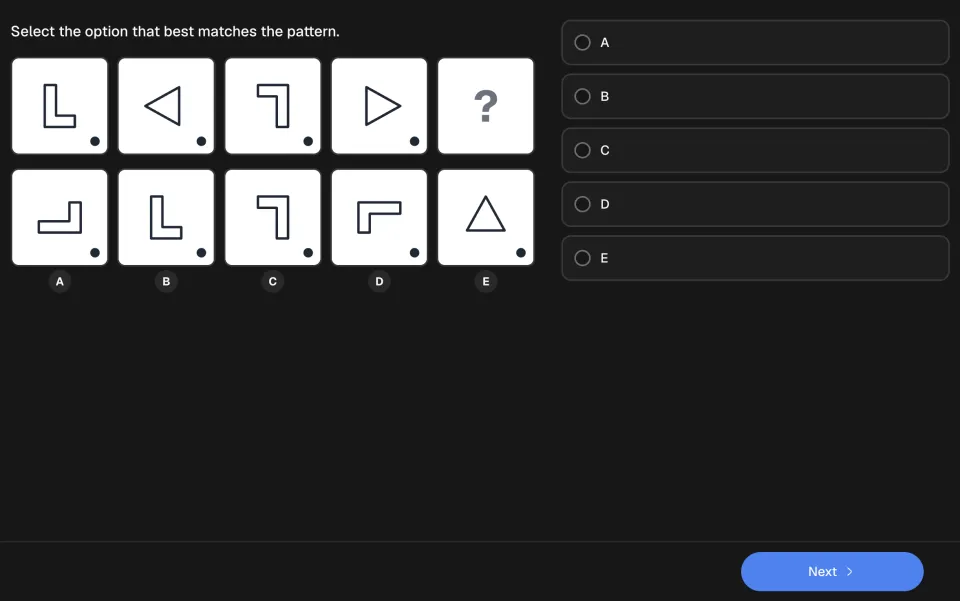
TestGorilla Abstract Reasoning
Fifty figure series in 10 minutes: four panels change by a rule and you pick the fifth from options A to E. Built so that almost nobody finishes, and scored as a percentile. Generated fresh every sitting.
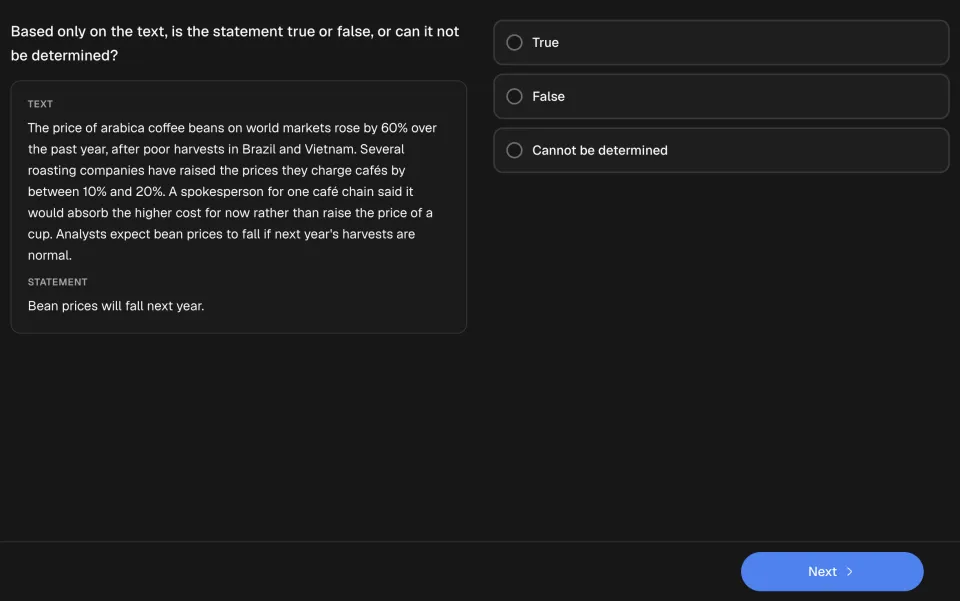
TestGorilla Rapid Cognitive Index
TestGorilla's RCI, a 10-minute general screener for entry-level and high-volume roles: verbal, then abstract, then numerical questions. 30 questions, ten of each (TestGorilla does not publish the count, so 30 is ours).
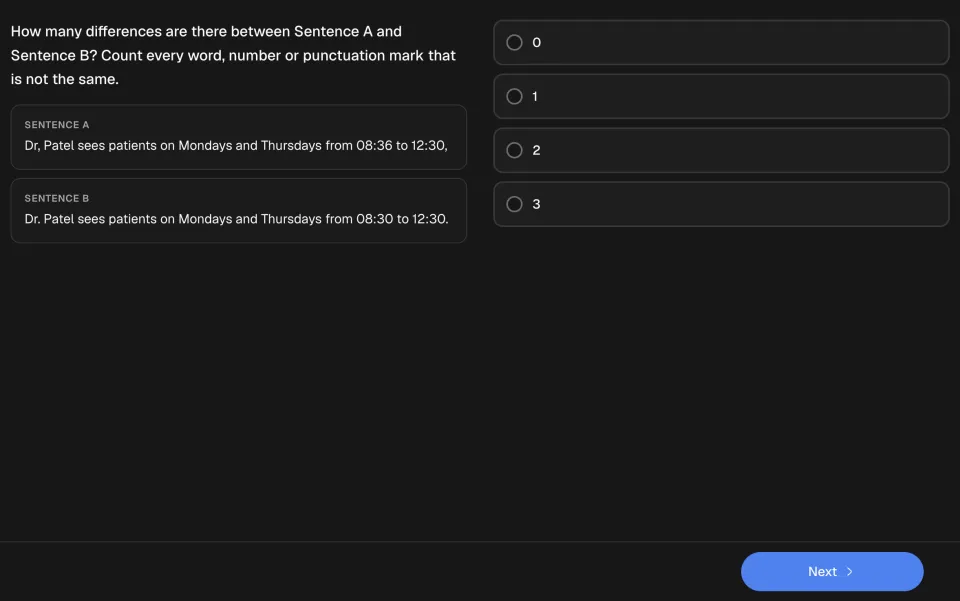
TestGorilla Attention to Detail (Textual)
Count the versions of a workplace snippet, count the differences between two sentences, and find the sentence that contradicts the others. 16 questions in 12 minutes; the differences hide in digits, punctuation, word forms and abbreviations. Generated fresh every sitting.
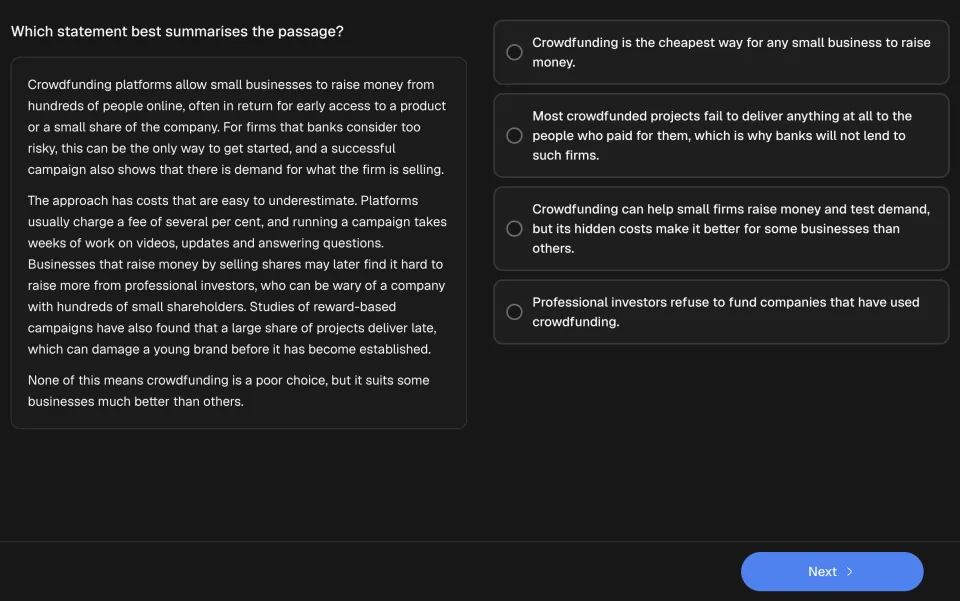
TestGorilla Reading Comprehension
One passage and one question per screen, from workplace memos and notices to short general articles: what the passage implies, what it refers to, or which statement is true. 12 questions in 13 minutes (TestGorilla does not publish the count, so 12 is ours), the longest clock in its cognitive library.
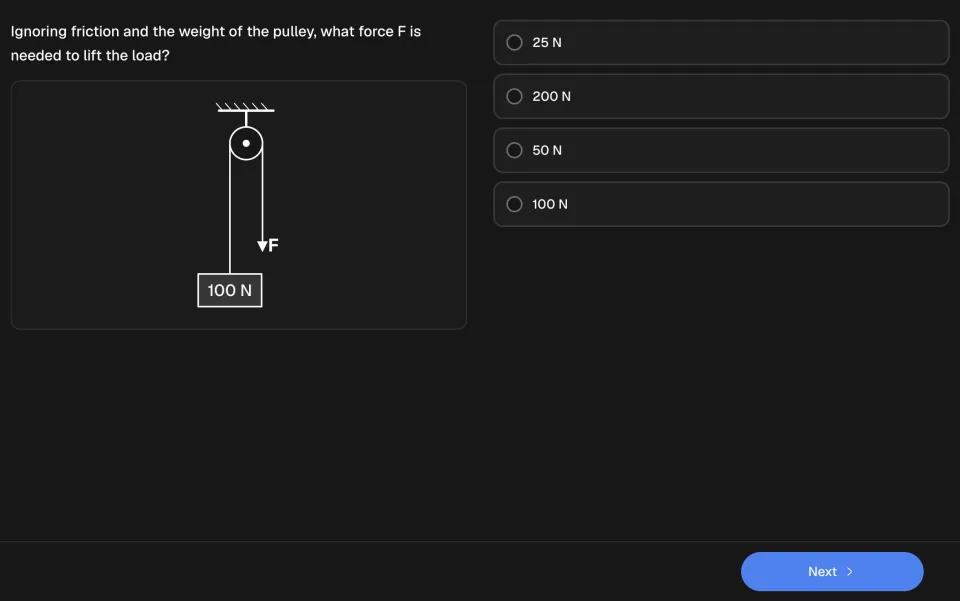
TestGorilla Mechanical Reasoning
21 questions in 10 minutes, most of them diagrams, on force and movement, velocity, and pulleys, gears and wheels: levers, spanners, beams on supports, belts and meshed gears. Three or four options each, often including 'the same'.
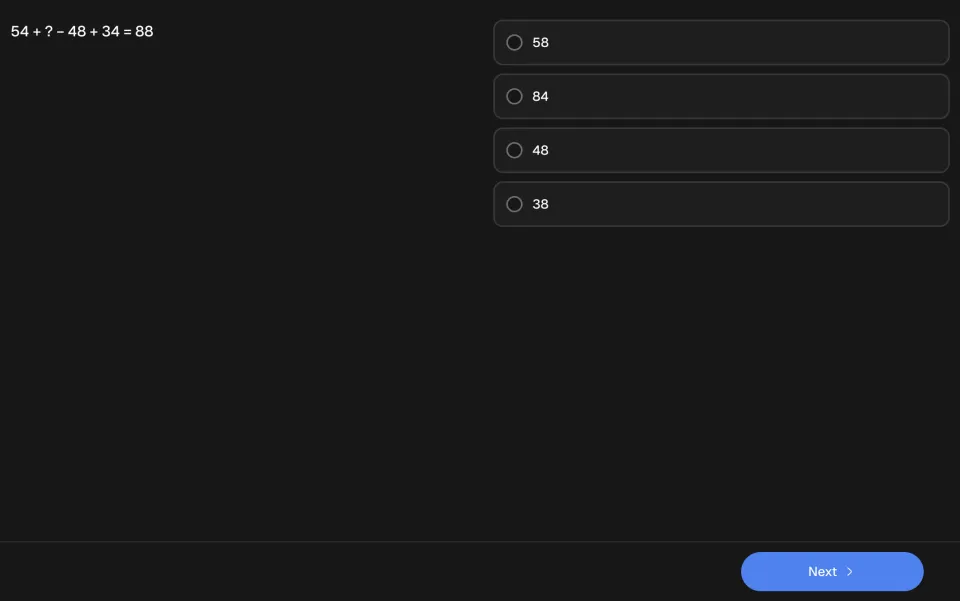
TestGorilla Basic Double-Digit Math
15 questions in 10 minutes, four options each: a missing number in a sum, multiples and products, the minutes between two clock times, and rounding. TestGorilla's basic maths screen for manufacturing, cashier and hospitality roles, generated fresh every sitting.
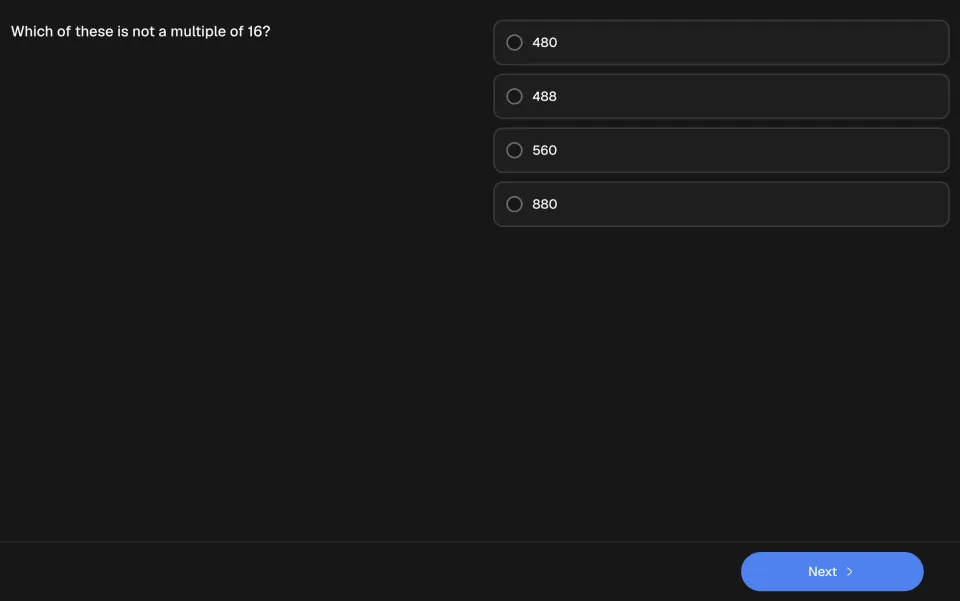
TestGorilla Basic Triple-Digit Math
The harder sibling of Double-Digit: three-digit sums with terms on both sides, 'not a multiple of' questions, primes, simple fractions and durations in hours, minutes and seconds. 15 questions in 10 minutes, four options each, generated fresh every sitting.
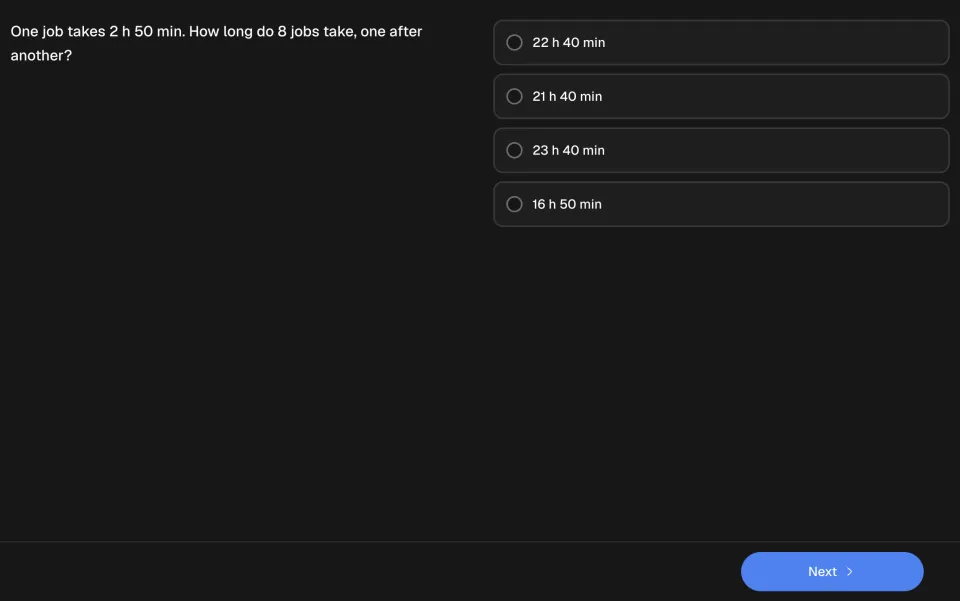
TestGorilla Intermediate Math
Half fractions and decimals, half percentages, rates, ratios and durations in days, hours and minutes, with fractions drawn stacked as TestGorilla draws them. 15 questions in 10 minutes, four options each, generated fresh every sitting.
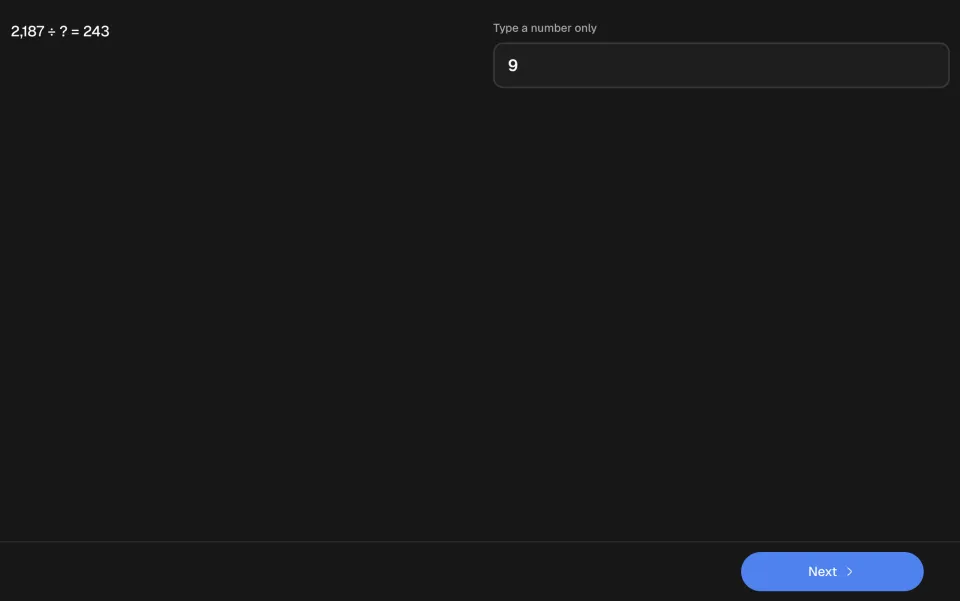
TestGorilla Basic Math Calculations
Three-digit addition, subtraction, multiplication and division set as equations with a blank anywhere, such as 432 − ? = 187, with every answer typed and no options to guess from. 15 questions in 10 minutes (TestGorilla does not publish the count, so 15 is ours).
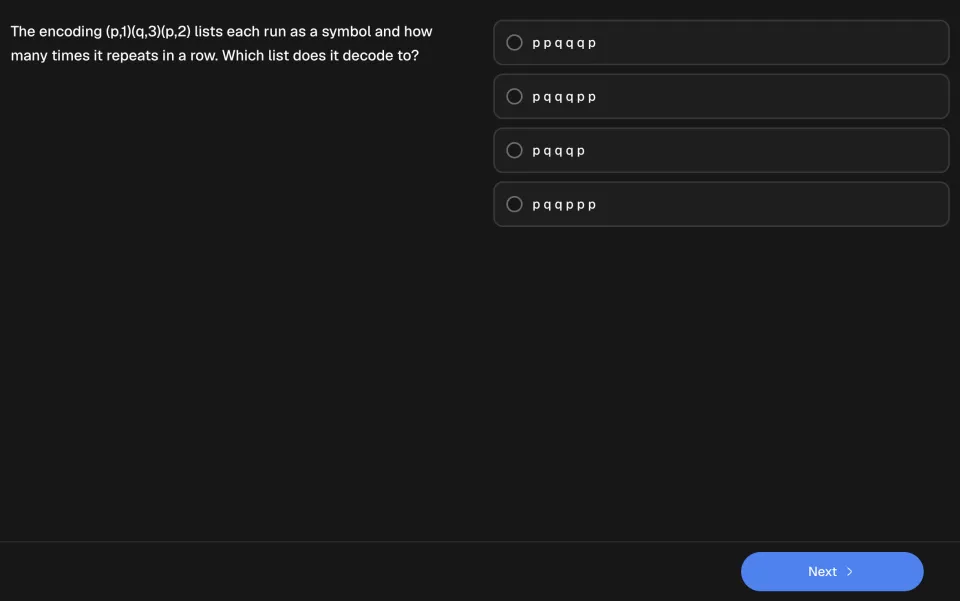
TestGorilla Computational Thinking
Short scenarios with no code: encode a list as runs, trace a step-by-step method, break a feature into ordered steps and pick the abstraction that fits. 12 questions in 10 minutes (TestGorilla does not publish the count, so 12 is ours).
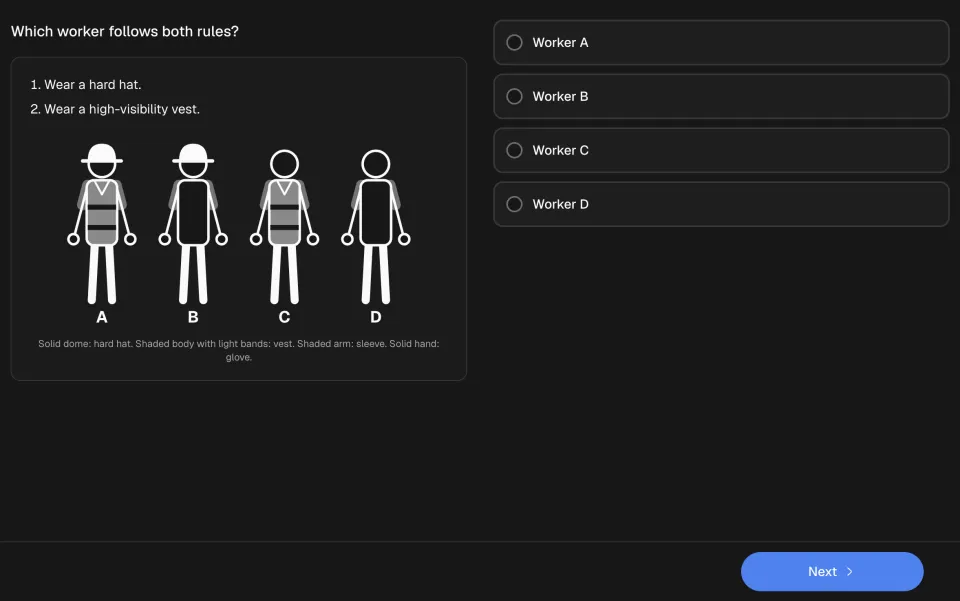
TestGorilla Understanding Instructions
Workplace policies and procedures to follow to the letter, some with select-all answers marked all or nothing, and drawn workers and shelves to check against rules. 15 questions in 10 minutes. The real test's spoken briefings are not included yet.
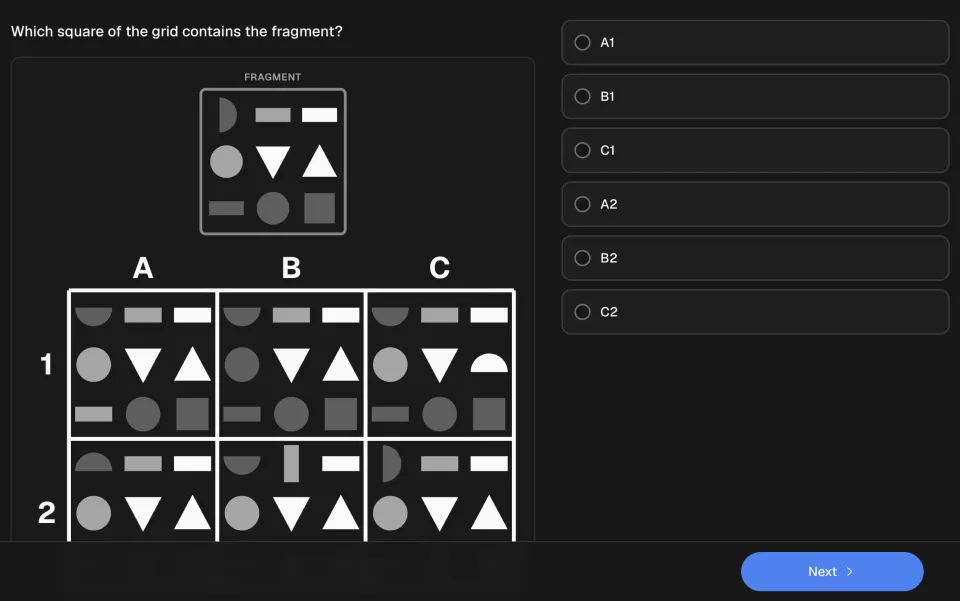
TestGorilla Attention to Detail (Visual)
Count the differences between two images, find the identical pair among four, count every square in a figure and place a fragment on a lettered grid. 12 questions in 10 minutes. Our images are generated patterns rather than TestGorilla's photographs.
TestGorilla Spatial Reasoning
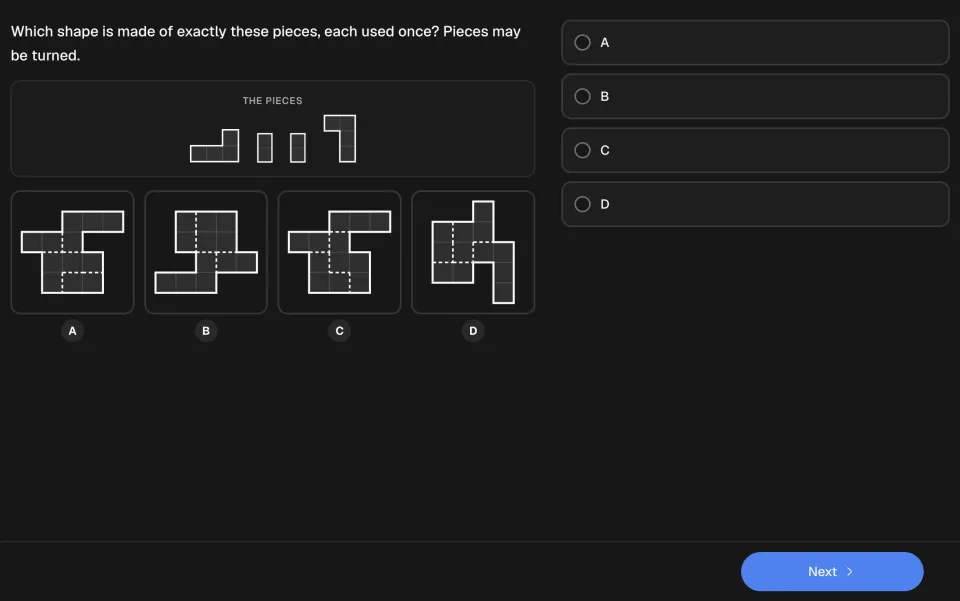
Turn solids made of cubes in your head, fold nets into cubes, fit flat pieces into a shape and find the next figure in a series. 12 questions in 10 minutes (TestGorilla does not publish the count, so 12 is ours), four options each.
At a glance
TestGorilla is an online skills-testing platform. An employer builds an assessment of up to five tests, and each cognitive test, such as Numerical Reasoning or Critical Thinking, runs on one clock of 9 to 13 minutes. You see one question per screen, cannot go back, and are scored as a percentile.
- Format
- One question per screen with a single clock for the whole test. Once you submit or skip a question you cannot go back to it.
- Length
- Each cognitive test runs 9 to 13 minutes. An assessment holds up to five tests plus custom questions, and TestGorilla says most take 60 to 90 minutes.
- Questions
- Drawn at random from a question bank, so candidates see different questions. Numerical Reasoning sets 12 questions from 102; Abstract Reasoning sets 50 from 138.
- Wrong answers
- No penalty, but a skipped question counts as wrong. When time runs out, the question on screen is not saved.
- Scoring
- A percentile against everyone who has taken that test, weighted so harder questions count for more.
- Devices
- Phones are allowed but not recommended; TestGorilla advises a laptop or desktop with Chrome. The test must stay in full-screen mode.
Checked against TestGorilla candidate help centre: finishing your assessment, TestGorilla candidate help centre: common questions, TestGorilla candidate help centre: taking your assessment, TestGorilla candidate help centre: devices and connectivity, TestGorilla help centre: assessment and test questions, TestGorilla help centre: guide to tests, TestGorilla help centre: percentile scoring, TestGorilla Numerical Reasoning test facts and TestGorilla Abstract Reasoning test facts. Updated .
TestGorilla is a platform, not a test
An employer builds an assessment by picking up to five tests from TestGorilla's library of hundreds, so two TestGorilla invitations can have nothing in common. The welcome screen of your invitation lists the tests you will sit by name. Match those names against the list below before you practise anything.
We cover the cognitive tests only. TestGorilla's role-specific, software, programming, language, personality and culture, situational judgement and typing tests are not here, and neither are its video and AI interviews, its job simulations or any custom questions the employer adds.
Which TestGorilla test is yours?
TestGorilla's seventeen cognitive tests, with their real clocks. Six have a question count TestGorilla does not publish; for those, the count shown is the one we chose, and each test's instructions say so.
Numerical Reasoning
10 minutes, 12 questions
Number patterns, fractions and percentages, text and tables, charts and graphs.
Verbal Reasoning
10 minutes, 15 questions
Word analogies, and true, false or cannot be determined statements on short texts.
Critical Thinking
12 minutes, count not published (we use 12)
Syllogisms, inferences, assumptions, and data that strengthens or weakens an argument.
Problem Solving
9 minutes, 12 questions
Schedules and rates, ordering puzzles with rules, and tables filtered against requirements.
Abstract Reasoning
10 minutes, 50 questions
Which panel comes next in a sequence of four. No words at all.
Rapid Cognitive Index (RCI)
10 minutes, count not published (we use 30)
Verbal, abstract and numerical questions on one short clock.
Reading Comprehension
13 minutes, count not published (we use 12)
The main thought of a passage, and what it implies.
Spatial Reasoning
10 minutes, count not published (we use 12)
Mental rotation, folding cube nets, fitting pieces into a shape and figure sequences.
Mechanical Reasoning
10 minutes, 21 questions
Force and movement, velocity, and pulleys, gears and wheels.
Attention to Detail (Textual)
12 minutes, 16 questions
Counting differences between lines of text, and spotting the one that disagrees.
Attention to Detail (Visual)
10 minutes, 12 questions
Differences between images, identical pairs, counting shapes, locating a fragment.
Understanding Instructions
10 minutes, 15 questions
Following written, visual and spoken instructions. Formerly Following Instructions.
Basic Math Calculations
10 minutes, count not published (we use 15)
Typed answers to sums with three-digit numbers and a missing term.
Basic Double-Digit Math
10 minutes, 15 questions
Adding, subtracting, multiplying and dividing, time between two clocks, rounding.
Basic Triple-Digit Math
10 minutes, 15 questions
The same skills with larger numbers, plus primes, multiples and fractions.
Intermediate Math
10 minutes, 15 questions
Fractions and decimals, percentages, rates and ratios, adding durations.
Computational Thinking
10 minutes, count not published (we use 12)
Patterns, algorithms, breaking a problem down and abstraction, with no code.
The screen and its rules, which catch people out
One way, one clock
- One question per screen, and you cannot go back.
- You can press Next without answering, after a confirmation, but that question is marked wrong and you cannot return to it.
- One clock for the whole test, not one per question. When it reaches zero, the question on screen is not saved, even if you have picked an answer.
- No penalty for a wrong answer, so never leave one blank.
Full-screen, monitored, on any device
- Every test runs in full-screen. Leave it and the question is hidden while the clock keeps running, and the exit is logged for the employer.
- Webcam snapshots, tab switches and pasting are recorded and summarised for the employer beside your score.
- Pen, paper and a calculator are allowed.
- The real test can be taken on a phone, but TestGorilla recommends a computer and Chrome. Our practice works on both.
Our practice reproduces the one-way screen, the skip rule and the single clock. It describes the full-screen rule and the monitoring in each test's instructions rather than enforcing them, and it leaves out the few unscored practice questions the real test opens with.
How TestGorilla scores you: a percentile, not a pass mark
Each test is reported as a percentile against everyone who has taken that test, with harder questions weighted more than easy ones, and your raw percentage beside it. TestGorilla says there is no pass or fail. The employer decides what to do with the number, usually by ranking applicants or filtering out those below a level they choose, so the score you need depends on who else applied.
Two things follow. A skipped question costs as much as a wrong one, so answer everything. And on tests like Abstract Reasoning, which is built so that almost nobody finishes, a raw score that looks low can still be a strong percentile. Our results page shows your accuracy by skill area and difficulty, and tells you which area to work on next.
TestGorilla FAQs
Can I go back to a question or skip it?
You cannot go back. You can skip by pressing Next without an answer, after a confirmation, but a skipped question counts as wrong and you cannot return to it. Our practice works the same way.
Are wrong answers penalised? Should I guess?
There is no penalty for a wrong answer, so always answer. TestGorilla puts it plainly: better to score a point through luck than to skip and guarantee no points.
Can I use a calculator?
Yes. TestGorilla tells candidates they can use pen, paper and a calculator during the assessment, but should avoid AI and other tools. Bain says the same for its TestGorilla stage.
Is there a pass mark?
No. TestGorilla reports a percentile against everyone who has taken the test, with harder questions weighted more, beside your raw percentage, and says there is no pass or fail. The employer ranks or filters on the score themselves, so the bar depends on the other applicants.
What happens if I leave full-screen or my time runs out?
Leaving full-screen hides the question while the timer keeps running, and the employer sees the exit in your behaviour log. When time runs out, only answers you have submitted are saved; the question on screen is lost even if you had picked an answer.
Will I see my results?
Usually. Results are shared with candidates by default on paid plans and appear on your TestGorilla Profile, though the employer can turn this off. You never see which questions you got right.
Can I practise on TestGorilla itself?
Not safely. A TestGorilla Profile lets you take up to three tests a day, but you cannot retake a test for three months, your latest score always shows, and recruiters searching TestGorilla's talent pool can see it. TestGorilla says individual scores cannot be hidden. The only official practice is the handful of preview questions on each test page, which are the same practice questions you see at the start of the real test.
Can I get extra time?
Yes. If you declare a condition that affects memory or concentration you get 50% more time; if you are not fluent in the language of the test, 20%, and the employer is told; if both apply, 70%.
Can I take it on my phone?
The real test runs on a phone, but TestGorilla recommends a computer and the Chrome browser, and so do we: charts, tables and diagrams are easier to read on a larger screen. Our practice works on both, so you can practise on whichever you will use.
Companies That Use TestGorilla
TestGorilla is a self-serve hiring platform used mostly by small and mid-sized firms, so the employer that sends you a TestGorilla link is rarely a household name. One large employer says so on its own careers page.
Bain & Company
Management ConsultingIntern and full-time consulting applicants may be asked to complete a TestGorilla or Sova digital assessment of about 30 to 40 minutes, with a calculator allowed for TestGorilla. Bain does not say which TestGorilla tests it sets.
An employer picks up to five tests from TestGorilla's library of hundreds, and the invitation's welcome screen lists them by name. Check that list against the cognitive tests on this page before you prepare.
Guides and Tips
Read up before you practise: what the tests reward, what catches candidates out, and why shortcuts do not work.
TestGorilla Numerical Reasoning test: how it works
TestGorilla’s Numerical Reasoning test gives you 12 questions in 10 minutes on number series, percentages, tables and charts, one question per screen with no way back.
Can You Cheat TestGorilla? The Screen Locks
Switch away and the question disappears while the clock runs on. Why a one-way, tightly timed test leaves no room for a lookup.
TestGorilla Critical Thinking test: how it works
TestGorilla’s Critical Thinking test gives you 12 minutes of syllogisms, statement pairs, assumptions and arguments to weigh, and TestGorilla rates it Advanced.
TestGorilla Cognitive Tests: What to Expect
A TestGorilla invitation lists its tests by name. What each of the seventeen cognitive tests is, which roles tend to meet which, and why practising on TestGorilla itself is a trap.
TestGorilla Verbal Reasoning test: how it works
TestGorilla’s Verbal Reasoning test gives you 15 questions in 10 minutes: word analogies first, then short texts with a statement to mark True, False or Cannot be determined.
TestGorilla Problem Solving test: how it works
TestGorilla’s Problem Solving test gives you 12 questions in 9 minutes on staffing and schedules, ordering puzzles with rules and choices against a list of requirements, about 45 seconds each.
TestGorilla Abstract Reasoning test: how it works
TestGorilla’s Abstract Reasoning test is a speed test of 50 picture sequences in 10 minutes, built so that very few people finish.
TestGorilla Rapid Cognitive Index (RCI): how it works
The RCI (Rapid Cognitive Index) is TestGorilla’s 10-minute general screener, mixing verbal, abstract and numerical questions on one clock for entry-level and high-volume hiring.
TestGorilla Reading Comprehension test: how it works
TestGorilla’s Reading Comprehension test gives you 13 minutes of passages, each followed by a single question about its main point or what it implies.
TestGorilla Mechanical Reasoning test: how it works
TestGorilla’s Mechanical Reasoning test gives you 21 questions in 10 minutes on forces, speed, gears, pulleys and levers, each set on a simple picture.
TestGorilla Spatial Reasoning test: how it works
TestGorilla’s Spatial Reasoning test gives you 10 minutes of picture questions: turning objects, folding boxes, fitting pieces together and continuing a sequence.
TestGorilla Attention to Detail test: how it works
TestGorilla’s Attention to Detail (Textual) test gives you 16 questions in 12 minutes: count the versions of a snippet, count the differences between two sentences, and find the sentence that contradicts the rest.
TestGorilla Attention to Detail Visual test: how it works
TestGorilla’s Attention to Detail (Visual) test gives you 12 image questions in 10 minutes: spot differences, find an identical pair, count squares and locate a fragment on a grid.
TestGorilla Understanding Instructions test: how it works
TestGorilla’s Understanding Instructions test gives you 15 questions in 10 minutes: written rules, pictures to check against a rule and short spoken briefings, each followed by a question on what the instruction means.
TestGorilla Computational Thinking test: how it works
TestGorilla’s Computational Thinking test gives you 10 minutes of short scenarios on breaking problems into steps, spotting patterns, choosing efficient methods and abstraction. There is no code in it.
TestGorilla Basic Math Calculations test: how it works
TestGorilla’s Basic Math Calculations test gives you 10 minutes of three-digit addition, subtraction, multiplication and division, set as equations with a blank to fill. You type every answer.
TestGorilla Basic Double-Digit Math test: how it works
TestGorilla’s Basic Double-Digit Math test gives you 15 multiple-choice questions in 10 minutes on single- and double-digit sums, products, clock times and rounding.
TestGorilla Basic Triple-Digit Math test: how it works
TestGorilla’s Basic Triple-Digit Math test gives you 15 multiple-choice questions in 10 minutes on three-digit sums, durations, multiples, primes and simple fractions.
TestGorilla Intermediate Math test: how it works
TestGorilla’s Intermediate Math test gives you 15 multiple-choice questions in 10 minutes: half on fractions and decimals, half on percentages, rates, ratios and durations.
Practice by Test Type
Compare the same format across every provider that uses it, and see what each one is really measuring.
Numerical Reasoning Test Practice
Tables, charts, percentages and ratios against the clock. The most common screening test on graduate schemes and analyst roles.
Verbal Reasoning Test Practice
Short dense passages and true, false or cannot say answers. Judged on what the text supports, never on what you already know.
Logical Reasoning Test Practice
The umbrella name on many invitations. Covers the four rule-based formats and how to tell which one you have actually been sent.
Deductive Reasoning Test Practice
The rules are handed to you. Work out what must follow from them, and nothing more, under tight time pressure.
Abstract Reasoning Test Practice
Matrices, figure series and odd-one-out sets sold under the abstract or non-verbal label. No words, no numbers, one missing piece.
Spatial Reasoning Test Practice
Turn, fold, mirror and assemble shapes in your head. Set for engineering, military and aviation roles and inside general ability tests.
Mechanical Reasoning Test Practice
Drawn gears, pulleys, levers and fluids. Predict which way things turn, what balances and what moves fastest.
Critical Thinking Test Practice
Judge inferences, assumptions and arguments from short passages. The Watson Glaser that law firms set is the best known.
Error Checking Test Practice
Compare an original with a copy and find what changed. Short, fast and scored on accuracy as much as speed.
Cognitive Ability Test Practice
Short general tests that mix verbal, numerical, logical and spatial items, such as the CCAT, Wonderlic and PI Cognitive.
Not sure who sent your assessment? The provider identification guide matches invitation names to publishers, and what to expect from TestGorilla's cognitive tests walks through each test and the roles that tend to meet it. If you are wondering whether any of this can be short-circuited, we answer that at can you cheat TestGorilla.
About CogniPrep TestGorilla Practice
CogniPrep provides independent practice for the cognitive ability tests in TestGorilla's library. TestGorilla is a self-serve hiring platform, a Dutch company founded in 2019, whose customers are mostly small and mid-sized employers. They build an assessment from up to five tests and send it from talent-assessment.testgorilla.com. Every test shares one format: a single clock, one question per screen, no going back, a skip marked wrong, no penalty for a wrong answer, and a percentile against everyone who has taken the test as the result, with harder questions weighted more. Our questions are original and written to TestGorilla's published skill areas, formats, option counts and clocks. We are not affiliated with TestGorilla.
- 17 tests available: Numerical Reasoning, Critical Thinking, Verbal Reasoning, Problem Solving, Abstract Reasoning, Rapid Cognitive Index, Attention to Detail (Textual), Reading Comprehension, Mechanical Reasoning, Basic Double-Digit Math, Basic Triple-Digit Math, Intermediate Math, Basic Math Calculations, Computational Thinking, Understanding Instructions, Attention to Detail (Visual), Spatial Reasoning
- Free: Numerical Reasoning and Critical Thinking
- Real clocks: 9 to 13 minutes per test
- Counts TestGorilla does not publish are marked as ours in each test
- Results by skill area and difficulty, with advice on what to practise next
- Works on a phone and on a computer
Ready to Start Practising?
Sign up for free to try 2 tests, or unlock all 17 TestGorilla practice tests with unlimited practice sessions.