
SIFT Practice Test for Army Flight School
The SIFT is the US Army's test for everyone applying to fly its helicopters: seven subtests, from a two-minute perceptual speed sprint to adaptive maths, scored as one number from 20 to 80. You need 40 to qualify, Army recruiting lists 55 and above as Most Preferred, and you get two attempts in a career. Practise each subtest on its real clock and marking.
Also searched as the SIFT test, the Selection Instrument for Flight Training, the Army flight aptitude test and the WOFT test. Not the police national sift.
Free Test
Free to try with a free account. Unlock this provider for unlimited practice.
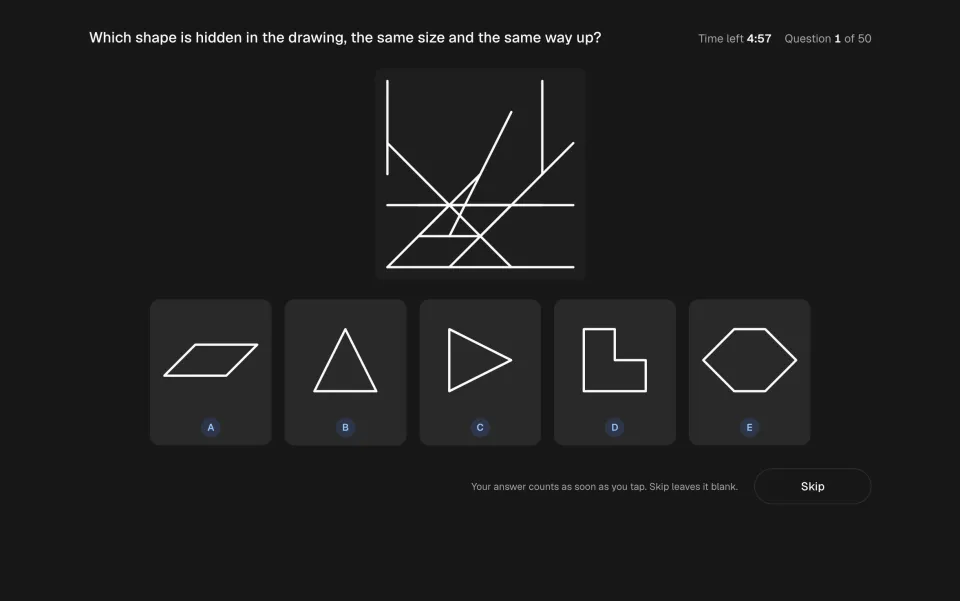
Hidden Figures (HF)
The second perceptual speed subtest of the Army SIFT: 50 questions in 5 minutes. Find which of five simple shapes is hidden in a complex drawing, at the same size and the same way up. A share of each wrong answer is taken off, so skip what you cannot see.
Premium Tests
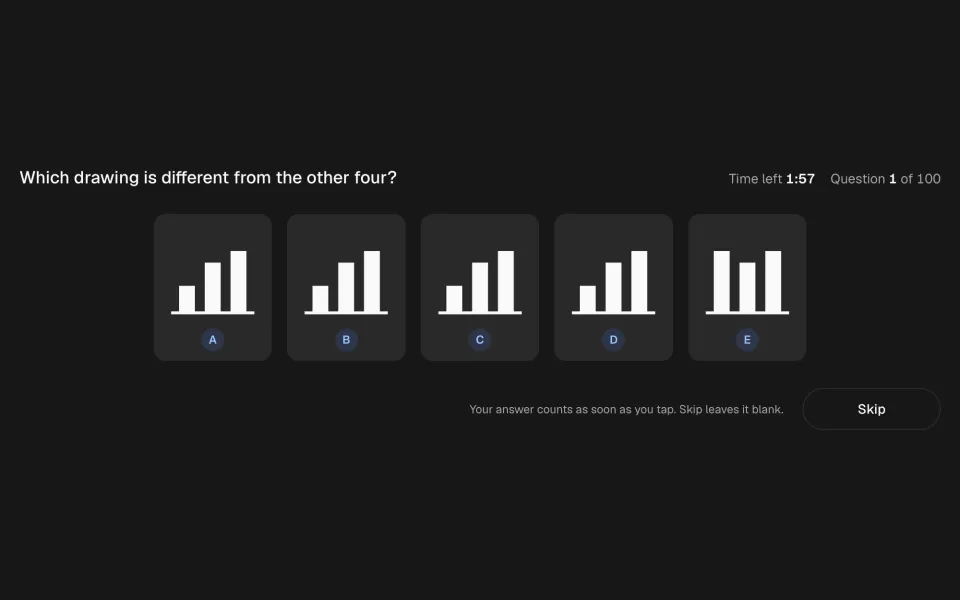
Simple Drawings (SD)
The first perceptual speed subtest of the Army SIFT: 100 questions in 2 minutes, a little over a second each. Five drawings sit in a row and one differs from the rest: a clock at another time, an arrow turned, a dot moved. Wrong answers cost part of a right one.
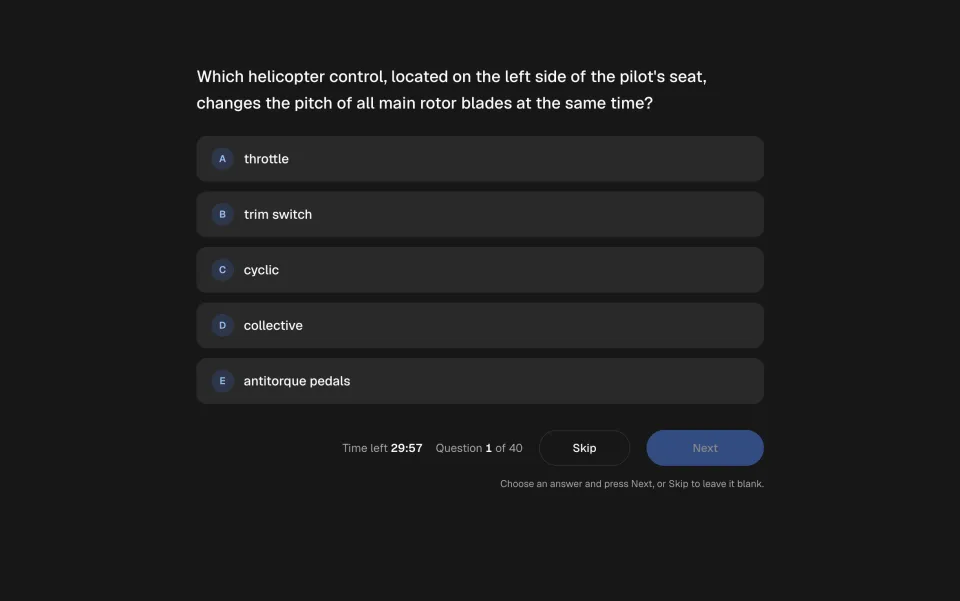
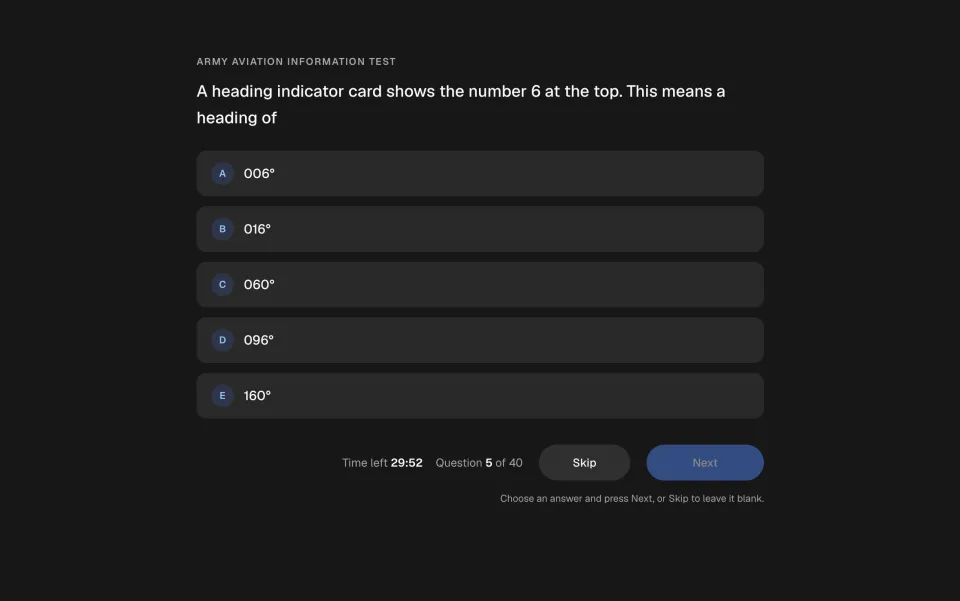
Army Aviation Information Test (AAIT)
The aviation knowledge subtest of the Army SIFT: 40 questions in 30 minutes, five options each, leaning to helicopters as the Army’s sample does. Rotor aerodynamics, flight controls, aircraft parts, instruments, flight rules, airspace, weather and Army aircraft. Blanks count as wrong.
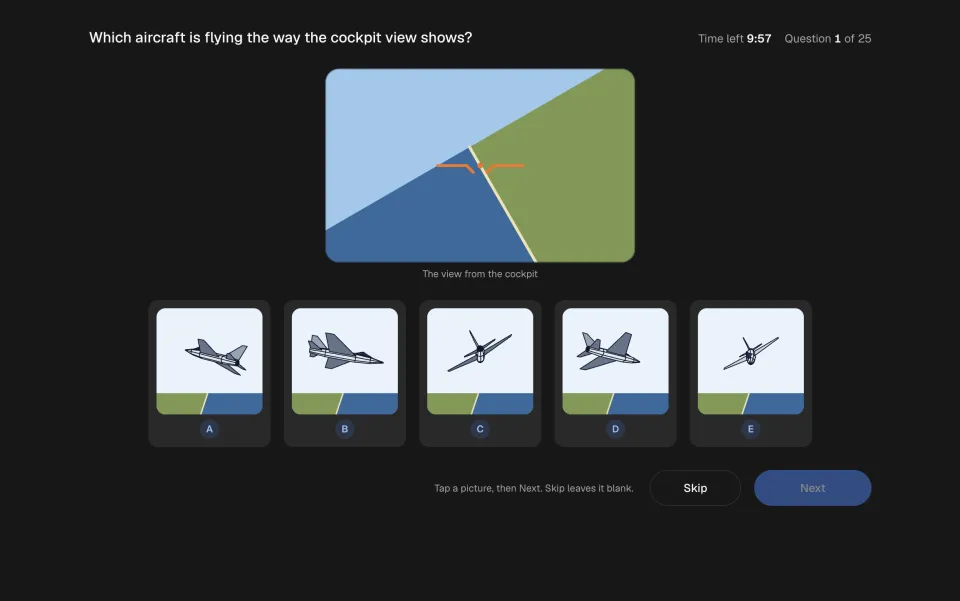
Spatial Apperception Test (SAT)
The spatial subtest of the Army SIFT: 25 questions in 10 minutes. A view from the cockpit sits above five aircraft seen from outside; pick the one climbing, diving or level, banked or not, and heading the way the view shows against the coast. Blanks count as wrong.
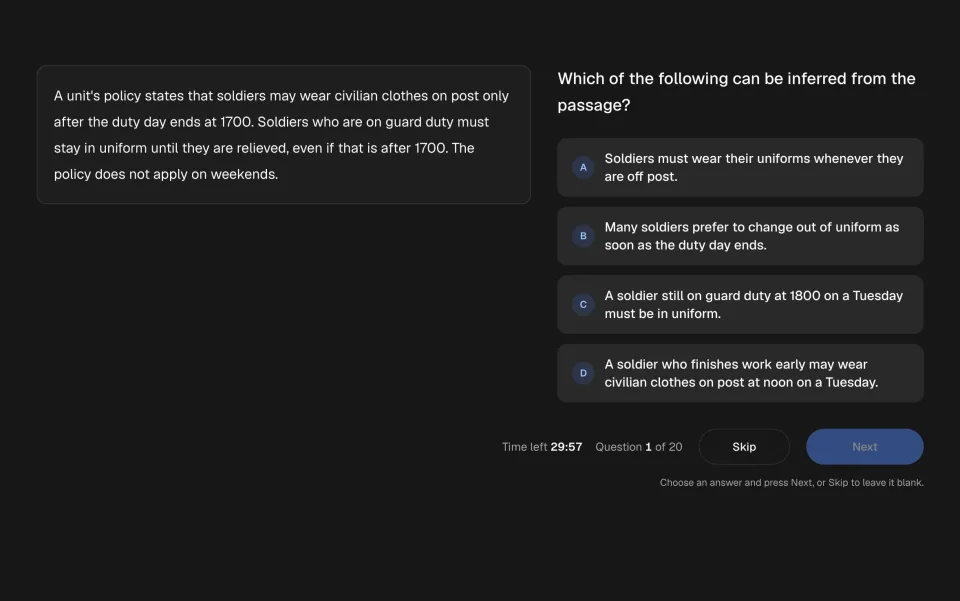
Reading Comprehension Test (RCT)
The reading subtest of the Army SIFT: 20 passages in 30 minutes, one question each. Four statements follow every passage and only one can be worked out from the passage alone. Unlike the maths and mechanical parts it is not adaptive, and blanks count as wrong.
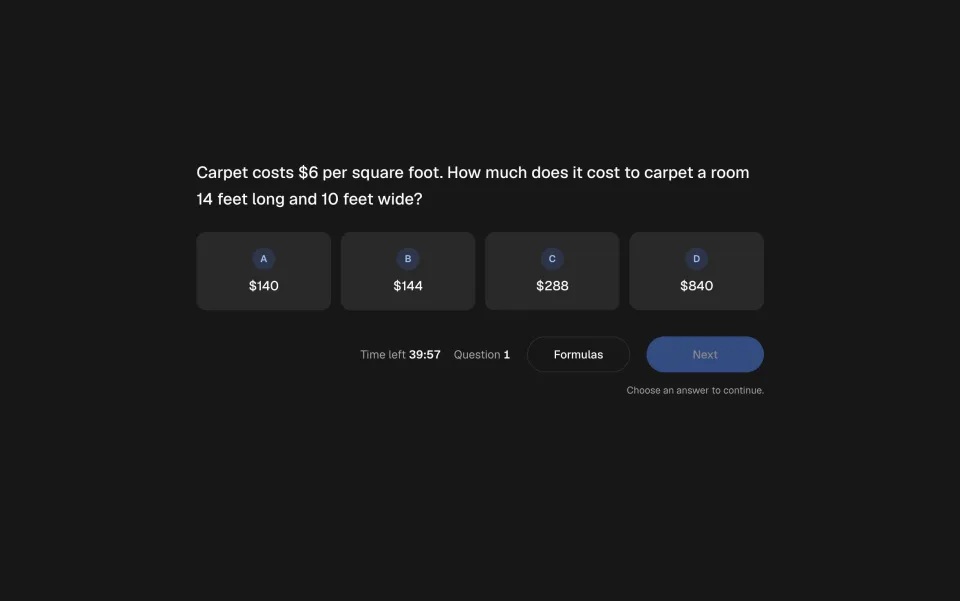
Math Skills Test (MST)
The maths subtest of the Army SIFT: adaptive, 40 minutes, with no calculator and a few formulas provided. Arithmetic, algebra, word problems, time and distance, geometry and probability, four options each. It can end before the clock once it has measured you.
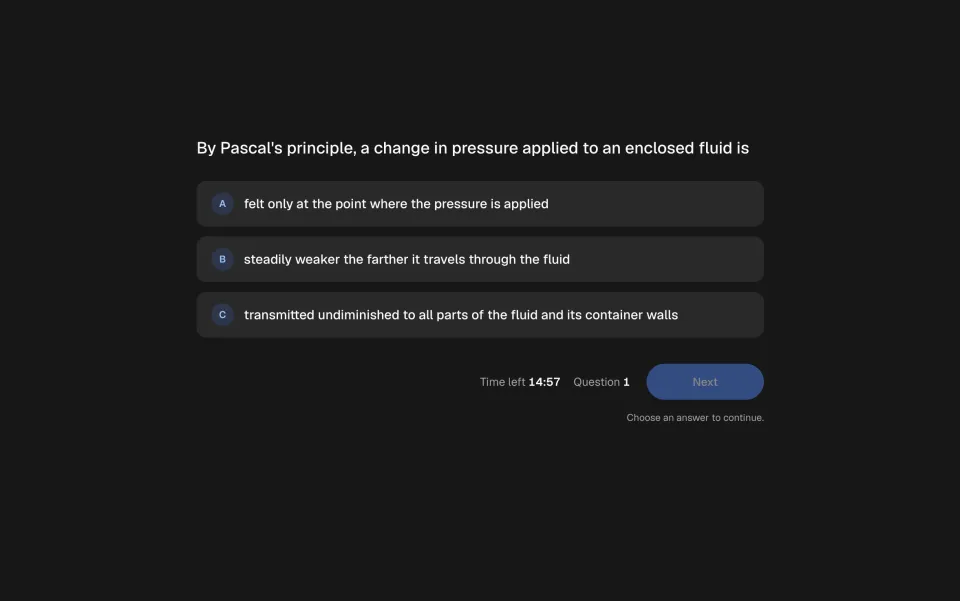
Mechanical Comprehension Test (MCT)
The mechanical subtest of the Army SIFT: adaptive, 15 minutes, three options each, mostly with drawings. Gears and belts, pulleys and levers, liquids and gases, forces and weight. It can end before the clock once it has measured you.
SIFT Full Practice Test
All seven Army SIFT subtests in the Army’s order, each on its own clock, 132 minutes of test time. You get an estimated SIFT score on the real 20 to 80 scale against the 40 minimum and the 55 Army recruiting lists as Most Preferred, a score for each part, and you can stop between parts.
Who takes the SIFT
Warrant officer aviation applicants
Soldiers applying for Warrant Officer Flight Training, and civilians enlisting on the WOFT option to become 153A rotary wing aviators. You also need a GT score of 110 from the ASVAB, a separate test.
Officers and cadets branching aviation
Lieutenants and captains applying for flight training, and cadets at ROTC, West Point or Officer Candidate School who want the Aviation branch. ROTC cadets are advised to pass it by the summer after their junior year.
What comes after it
The SIFT comes first. You cannot request the Class 1 flight physical until you have passed it, and your score letter then goes into the packet a selection board weighs alongside your record.
The seven subtests of the SIFT
They come in this order, each with its own directions and clock, after a 10-minute background section. Simple Drawings and Hidden Figures together make the Perceptual Speed and Accuracy Test; Reading, Math Skills and Mechanical Comprehension make the Cognitive Abilities Test.
| Subtest | Questions | Minutes | Marking |
|---|---|---|---|
| Simple Drawings | 100 | 2 | Wrong answers cost part of a right one |
| Hidden Figures | 50 | 5 | Wrong answers cost part of a right one |
| Army Aviation Information | 40 | 30 | Blanks count as wrong |
| Spatial Apperception | 25 | 10 | Blanks count as wrong |
| Reading Comprehension | 20 | 30 | Blanks count as wrong |
| Math Skills | Varies | 40 | Adaptive; unreached questions cost |
| Mechanical Comprehension | Varies | 15 | Adaptive; unreached questions cost |
We build all seven, plus the full practice test that runs them in a row. The background section asks about you rather than testing you, so it is not part of the practice.
Three marking rules, three strategies
Speed tests: do not guess blindly
Simple Drawings and Hidden Figures score the number you get right less a portion of the number you get wrong. Most people do not finish them. Work fast, answer what you can see, and skip what you cannot.
Fixed tests: never leave a blank
Aviation Information, Spatial Apperception and Reading Comprehension count a blank as wrong and take nothing off for a wrong answer. Pace yourself to reach the end, and guess on whatever is left before the clock runs out.
Adaptive tests: steady, not random
Math Skills and Mechanical Comprehension adjust to your answers and take a penalty for too few questions reached. A test that ends itself early carries no penalty, and the Army says random guessing near the end usually costs more than the penalty does.
SIFT scores: 40 to qualify, 55 to compete
One score from 20 to 80. The scale has a mean of 50 and a standard deviation of 10, so 40 is one standard deviation below the average examinee. All seven subtests feed it.
A formula the Army does not publish. It is compensatory: a strong subtest can make up for a weak one. That makes every part worth practising, and none worth giving up on.
40 qualifies; aim for 55. 40 is the minimum and cannot be waived. Army recruiting lists 55 and above as Most Preferred for warrant officer aviators, and an Officer Candidate School guide calls 55 about average for accepted candidates. More in what is a good SIFT score.
Two attempts, and a pass is final
A pass cannot be retaken. Once you reach 40 your score stands for good, so a 41 cannot be raised to a 55 later. Sit it when your practice scores are where you want them.
One retest after a fail. It can come no sooner than the 46th day after your first attempt, and for serving soldiers the immediate commander approves it. Many guides still say 180 or 181 days, a rule the Army replaced in 2022.
A second fail ends it. Two fails end your eligibility for Army aviation. Use the 45 days to work on your weakest parts rather than resitting cold.
On the day
- You sit it on a computer at a Military Entrance Processing Station, an Army Education Center, an ROTC unit or another Army testing site, including overseas. Civilians book through a recruiter.
- Soldiers bring their CAC and a DA Form 4187 signed by their unit. No phones or other electronic devices.
- No calculator. Paper and pencils are supplied, and a few formulas are on screen for Math Skills.
- It is free and in English only. Allow up to three hours with check-in.
- Pass or fail appears on screen when you finish. Your score letter is official once the test control officer signs it.
How the SIFT differs from the ASTB-E and the AFOQT
The ASTB-E (Navy, Marine Corps and Coast Guard)
The ASTB-E shares the SIFT's maths, reading and mechanical tests, but its reading test adapts too, it reports an OAR and three aviation ratings rather than one score, and it allows three attempts 30 days apart. It also has hand-eye coordination tasks.
The AFOQT (Air Force and Space Force officers)
The AFOQT has twelve fixed subtests, none adaptive, and reports six percentiles against other applicants. Its older form had a Hidden Figures test; the current one does not. None of these scores transfers to the SIFT.
How our practice works
The Army's clocks and marking.Each subtest has the Army's question count and time limit and its own marking rule: wrong answers cost on the speed tests, blanks count as wrong on the fixed tests, and Math Skills and Mechanical Comprehension adapt and charge for questions left unreached.
Fresh questions. Simple Drawings, Hidden Figures, Spatial Apperception and Math Skills are drawn new every time, and most Mechanical Comprehension questions are too. Aviation Information and Reading come from our own banks of written questions.
Scores on the SIFT's scale.Every result is our estimate on the 20 to 80 scale, with the 40 minimum and the 55 marked. The full practice test combines all seven into an estimated SIFT score, weighting them equally because the Army's formula is not published, and tells you which parts are holding it down.
Frequently Asked Questions
What is the minimum SIFT score?
40, on a scale of 20 to 80. Army recruiting lists 55 and above as Most Preferred for warrant officer aviators, and selected applicants have historically scored in that range.
How many times can I take the SIFT?
Twice at most. A pass cannot be retaken to raise it. After a fail you get one retest, no sooner than the 46th day after the first attempt, and a second fail ends your eligibility for Army aviation.
How long is the SIFT?
About two and a half hours. The seven subtests take 132 minutes, a background section adds 10, and with check-in the Army says to allow up to three hours.
Can I use a calculator on the SIFT?
No. A few formulas are provided on screen for the maths test, and you are given scrap paper and pencils.
Is the SIFT adaptive?
Only Math Skills and Mechanical Comprehension are. The other five subtests give everyone the same number of questions on a fixed clock.
Should I guess on the SIFT?
It depends on the part. Not blindly on Simple Drawings and Hidden Figures, where wrong answers cost you. Yes on Aviation Information, Spatial Apperception and Reading, where a blank counts as wrong. On the two adaptive parts, keep a steady pace rather than guessing at random as time runs out.
Where do I take the SIFT?
At a Military Entrance Processing Station, an Army Education Center, an ROTC unit or another Army testing site, on a secure Army server with a proctor. Civilians book it through a recruiter. It is free.
When do I get my SIFT score?
You see pass or fail on screen as soon as you finish. The score itself comes on a score letter, which is official only once the test control officer has signed it.
Wondering whether there is a shortcut? Read can you cheat the SIFT.
Guides and Tips
Read up before you practise: what the tests reward, what catches candidates out, and why shortcuts do not work.
SIFT Hidden Figures test: how it works
Hidden Figures is the second perceptual speed subtest of the Army SIFT: 50 line drawings in 5 minutes, and in each one you find which of five simple shapes is hidden inside.
Can You Cheat the Army SIFT? Only Two Tries
A pass locks in and a second fail ends it. Why the Army’s flight aptitude test leaves no room for a shortcut.
SIFT Simple Drawings test: how it works
Simple Drawings opens the Army SIFT: 100 rows of five drawings in 2 minutes, and in each row you pick the one that differs from the other four.
What Is a Good Army SIFT Score? 40 vs 55
A SIFT score of 40 qualifies you for Army flight training; 55 is what competitive applicants score. Because a pass can never be retaken, the score you walk out with is the one every board sees.
SIFT Army Aviation Information Test: how it works
The Army Aviation Information Test (AAIT) is the knowledge subtest of the SIFT: 40 questions in 30 minutes on aviation terms, aircraft parts, aerodynamics and flight rules, leaning to helicopters.
SIFT Spatial Apperception Test: how it works
The Spatial Apperception Test (SAT) is the spatial subtest of the Army SIFT: 25 questions in 10 minutes, each asking which of five aircraft is flying the way a view from the cockpit shows.
SIFT Reading Comprehension Test: how it works
The Reading Comprehension Test (RCT) is the reading subtest of the Army SIFT: 20 short passages in 30 minutes, each followed by four statements of which only one can be worked out from the passage.
SIFT Math Skills Test: how it works
The Math Skills Test (MST) is the maths subtest of the Army SIFT: adaptive arithmetic, algebra, word problems and geometry questions in 40 minutes, with no calculator.
SIFT Mechanical Comprehension Test: how it works
The Mechanical Comprehension Test (MCT) is the mechanical subtest of the Army SIFT: adaptive questions in 15 minutes on forces, levers, pulleys, gears and liquids, mostly with a drawing and always with three options.
full-length SIFT practice test: how it works
The SIFT is sat in one sitting of about two and a half hours, and its seven subtests are combined into one score from 20 to 80. A full practice test is the only way to rehearse that.
Practice by Test Type
Compare the same format across every provider that uses it, and see what each one is really measuring.
Numerical Reasoning Test Practice
Tables, charts, percentages and ratios against the clock. The most common screening test on graduate schemes and analyst roles.
Verbal Reasoning Test Practice
Short dense passages and true, false or cannot say answers. Judged on what the text supports, never on what you already know.
Spatial Reasoning Test Practice
Turn, fold, mirror and assemble shapes in your head. Set for engineering, military and aviation roles and inside general ability tests.
Mechanical Reasoning Test Practice
Drawn gears, pulleys, levers and fluids. Predict which way things turn, what balances and what moves fastest.
Error Checking Test Practice
Compare an original with a copy and find what changed. Short, fast and scored on accuracy as much as speed.
About CogniPrep Army SIFT Practice
CogniPrep provides practice for the Selection Instrument for Flight Training (SIFT), the US Army's aviation selection test described in DA Pam 611-256-2. Candidates search for it as the SIFT test, the Army SIFT, the Army flight aptitude test, the Army pilot test and the WOFT test. CogniPrep is not affiliated with the US Army or Army Personnel Testing.
- 8 practice tests: Hidden Figures (HF), Simple Drawings (SD), Army Aviation Information Test (AAIT), Spatial Apperception Test (SAT), Reading Comprehension Test (RCT), Math Skills Test (MST), Mechanical Comprehension Test (MCT), SIFT Full Practice Test
- Simple Drawings and Hidden Figures: 100 in 2 minutes and 50 in 5, with wrong answers costing
- Aviation Information, Spatial Apperception and Reading: fixed length, blanks count as wrong
- Math Skills and Mechanical Comprehension: adaptive, no calculator
- Warrant officer, officer and cadet applicants for Army flight training
Ready to Start Practising?
Sign up for free to try Hidden Figures, or unlock all 8 practice tests, including the full SIFT with an estimated score, with unlimited sessions.