
AFOQT Practice: the Air Force Officer Qualifying Test, Subtest by Subtest
Every applicant for a US Air Force or Space Force commission sits the AFOQT, whether through AFROTC, Officer Training School, the Air Force Academy, the Reserve or the Air National Guard. Our practice gives you the ten scored ability subtests at their real lengths and time limits, scored the way the Air Force counts them: the number you get right, with no penalty for guessing, added into the six composites.
Also called the Air Force Officer Qualifying Test, the eAFOQT, the OTS test or the AFROTC test.
Free Tests
Free to try with a free account. Unlock this provider for unlimited practice.
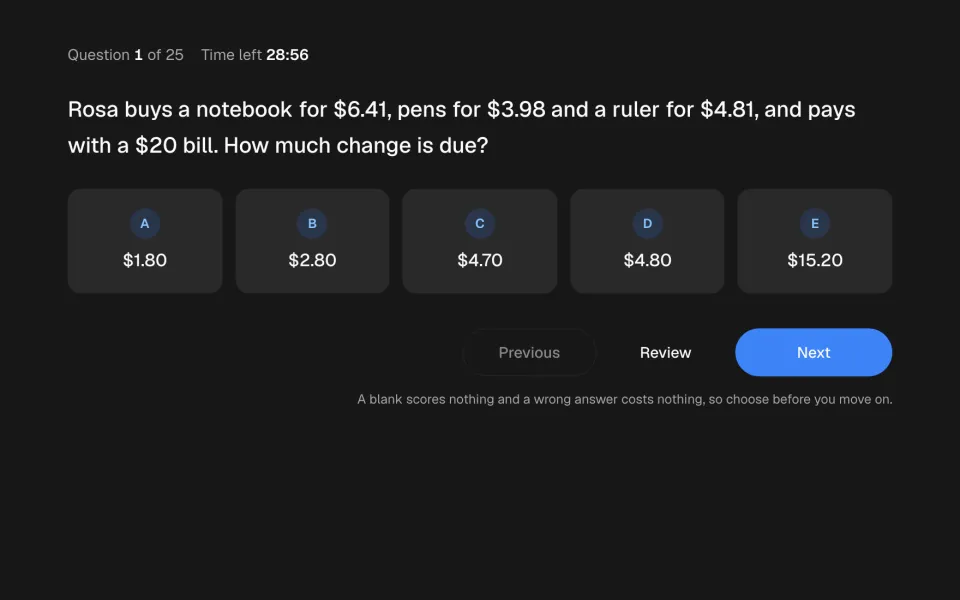
Arithmetic Reasoning (AR)
The AFOQT word-problem subtest at its real length: 25 questions in 29 minutes, five options each, US units and dollars, no calculator. It counts towards the Quantitative composite, which has an official minimum, and towards Academic Aptitude.
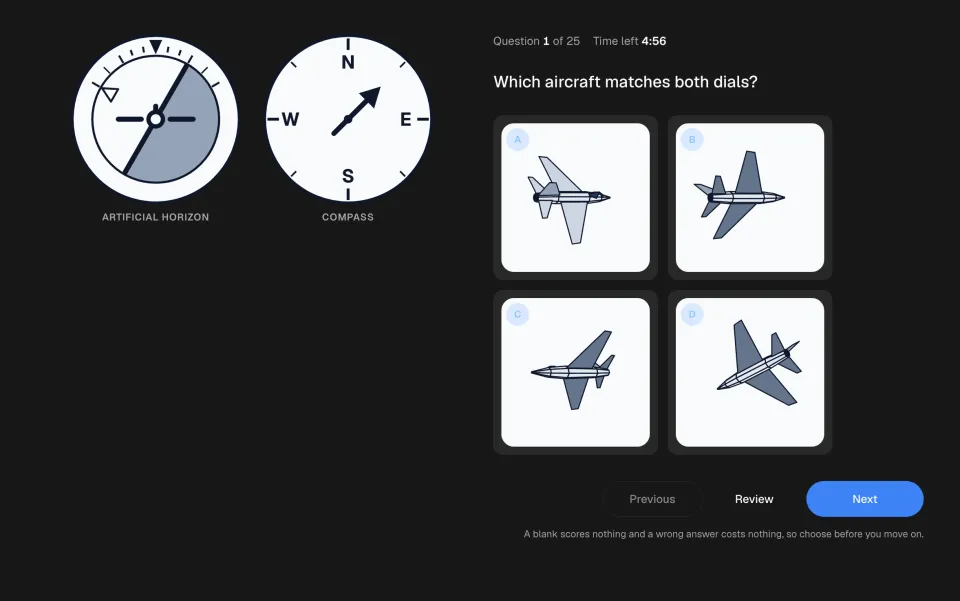
Instrument Comprehension (IC)
The subtest most candidates have never seen before: read an artificial horizon and a compass, then pick the one aircraft of four that is flying that way. 25 questions in 5 minutes, as on the real test. It counts towards the Pilot and Air Battle Manager composites.
Premium Tests
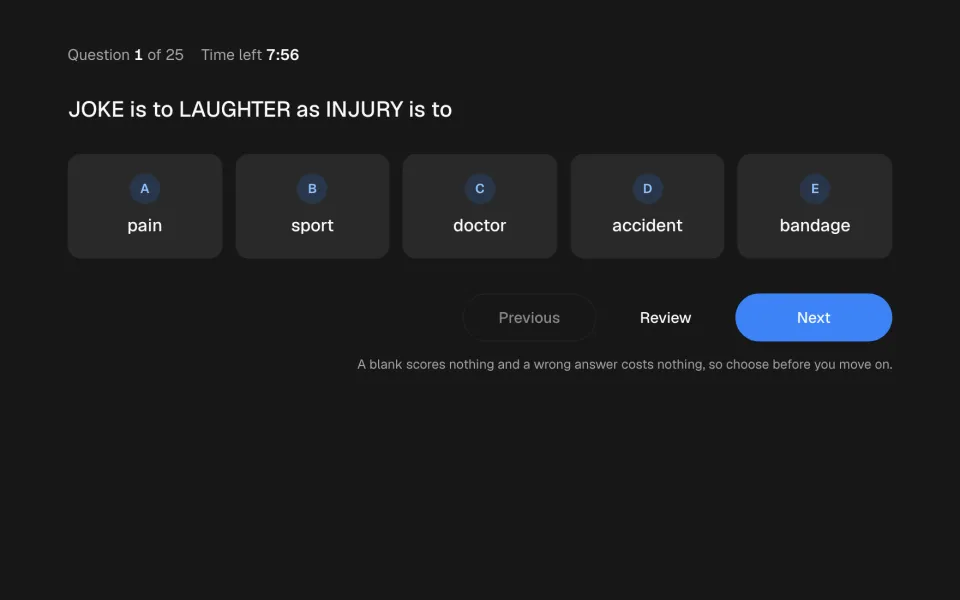
Verbal Analogies (VA)
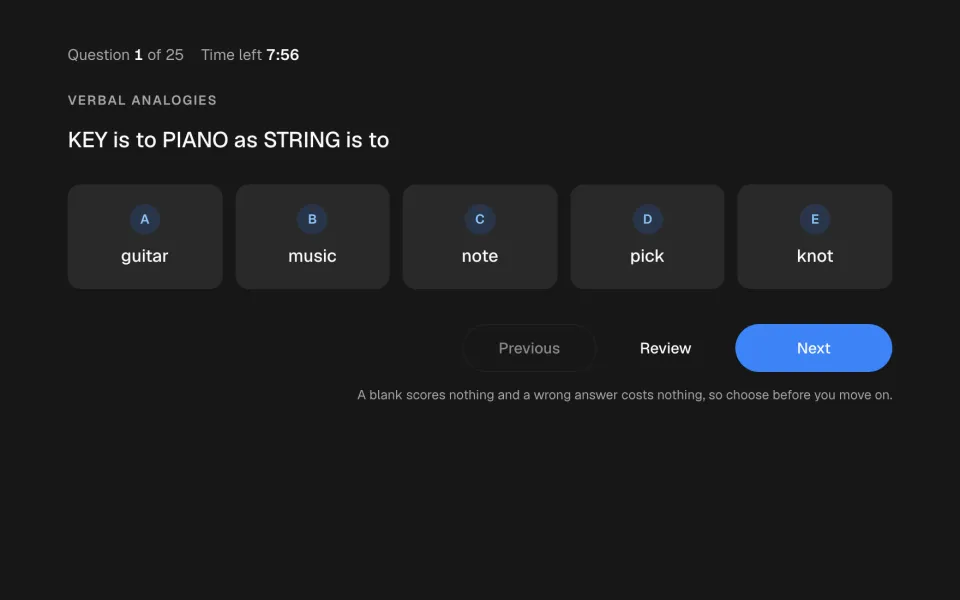
The first AFOQT subtest: 25 analogies in 8 minutes, five options each. Work out how the first two words are related, then find the pair that matches. It counts towards the Verbal composite, which has an official minimum, and towards Academic Aptitude.
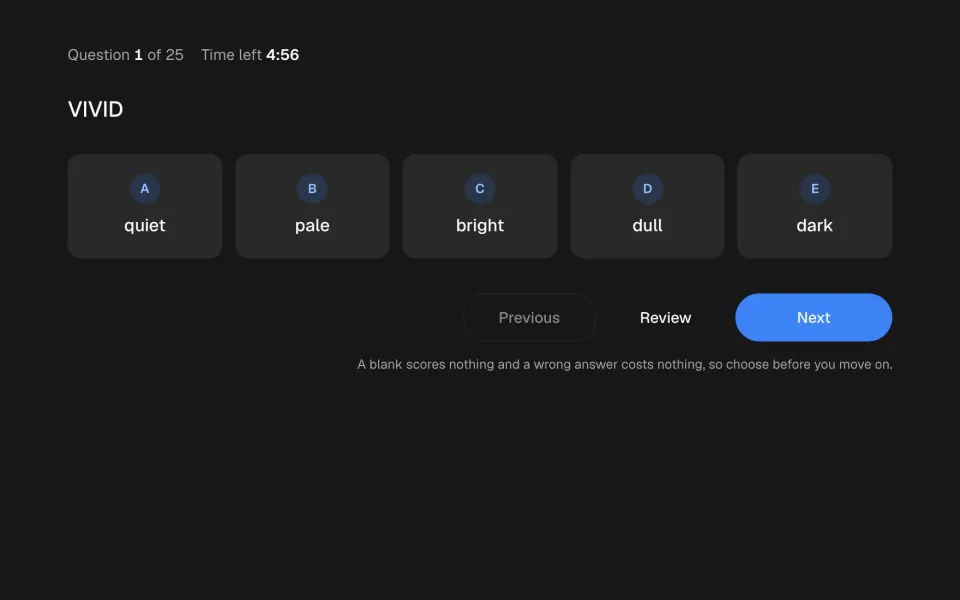
Math Knowledge (MK)
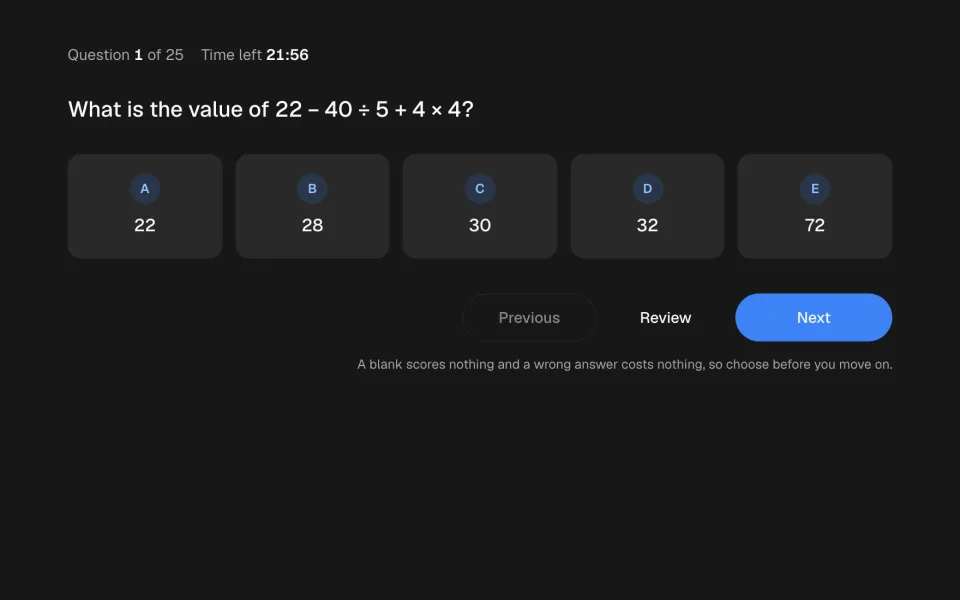
The AFOQT mathematics subtest: 25 questions in 22 minutes on algebra, geometry, number theory and probability, with no calculator. It feeds more composites than any other subtest: Pilot, Combat Systems Officer, Air Battle Manager, Academic Aptitude and Quantitative.
Reading Comprehension (RC)
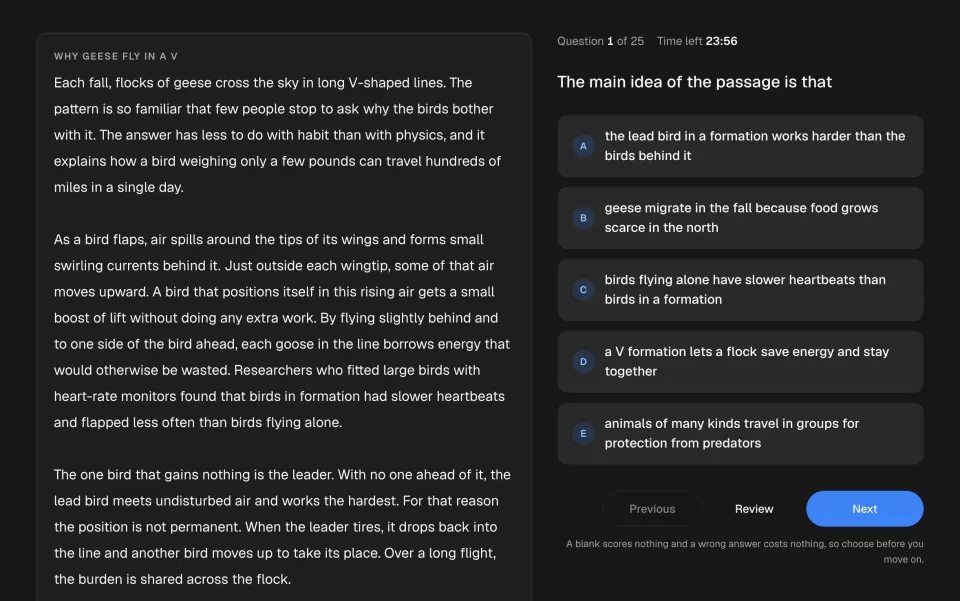
The AFOQT reading subtest: 25 questions in 24 minutes on long, dense passages of the kind an officer reads at work. Questions ask for the main idea, details, inferences, word meanings and the author’s purpose. It counts towards the Verbal composite and Academic Aptitude.
Physical Science (PS)
The AFOQT science subtest: 20 questions in 10 minutes on mechanics, electricity, heat, light, sound, chemistry and astronomy. It is on the real test but feeds none of the six composites in the published Form T table, so practise it last.
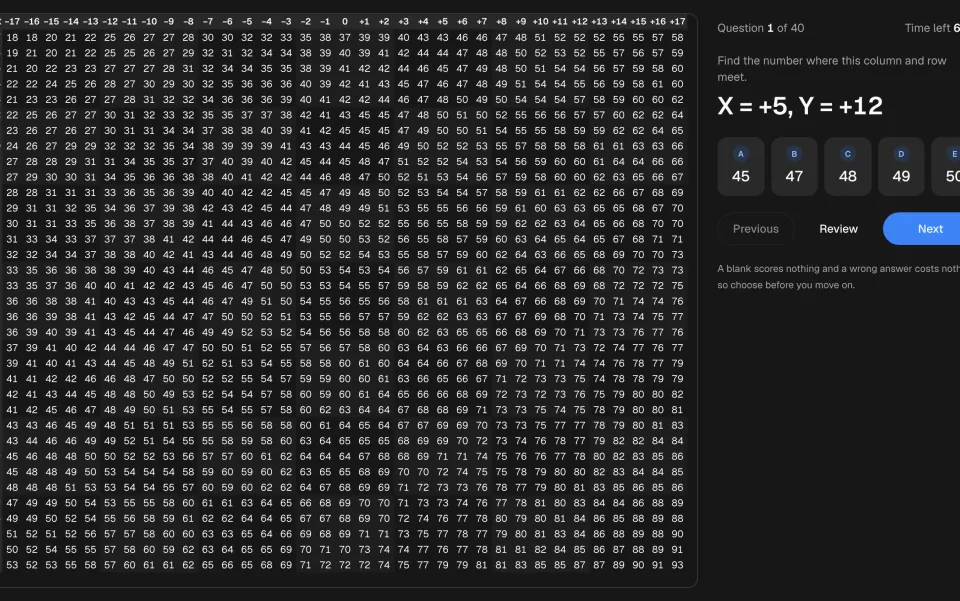
Table Reading (TR)
The fastest AFOQT subtest: 40 questions in 7 minutes. Each gives an X and a Y value; you find where that column and row meet in a large table of numbers and pick the value. It counts towards the Pilot, Combat Systems Officer and Air Battle Manager composites.
Block Counting (BC)
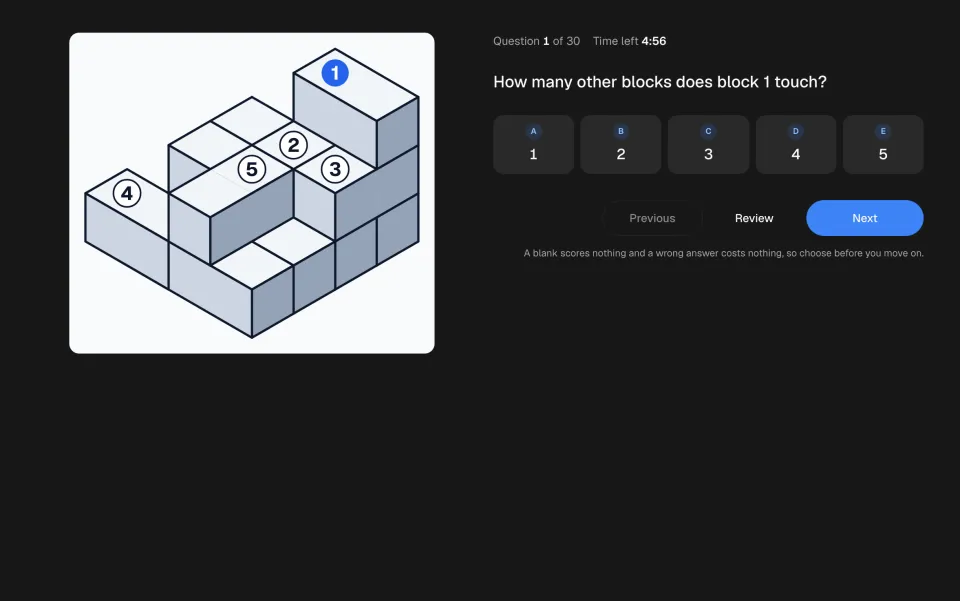
The AFOQT spatial subtest: 30 questions in 5 minutes. Each shows a pile of identical blocks, some numbered, and asks how many other blocks a numbered block touches, including the ones you cannot see. It counts towards the Combat Systems Officer and Air Battle Manager composites.
Aviation Information (AI)
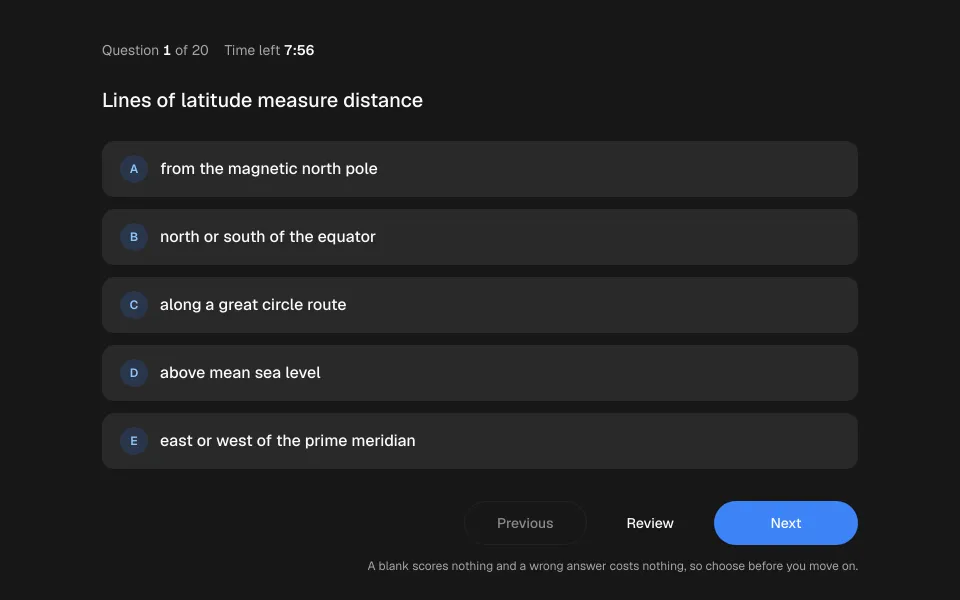
The AFOQT aviation knowledge subtest: 20 questions in 8 minutes on how an aircraft flies, its parts and controls, flight instruments, airport lights and markings, and basic flight rules. It counts towards the Pilot and Air Battle Manager composites.
AFOQT Full Battery
All ten scored ability subtests in the order the computer test gives them, each on its own clock: 260 questions and 2 hours 3 minutes of testing, with a break after Reading Comprehension. You get the number correct for all six composites, Pilot, Combat Systems Officer, Air Battle Manager, Academic Aptitude, Verbal and Quantitative, and which one to work on. You can stop between subtests and pick it up within a day.
Is the AFOQT your test?
Yes, for an Air Force or Space Force commission
Officer applicants by every route, and anyone hoping to fly as a pilot, remotely piloted aircraft pilot, combat systems officer or air battle manager. One sitting gives every composite, so “the pilot test” and “the verbal test” are the same AFOQT.
No, if you are enlisting
Enlisted Airmen and Guardians take the ASVAB. Officer applicants do not need it. The Air Force entry requirements guide covers both routes.
No, for the Navy, Marine Corps or Coast Guard
Their officer and aviation applicants sit the ASTB-E, which is adaptive and penalises unanswered questions. The AFOQT is neither, and the two scores do not transfer.
The twelve AFOQT subtests
The current version is Form T, taken on a computer at a Pearson VUE test centre since about 2025. Each subtest has its own clock and comes in this fixed order, as listed by Pearson VUE in November 2026. Older guides still show Form S, with Rotated Blocks, Hidden Figures and General Science; those subtests are gone.
| Subtest | Questions | Minutes |
|---|---|---|
| Verbal Analogies | 25 | 8 |
| Arithmetic Reasoning | 25 | 29 |
| Word Knowledge | 25 | 5 |
| Math Knowledge | 25 | 22 |
| Reading Comprehension | 25 | 24 |
| Situational JudgmentNot practised here | 16 | 35 |
| Break | 15 | |
| Self-Description InventoryNot graded | 240 | 45 |
| Physical Science | 20 | 10 |
| Table Reading | 40 | 7 |
| Instrument Comprehension | 25 | 5 |
| Block Counting | 30 | 5 |
| Aviation Information | 20 | 8 |
We build the ten ability subtests and the full battery. Every question has four or five options and one right answer. The Situational Judgment Test and the Self-Description Inventory are explained further down.
The six composites, and which subtests feed them
You never get a score per subtest. The number you get right on each subtest is added into composites, and each composite is reported as a percentile. Math Knowledge feeds five of the six, which makes it the subtest most worth your time. Physical Science feeds none of them in the published Form T table, though it is still on the test.
| Composite | Subtests | Used for |
|---|---|---|
| Verbal | Verbal Analogies, Word Knowledge, Reading ComprehensionEvery commission. Minimum: 15th percentile. | Every commission. Minimum: 15th percentile. |
| Quantitative | Arithmetic Reasoning, Math KnowledgeEvery commission. Minimum: 10th percentile. | Every commission. Minimum: 10th percentile. |
| Academic Aptitude | All five verbal and maths subtestsSelection boards. No published minimum. | Selection boards. No published minimum. |
| Pilot | Math Knowledge, Table Reading, Instrument Comprehension, Aviation InformationPilot and RPA pilot selection, and part of the PCSM score. | Pilot and RPA pilot selection, and part of the PCSM score. |
| Combat Systems Officer (CSO) | Math Knowledge, Table Reading, Block Counting and a verbal subtestCombat systems officer selection. | Combat systems officer selection. |
| Air Battle Manager (ABM) | Math Knowledge, Table Reading, Instrument Comprehension, Block Counting, Aviation Information and a verbal subtestAir battle manager selection. | Air battle manager selection. |
Verbal Analogies and Word Knowledge each count towards one of the two rated composites, Combat Systems Officer or Air Battle Manager. The Situational Judgment Test has a composite of its own.
What a percentile means, and why 15 and 10 are harder than they look
It ranks you, it does not count your answers. A Quantitative score of 10 means your Arithmetic Reasoning and Math Knowledge totals matched or beat 10% of the comparison group. About 1 in 100 people score 1 on Quantitative, even though almost all of them answered far more than 1% of the maths questions correctly.
The comparison group is other applicants. Form T was normed on Air Force applicants in autumn 2014, a more competitive pool than the one behind the previous form. The Air Force says this has made reaching the 15th percentile on Verbal and the 10th on Quantitative more challenging. Beating 15 in 100 officer applicants is not a low bar.
The minimums. Every commission needs at least 15 on Verbal and 10 on Quantitative. Pilot and combat systems officer applicants are widely reported to need 25 on their rated composite; that figure is reported, not officially published. Selection boards weigh your composites with your grades, experience and fitness, so the minimum gets you considered rather than selected.
Pilot, CSO and ABM: the rated jobs
If you want to fly or control aircraft, the board also looks at the Pilot, Combat Systems Officer and Air Battle Manager composites. These lean on the subtests that feel least like school: Table Reading, Instrument Comprehension, Block Counting and Aviation Information. They are also the ones that improve fastest with timed practice, because the format is new to almost everyone.
PCSM. Pilot and remotely piloted aircraft applicants get a Pilot Candidate Selection Method score, which combines the Pilot composite, the Test of Basic Aviation Skills and your flying hours, counted up to 60. The minimum PCSM is 10.
TBAS. The Test of Basic Aviation Skills is a separate test taken with a stick, a throttle and headphones, tracking targets while answering questions. It needs that equipment, so we do not simulate it.
Rules worth knowing before you book
Number right, no penalty. Wrong answers cost nothing. Pearson VUE says every question must be answered to receive results, so when time is nearly up, put an answer on everything left.
Not adaptive. Everyone gets the same fixed subtests and question counts. Several subtests are speeded on purpose, so many people do not finish them: Table Reading, for one, allows about 10 seconds a question.
No calculator. You get a pencil and scratch paper, and a timer for each subtest on screen.
Two attempts, a third by waiver. Attempts must be at least 90 days apart. Your best score on each composite across your attempts is the one that counts, and passing scores do not expire. Results take two to three business days and appear on the AFOQT portal.
Free, by voucher. Your recruiter or test control officer gives you a voucher code to book a Pearson VUE seat. AFROTC cadets usually test with their detachment, often in their first or second year.
The Situational Judgment Test and the Self-Description Inventory
Situational Judgment (16 questions, 35 minutes)
Each question describes a situation a junior officer might meet, with several possible responses. In the current version you rate how likely you would be to take each one, and you can give the same rating to more than one. The Air Force says there is no strategic way to answer it and does not publish the key, so we do not score a version of it. Answer as you would actually act.
Self-Description Inventory (240 statements, 45 minutes)
Statements such as “I always try to finish what I start”, each answered from strongly disagree to strongly agree. It is a personality inventory and is not graded, so there is nothing to practise. Answer honestly and at a steady pace: 240 statements in 45 minutes is about 11 seconds each.
Can you study for the AFOQT?
The Air Force’s 2014 information pamphlet said studying would not help. Since 2025 the Air Force has shipped its own free familiarisation tool, OATTS, the only officially endorsed one, with lessons on every subtest and on the TBAS. Use it.
Both are partly right. The knowledge subtests (Word Knowledge, Math Knowledge, Physical Science, Aviation Information) reward study in the usual way. The speeded ones (Table Reading, Instrument Comprehension, Block Counting) reward knowing the format so well that you lose no time working out what to do. That is what timed practice at the real length is for.
What our practice scores, and what it does not
Each game uses the real question count and time limit, five options a question (four pictures in Instrument Comprehension), no calculator, and the real scoring rule: the number right, with no penalty. The questions are our own, written to the content the Air Force describes, in US spelling and units as on the test.
You see your number right and, on the full battery, all six composites as raw totals. We also compare you with other CogniPrep users. Neither is an AFOQT percentile: the Air Force’s conversion tables are not published, so any figure claiming to be one would be invented.
Within a subtest you can go back and change answers until the clock runs out, as the paper form allowed. The Air Force does not publish whether the computer form lets you go back, so practise answering in order too. The speeded subtests work on a phone, but the real test is on a desktop screen, so use a computer if you can.
Frequently Asked Questions
How long is the AFOQT and how many questions are there?
516 multiple-choice questions in twelve subtests. With check-in, instructions and a 15-minute break it takes about five hours. The subtests themselves add up to 203 minutes.
What AFOQT score do I need?
At least the 15th percentile on Verbal and the 10th on Quantitative for any commission. Rated jobs ask more: minimums of 25 on the Pilot and Combat Systems Officer composites are widely reported, and pilot applicants also need a PCSM score of at least 10.
Is there a penalty for guessing on the AFOQT?
No. Your score is the number of questions you get right, so a wrong answer costs nothing. Pearson VUE says every question must be answered to receive results, so never leave one blank.
How is the AFOQT scored?
The number you get right on each subtest is added into six composites, and each composite is reported as a percentile from 1 to 99 against Air Force applicants. A Verbal score of 56 means you did as well as or better than 56% of them. It is not the percentage of questions you got right.
How many times can I take the AFOQT?
Twice, or three times with an approved waiver, and at least 90 days apart. Your best score on each composite across your attempts becomes your score of record, and passing scores do not expire.
Can I use a calculator on the AFOQT?
No. You are given a pencil and scratch paper for the maths subtests.
Where do I take the AFOQT?
At a Pearson VUE test centre, some of them on bases, with a voucher from your recruiter or test control officer. The test is free. AFROTC cadets usually sit it at a supervised session their detachment runs.
Is there an official AFOQT practice test?
The Air Force’s free OATTS app is the only officially endorsed familiarisation tool for the AFOQT and the TBAS. It explains each subtest with lessons and short knowledge checks. Timed practice at the real length is what our games add.
Guides and Tips
Read up before you practise: what the tests reward, what catches candidates out, and why shortcuts do not work.
AFOQT Verbal Analogies: how it works
Verbal Analogies opens the AFOQT: 25 questions in 8 minutes, each asking you to find the pair of words related in the same way as the pair you are given.
Can You Cheat the AFOQT? It Is Always Proctored
Booked with a voucher, sat in a supervised room, ID checked at the door. Why the Air Force officer test has no shortcut, and what raises your score instead.
AFOQT Arithmetic Reasoning: how it works
Arithmetic Reasoning is the AFOQT’s word-problem subtest: 25 questions in 29 minutes, no calculator, and half of the Quantitative composite that every officer applicant must pass.
AFOQT Scores Explained: Why a 15 on Verbal Is Harder Than It Sounds
The AFOQT minimums look low: 15 on Verbal, 10 on Quantitative. They are percentiles against a competitive pool of officer applicants, and about 1 in 100 people score 1 on Quantitative despite getting most of the maths right.
AFOQT Word Knowledge: how it works
Word Knowledge is the AFOQT’s vocabulary subtest: 25 words in 5 minutes, each with five possible meanings and no sentence to help you.
AFOQT Math Knowledge: how it works
Math Knowledge is 25 questions in 22 minutes on algebra, geometry and number rules, and it feeds five of the AFOQT’s six composites, more than any other subtest.
AFOQT Reading Comprehension: how it works
Reading Comprehension is 25 questions in 24 minutes on passages of a few hundred words, and the last subtest before the break.
AFOQT Physical Science: how it works
Physical Science is 20 questions in 10 minutes on physics, chemistry and astronomy. It is on the test but feeds none of the six composites in the published Form T table.
AFOQT Table Reading: how it works
Table Reading is the fastest subtest on the AFOQT: 40 questions in 7 minutes, each asking for the number where an X column and a Y row meet in one large table.
AFOQT Instrument Comprehension: how it works
Instrument Comprehension shows you an artificial horizon and a compass and asks which of four aircraft is flying that way: 25 questions in 5 minutes, and no flying experience needed.
AFOQT Block Counting: how it works
Block Counting shows a drawn pile of identical blocks and asks how many other blocks each numbered block touches: 30 questions in 5 minutes.
AFOQT Aviation Information: how it works
Aviation Information is the last AFOQT subtest: 20 questions in 8 minutes on how aircraft fly, their parts and instruments, and airports, and the subtest that rewards study most directly.
AFOQT full practice test: how it works
The real AFOQT is a five-hour day. A full practice sitting tests what single subtests cannot: pace across all ten ability subtests, the switches between them, and how you hold up at the end.
Practice by Test Type
Compare the same format across every provider that uses it, and see what each one is really measuring.
Numerical Reasoning Test Practice
Tables, charts, percentages and ratios against the clock. The most common screening test on graduate schemes and analyst roles.
Verbal Reasoning Test Practice
Short dense passages and true, false or cannot say answers. Judged on what the text supports, never on what you already know.
Spatial Reasoning Test Practice
Turn, fold, mirror and assemble shapes in your head. Set for engineering, military and aviation roles and inside general ability tests.
Error Checking Test Practice
Compare an original with a copy and find what changed. Short, fast and scored on accuracy as much as speed.
About CogniPrep AFOQT Practice
CogniPrep provides practice versions of the ten ability subtests of the Air Force Officer Qualifying Test, Form T, and a full battery of all ten in the real order. The AFOQT is owned by the Department of the Air Force and delivered by Pearson VUE. CogniPrep is not affiliated with the US Air Force, the US Space Force or Pearson VUE.
- 11 practice tests: ten subtests and the full battery
- Real test: 516 questions in twelve subtests, about five hours with breaks
- No calculator and no penalty for guessing
- Two attempts, a third by waiver, 90 days apart; the best composite counts
Ready to Start Practising?
Sign up for free to try Arithmetic Reasoning and Instrument Comprehension, or unlock all eleven AFOQT games, including the full battery with every composite.