
ASTB-E and OAR Practice: the Navy’s Officer Aviation Test
The ASTB-E is how the US Navy, Marine Corps and Coast Guard select officer aviation applicants, and its first three parts make the OAR that Navy Officer Candidate School uses. Every part you can study for is adaptive, with no going back and a penalty for questions you do not reach. Our practice works the same way and gives you an estimate on the OAR’s 20 to 80 scale.
Also called the ASTB, the Aviation Selection Test Battery, the OAR test or the Navy OCS test.
Unlimited practice on all 5 tests for £10. One-time payment, no subscription.
Free Test
Free to try with a free account. Unlock this provider for unlimited practice.
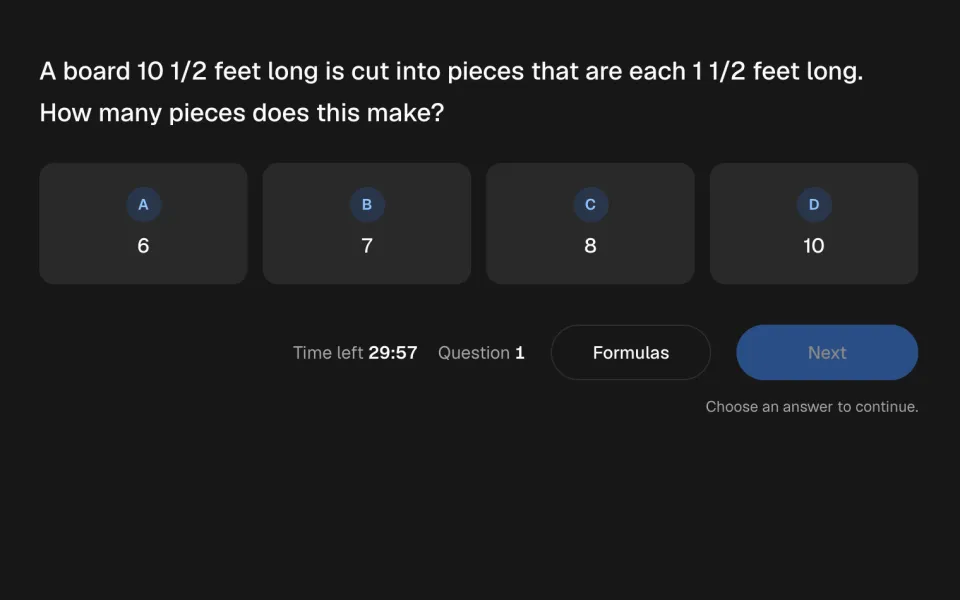
Math Skills Test (MST)
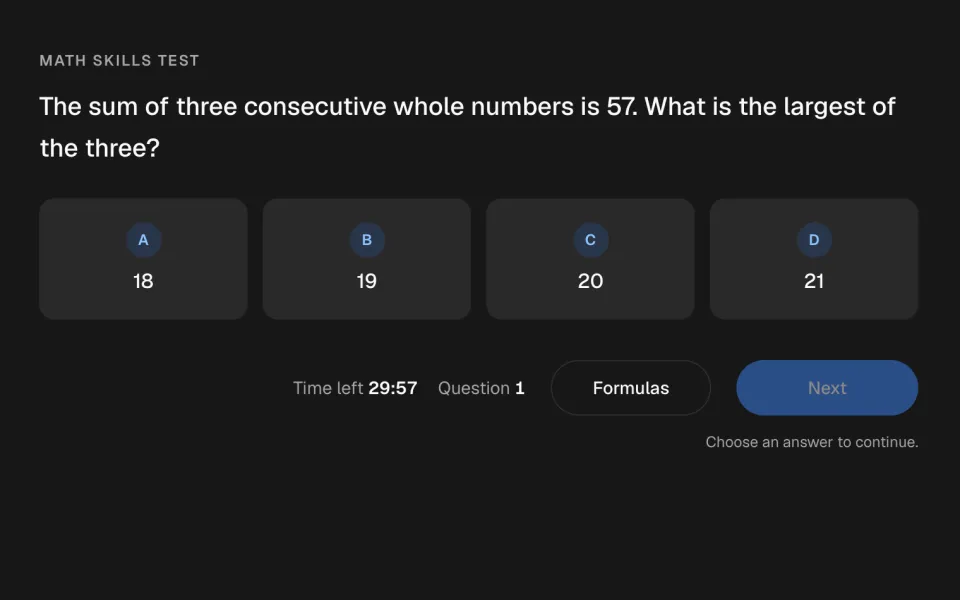
The maths part of the OAR and the ASTB-E: up to 30 adaptive questions in 30 minutes on arithmetic, algebra, geometry, time and distance, and probability, with no calculator and a formula sheet. It can end early once it has measured you, and you get a score on the OAR’s 20 to 80 scale.
Premium Tests
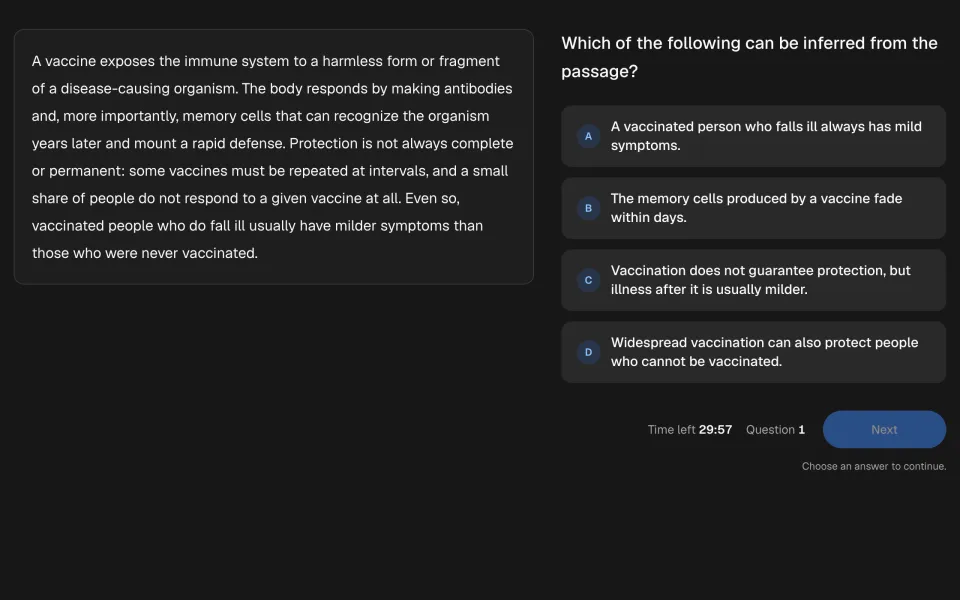
Reading Comprehension Test (RCT)
The reading part of the OAR: up to 20 passages in 30 minutes, one question each. Four statements follow every passage and only one can be inferred from the passage alone; the others may be true in real life, which is the trap. Adaptive, with no going back.
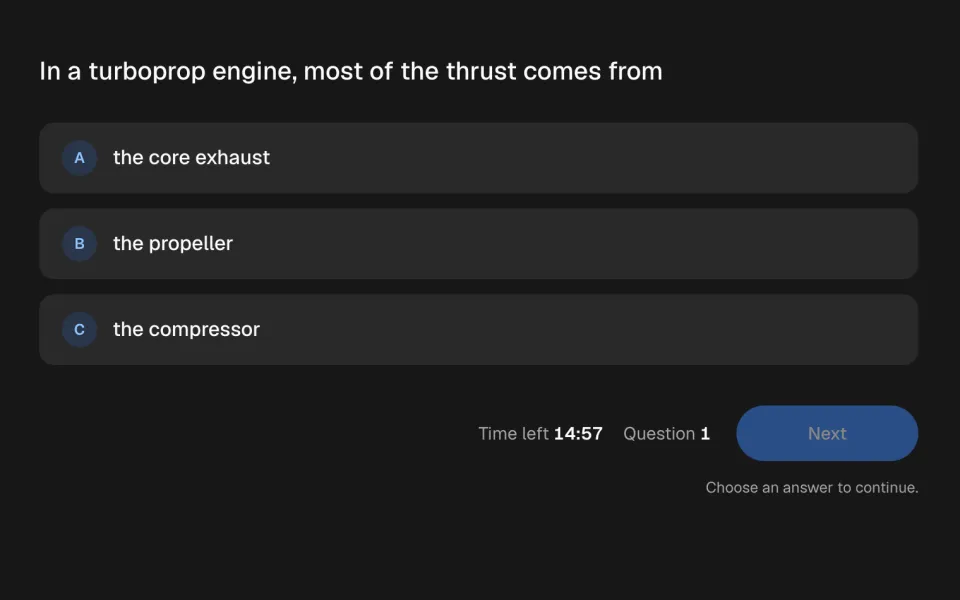
Mechanical Comprehension Test (MCT)
The mechanical part of the OAR: up to 30 adaptive questions in 15 minutes on gears, pulleys, levers, liquids and gases, engines and electricity, with drawings. Each question has three options, as on the real test, and you have about 30 seconds for each.
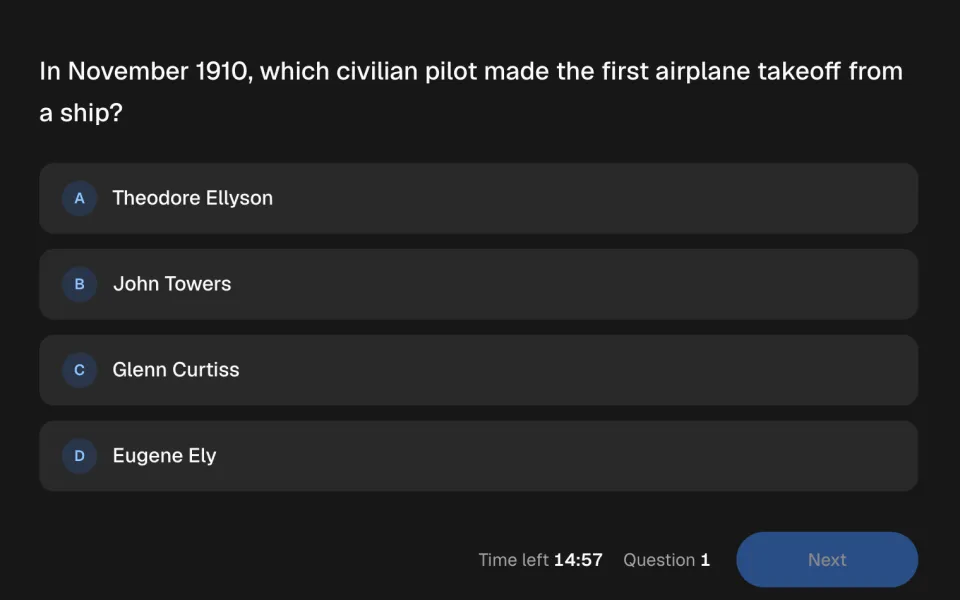
Aviation and Nautical Information Test (ANIT)
The knowledge part of the full ASTB-E, taken by aviation applicants: aviation history, ship and seamanship terms, aircraft parts, aerodynamics, flight rules and navigation. Up to 30 adaptive questions in 15 minutes. NMOTC calls it the part most easily improved by study.
OAR Battery
The three tests behind the Officer Aptitude Rating in one sitting: Math Skills, Reading Comprehension and Mechanical Comprehension, each adaptive and on its own clock, up to 75 minutes in all. You get an estimated OAR on the real 20 to 80 scale and a score for each part, and you can stop between parts.
The OAR or the whole ASTB-E?
The whole ASTB-E
If you are applying to fly as a pilot or a naval flight officer in the Navy, Marine Corps or Coast Guard. You sit all six parts and get four scores: the OAR plus AQR, PFAR and FOFAR.
The OAR alone
If you are applying to a non-aviation officer programme such as Navy Officer Candidate School. You sit the maths, reading and mechanical tests and get one score, which predicts academic performance at OCS. Practise all three in a row with the OAR Battery.
A different test
Air Force officer applicants sit the AFOQT, and enlisted applicants to every service sit the ASVAB. Both have their own scales, and neither score counts towards the ASTB-E.
The six parts of the ASTB-E
You take it online in a system called APEX, at one of over 250 registered sites: Navy officer recruiting stations, NROTC units, Marine Corps Officer Selection Offices and military institutes. It is free, in English only, and you bring photo ID and proof of your Social Security number. The order parts are delivered in is not published.
OAR · adaptive
Math Skills Test (MST)
Arithmetic, algebra and some geometry, as equations and word problems: solving for a variable, time and distance, simple probability, fractions, roots, exponents, angles, areas and perimeters. No calculator; formulas are provided.
OAR · adaptive
Reading Comprehension Test (RCT)
A passage and four statements. Only one can be inferred from the passage alone, and the wrong ones may still be true in real life.
OAR · adaptive
Mechanical Comprehension Test (MCT)
Introductory high school physics: liquids and gases and their effect on pressure, volume and velocity, engines, electricity, gears, weight distribution, pulleys and levers.
Full ASTB-E · adaptive
Aviation and Nautical Information Test (ANIT)
Aviation history, nautical terms and procedures, aircraft parts, aerodynamics, and flight rules. NMOTC calls it the part most easily improved by study, because it is largely knowledge.
Full ASTB-E · adaptive
Naval Aviation Trait Facet Inventory (NATFI)
A personality questionnaire. You see two statements at a time and pick the one that describes you better. The traits it measures are not published, and NMOTC says there is no need to study for it.
Full ASTB-E
Performance Based Measures (PBM)
Directional orientation problems, listening tasks and tracking with a stick and throttle, alone and at the same time. NMOTC suggests mental rotation practice and flight simulator software.
We build the four knowledge and ability parts. The NATFI is a personality inventory and the PBM needs a stick, a throttle and headphones, so neither is simulated here.
Adaptive, no going back, and why guessing hurts
Each question depends on your last. Right answers are usually followed by harder questions and wrong ones by easier questions. Each part draws from a library of several hundred items, and your score takes account of how hard the questions you met were, so two people who saw different questions can be compared.
You cannot skip, go back or change an answer. Once you press on, the answer stands. Read every option before you choose.
Unreached questions cost you. If time runs out before you have answered enough, a penalty is taken off, and it is larger the more questions you leave. NMOTC’s advice is “Work quickly but don’t guess”: guessing at random as time runs out will, in most cases, do more damage than the penalty. Keep a steady pace from the start instead.
A part can end before the clock. An adaptive part may stop early once it has measured you. That is normal and carries no penalty, and it is why the number of questions differs between candidates.
How the ASTB-E is scored
The OAR, from 20 to 80. It comes from the maths, reading and mechanical tests, in one-point steps, and predicts academic performance at Officer Candidate School. Most examinees score between 40 and 60.
AQR, PFAR and FOFAR, from 1 to 9. Candidates who sit the whole battery also get the Academic Qualifications Rating (ground school), the Pilot Flight Aptitude Rating (pilots in primary flight training) and the Flight Officer Flight Aptitude Rating (naval flight officers). Pilots are selected on AQR and PFAR, flight officers on AQR and FOFAR. These are stanines, which map to percentiles as below.
The formulas are not published. NMOTC says only that they are compensatory: a strong part can make up for a weak one. You see your scores as soon as you finish.
| Stanine | Percentile range |
|---|---|
| 1 | 1 to 4 |
| 2 | 4 to 11 |
| 3 | 11 to 23 |
| 4 | 23 to 40 |
| 5 | 40 to 60 |
| 6 | 60 to 77 |
| 7 | 77 to 89 |
| 8 | 89 to 96 |
| 9 | 96 to 99 |
Minimum scores, attempts and retests
Minimums differ by programme and service. The Navy sets them in Navy Personnel Command Program Authorizations 106 and 107, and the Marine Corps in Marine Corps Order 1542.1I. As of March 2023, the minimum to apply as a Navy pilot was an AQR of 4 and a PFAR of 5. For the OAR, about 35 for Navy OCS and 40 for Coast Guard OCS are commonly quoted (November 2026) but are not officially published. Ask your recruiter or officer selection officer for the figure that applies to you.
Three attempts, for life. Older forms of the ASTB (Forms 1 to 5) do not count towards them. A false name or Social Security number makes an illegal test, which can be invalidated and still counts as one of your three.
30 full days between attempts. The gap runs from finishing one attempt to starting the next and cannot be waived. If you retake the full battery you sit all of it again; scores are not mixed from different attempts.
The latest score counts. Your most recent attempt replaces every earlier score, even if some were higher. Retake only when you expect to do better.
What our practice scores, and what it does not
Each game adapts the way NMOTC describes the real test: harder after a right answer, no going back, a penalty when time runs out with questions unreached, and an early finish once it has measured you. The questions are our own, written to the content NMOTC lists, with US spelling and units as on the test.
Your result is our estimate on the OAR’s 20 to 80 scale, not an official score. The real item calibration and formulas are not published, so the number tells you roughly where you stand and which part to work on. It is not a prediction of the score NMOTC will give you.
NMOTC does not publish question counts or time limits. Ours use the reported ones: the Math Skills Test up to 30 questions in 30 minutes, Reading Comprehension up to 20 in 30 minutes, and Mechanical Comprehension up to 30 in 15 minutes. Some guides give 40 minutes for the maths. The ANIT uses the fixed form’s 30 questions in 15 minutes from before 2013.
Frequently Asked Questions
What is the difference between the OAR and the ASTB-E?
The OAR (Officer Aptitude Rating) is three of the ASTB-E’s six parts: the Math Skills, Reading Comprehension and Mechanical Comprehension tests. Aviation applicants take the whole ASTB-E. Applicants to other officer programmes, such as Navy Officer Candidate School, may only need the OAR; your recruiter will tell you which.
Is there a penalty for guessing on the ASTB-E?
There is a penalty for questions left unanswered when time runs out, and it grows with every one. NMOTC also warns that guessing at random as time runs out will, in most cases, cost more than that penalty. Work briskly and accurately from the first question instead.
What is a good OAR score?
The OAR runs from 20 to 80, and NMOTC says most examinees score between 40 and 60. Minimums differ by programme and service, so the score that is good enough for you depends on what you are applying for. Your recruiter or officer selection officer has the current figure.
How many times can I take the ASTB-E?
Three times in total. A retest can start only after 30 full calendar days from finishing the previous one, the gap cannot be waived, and your most recent attempt replaces all earlier scores even if they were higher.
Can I use a calculator on the ASTB-E?
No. The maths questions are designed to be done without one. Relevant formulas are provided, and you are given scrap paper.
How long does the ASTB-E take?
Between 2 hours and 3 hours 15 minutes for the full battery, and between 1 and 2 hours for the OAR alone. The time varies because the adaptive parts can end early.
Can I go back to a question?
No. The adaptive parts do not let you skip a question, go back to one or change an answer.
Guides and Tips
Read up before you practise: what the tests reward, what catches candidates out, and why shortcuts do not work.
ASTB Math Skills Test: how it works
The Math Skills Test is the maths part of the ASTB-E and of the OAR: adaptive arithmetic, algebra and geometry questions with no calculator.
Can You Cheat the ASTB-E? Only Three Attempts
Three lifetime attempts, the latest always counts, and a stand-in still uses one up. Why the Navy’s officer test cannot be gamed.
ASTB Reading Comprehension Test: how it works
The Reading Comprehension Test is the reading part of the ASTB-E and the OAR: for each passage, pick the one statement that follows from the passage alone.
Why Guessing at the End of the ASTB-E Costs You: The Unanswered Question Penalty
Most test advice says never leave a blank. On the ASTB-E, the Navy’s own advice is "work quickly but don’t guess". Why an adaptive test turns quick wrong answers into a lower score, and how to pace so the question never comes up.
ASTB Mechanical Comprehension Test: how it works
The Mechanical Comprehension Test is the physics part of the ASTB-E and the OAR: short questions on machines, fluids and electricity against a tight clock.
ASTB Aviation and Nautical Information Test: how it works
The ANIT is the knowledge test in the full ASTB-E: aviation history, ship terms, aircraft parts, aerodynamics and flight rules. It is not part of the OAR.
OAR test: how it works
The OAR is the score Navy Officer Candidate School and other officer programmes use: three parts of the ASTB-E, taken on their own or with the full battery.
Practice by Test Type
Compare the same format across every provider that uses it, and see what each one is really measuring.
Numerical Reasoning Test Practice
Tables, charts, percentages and ratios against the clock. The most common screening test on graduate schemes and analyst roles.
Verbal Reasoning Test Practice
Short dense passages and true, false or cannot say answers. Judged on what the text supports, never on what you already know.
Mechanical Reasoning Test Practice
Drawn gears, pulleys, levers and fluids. Predict which way things turn, what balances and what moves fastest.
About CogniPrep ASTB-E Practice
CogniPrep provides practice versions of the Math Skills, Reading Comprehension, Mechanical Comprehension and Aviation and Nautical Information tests of the Aviation Selection Test Battery, Series E, and of the Officer Aptitude Rating. The ASTB-E is run by the Navy Medicine Operational Training Command in Pensacola. CogniPrep is not affiliated with the US Navy, and NMOTC does not endorse any study guide.
- 5 practice tests: four single parts and the OAR Battery
- Real test: 2 hours to 3 hours 15 minutes in full, 1 to 2 hours for the OAR alone
- No calculator; formulas and scrap paper are provided
- Three lifetime attempts, 30 days apart, and the latest score counts
Ready to Start Practising?
Sign up for free to try the Math Skills Test, or unlock all five ASTB-E games with unlimited sessions and feedback written against the OAR scale.