Why Guessing at the End of the ASTB-E Costs You: The Unanswered Question Penalty
The ASTB-E and OAR penalise questions left unanswered, yet the Navy warns random guessing usually costs more. How the adaptive test reads it, and how to pace.
Most advice about timed multiple-choice tests says the same thing: never leave a question blank, because a guess might be right and a blank never is. On the ASTB-E, the test the US Navy, Marine Corps and Coast Guard use to select officer aviation applicants, that advice is wrong. The Navy’s own guidance is “Work quickly but don’t guess”. This is why, and what to do instead.
What the rules actually say
The Navy Medicine Operational Training Command, which runs the ASTB-E, publishes three rules about unfinished questions on its adaptive parts. If you fail to complete enough questions before time expires, a penalty may be applied to your score. The penalty is higher the more questions are left unanswered. And it is never applied to a part that ends by itself before time runs out.
Then comes the advice that surprises people. Examinees are told not to guess at random as time is about to expire, because if you have worked diligently and quickly, random guessing will, in most cases, be more damaging to your score than the penalty for not finishing.
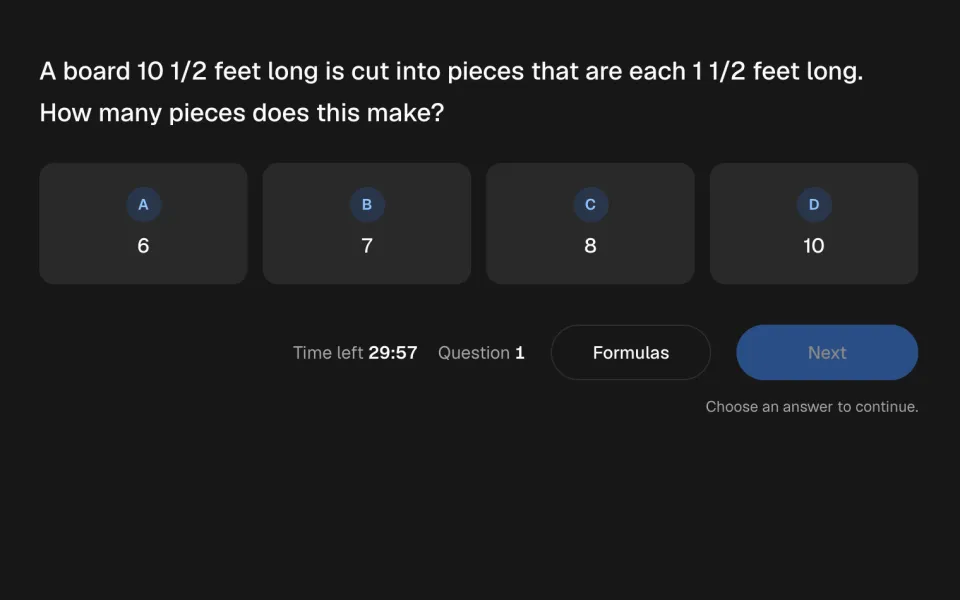
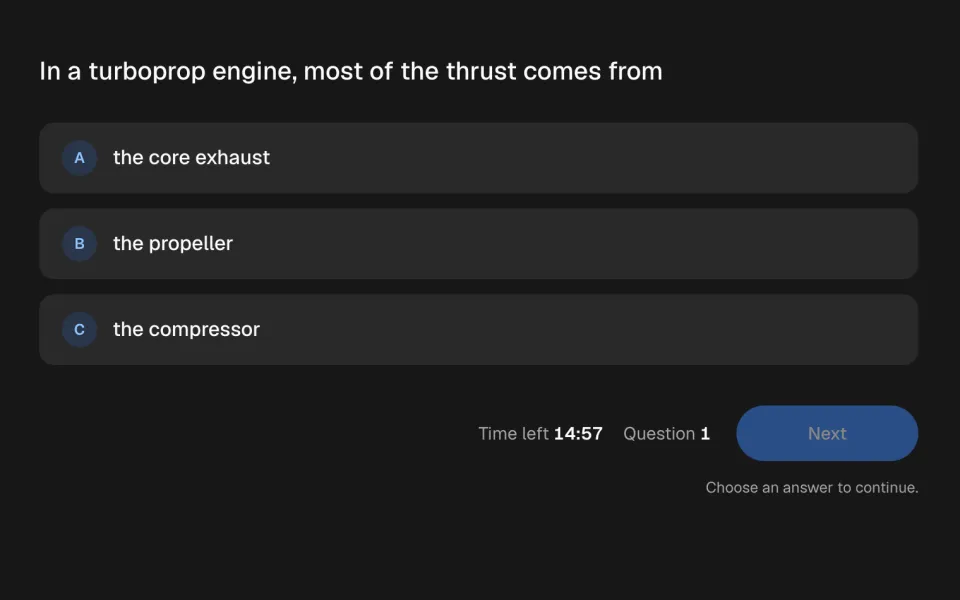
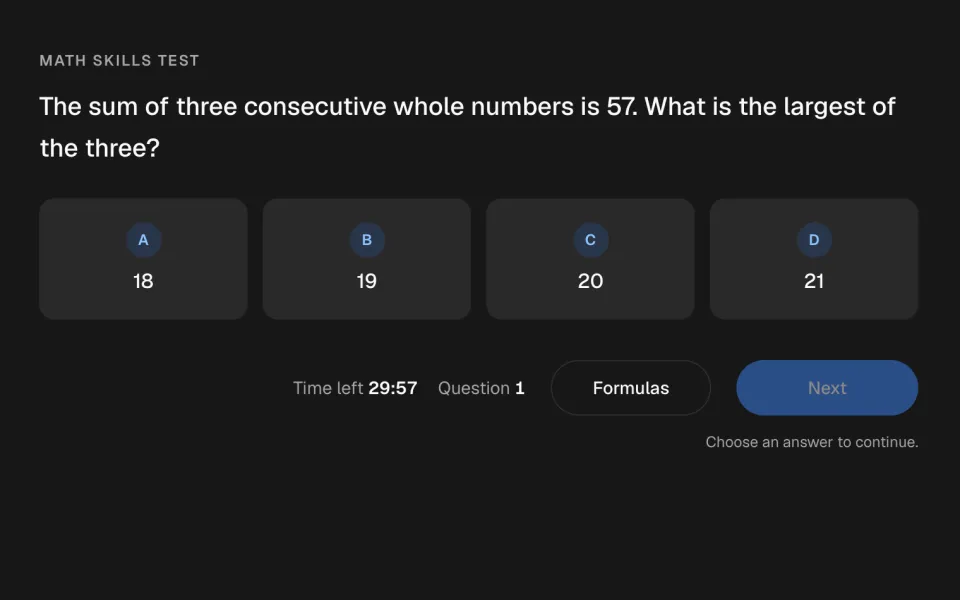
The adaptive parts are the Math Skills Test, the Reading Comprehension Test and the Mechanical Comprehension Test, which together make the Officer Aptitude Rating (OAR), and the Aviation and Nautical Information Test in the full battery. The personality inventory is adaptive too, but it has no right answers to guess.
Why a guess can cost more than a blank
On a fixed paper test, every question is worth the same and a wrong answer simply scores nothing, so a guess cannot hurt. An adaptive test works differently. It does not count right answers; it estimates your ability from the pattern of right and wrong answers at each level of difficulty. Each part draws from a library of several hundred questions scaled by difficulty, and your score takes account of how hard the questions you met were.
That is what makes a rushed guess expensive. A wrong answer is evidence that your level is lower than the test thought. A run of quick wrong answers at the end, each one on a question the test chose because it expected you to have a fair chance at it, pulls the estimate down. Most random guesses are wrong, so a burst of them mostly adds evidence in the wrong direction.
A question you never reach adds no evidence either way. The penalty exists so that leaving questions is not free, but the Navy’s guidance is that, for a candidate who has been working steadily, it usually costs less than filling the gap with noise.
Why the test sometimes ends early
An adaptive part can terminate before its clock runs out, and when it does there is no penalty at all. The Navy does not say exactly when this happens. The general idea of adaptive testing is that once the test is sure enough of your level, more questions add little, so it stops. Two candidates can therefore see different numbers of questions, and finishing early is not a sign that something went wrong.
This also explains why the number of questions on each part is not published. The counts usually quoted, such as up to 30 questions in 30 minutes for the Math Skills Test, are maximums, not a fixed length every candidate sees.
How to pace so the question never comes up
The best way to deal with the penalty is to make it irrelevant by finishing, or by letting the test finish for you. That is a pacing problem, and it can be practised.
- Know your per-question budget. From the reported limits, that is about a minute a question in maths, about 90 seconds a question in reading, and about 30 seconds a question in mechanical comprehension.
- Do not over-invest in one question. You cannot skip and come back, so a question you are stuck on has to be answered and left. Make your best reasoned choice and move on.
- Make educated guesses, not random ones. The advice is against random guessing. Ruling out two options and choosing between the rest is reasoning, and it belongs in every question you reach.
- Speed up the slow skills. No calculator is allowed on the maths, so arithmetic speed is the usual reason candidates run short. The mechanical part has the tightest clock and rewards knowing a few rules cold.
Why it matters more on the ASTB-E than most tests
You get three attempts in your lifetime, at least 30 full days apart, and your most recent score replaces every earlier one, even if it is lower. A bad habit at the end of a timed part is not something you can average out over a few sittings. It is worth getting right before the first attempt.
Our ASTB-E and OAR practice applies the same rules: it adapts, takes points off when time runs out with questions unreached, and can end before the clock. Its feedback tells you when your last answers were fast and wrong. For the reading and maths parts in detail, see the guides to the ASTB Math Skills Test and the OAR test.