AFOQT Scores Explained: Why a 15 on Verbal Is Harder Than It Sounds
AFOQT scores are percentiles against other officer applicants, not marks out of 100. What Verbal 15 and Quantitative 10 mean, and how to clear them.
Every Air Force and Space Force officer applicant needs at least 15 on the AFOQT Verbal composite and 10 on Quantitative. Read as marks out of 100, those look like numbers almost anyone could reach. They are not marks. They are percentiles, against a group of people who were all trying to become officers, and that changes what it takes to clear them.
A percentile, not a percentage
The Air Force reports AFOQT scores as percentiles from 1 to 99. Its personnel centre is blunt about what they are not: they do not refer to the number or percentage of questions you answered correctly. Your raw score, the number right on the subtests behind a composite, is compared with a normative sample, and your score is the share of that sample you matched or beat.
Its own example is Quantitative. A score of 10 means your raw scores on Arithmetic Reasoning and Math Knowledge were the same as or better than 10% of the sample. It adds that about 1 in 100 examinees receive a Quantitative score of 1, even though nearly all of them answered far more than 1% of the maths correctly. A 1 does not mean you got almost nothing right. It means almost everyone in the comparison group did better.
Who you are being compared with
The current form, Form T, was normed on a representative sample of applicants from autumn 2014. These are not a cross-section of the population. They are people applying for a commission, on the way to or already holding a degree. The Air Force says the applicant pool has become more competitive over time, and that scoring at or above the 10th percentile on Quantitative or the 15th on Verbal has become more challenging as a result.
So 15 on Verbal means you matched or beat 15% of a strong, self-selected group. That is a real bar. It is not the same as getting 15% of the questions right, or anything close.
What goes into Verbal and Quantitative
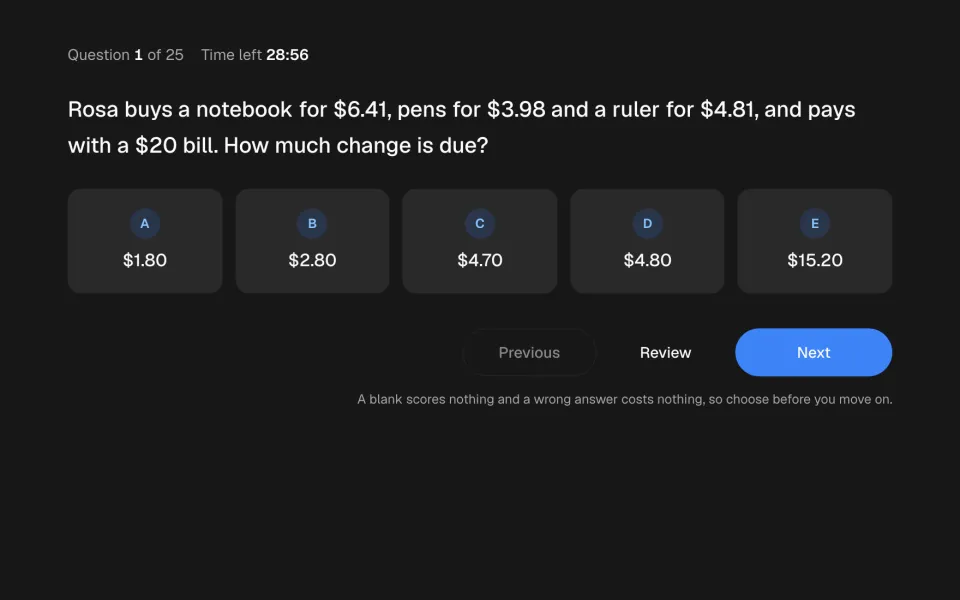
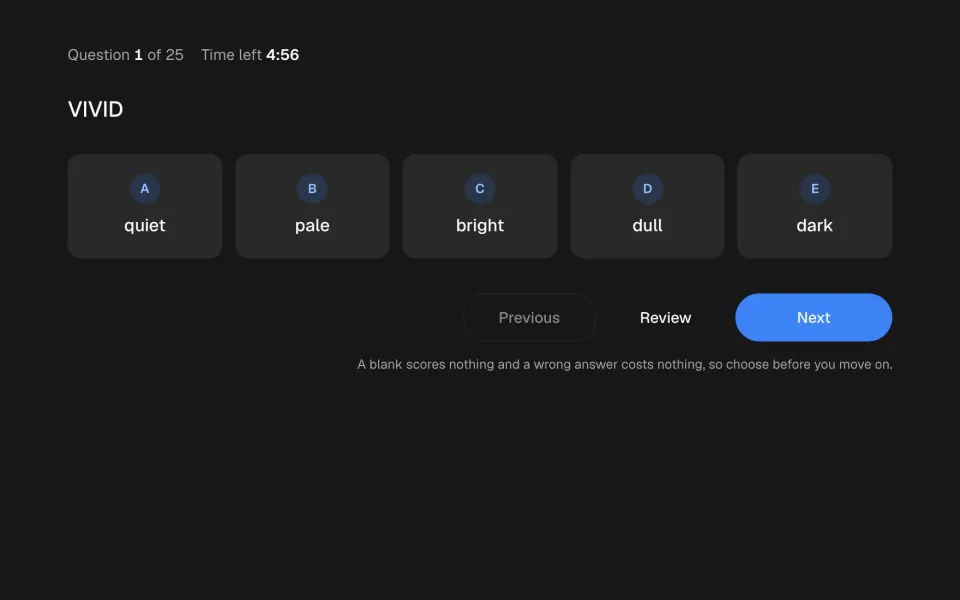
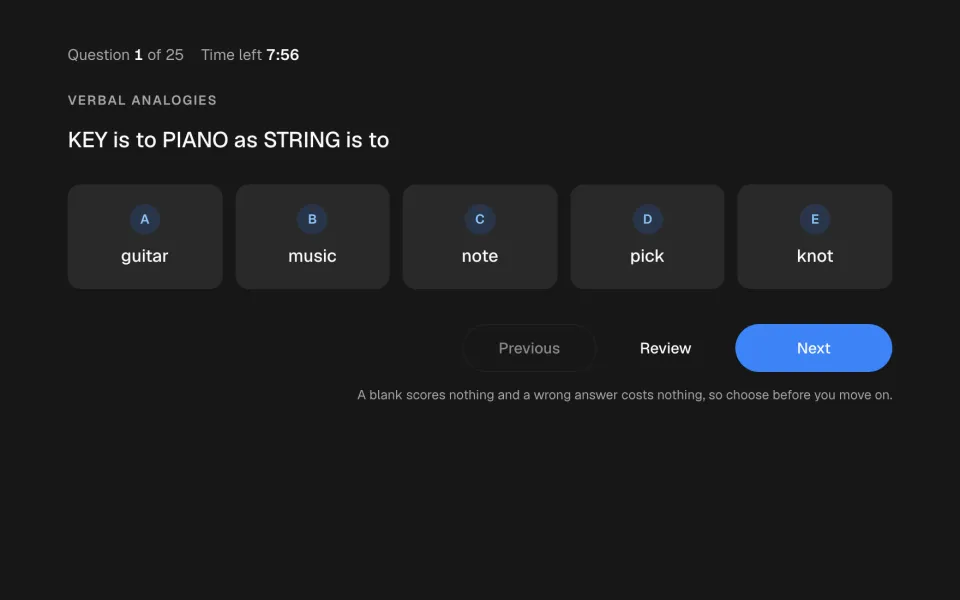
Verbal is built from three subtests: Verbal Analogies (25 questions in 8 minutes), Word Knowledge (25 words in 5 minutes) and Reading Comprehension (25 questions in 24 minutes). Quantitative is Arithmetic Reasoning (25 word problems in 29 minutes) and Math Knowledge (25 questions in 22 minutes). Both are scored as the number right, with no penalty for a wrong answer, and every question must be answered for you to receive results.
Those five subtests together also make Academic Aptitude, which AFROTC weighs when it selects cadets for the Professional Officer Course. The rated composites, Pilot, Combat Systems Officer and Air Battle Manager, draw on Math Knowledge and Table Reading among others, so the maths subtests matter well beyond the Quantitative minimum.
How to give yourself room above the line
- Treat Word Knowledge as a weeks-long project. Twelve seconds a word leaves no time to work a meaning out, so the score reflects what you already know. Reading widely and learning Latin and Greek roots is slow, which is why it has to start early.
- Practise maths by hand. There is no calculator and no formula sheet. Most lost marks on Arithmetic Reasoning are set-up errors and slow long division, both of which practice fixes.
- Learn the analogy relationships. Synonym, opposite, part and whole, degree, cause and effect: naming the relationship at once is what makes 19 seconds a question enough.
- Pace Reading Comprehension by passage. The computer test allows 24 minutes, much less than the 38 older paper guides describe.
- Answer everything. A guess costs nothing and a blank stops you getting results.
A weak first score is not final
You can take the AFOQT twice, or three times with an approved waiver, with at least 90 days between sittings. The Air Force superscores: your best result on each composite across your valid attempts becomes your score of record, so a retest can only raise a composite, never lower it. Scores do not expire.
Our AFOQT practice covers all ten ability subtests at their real counts and timings. Start with the guides to AFOQT Word Knowledge and AFOQT Arithmetic Reasoning, then sit the full AFOQT practice test to see your raw score behind every composite. It shows raw scores, not percentiles, for the reason above.