NJ LEE Guide: Police and Sheriff’s Officer Exam
The NJ LEE is one exam for municipal police, county police and sheriff’s officer jobs. What is on the LEAB, how the day works and how the list is ranked.
If you want to be a police officer, a county police officer or a sheriff's officer in New Jersey, your first scored step is almost certainly the Entry-Level Law Enforcement Examination, the LEE. It is one exam for all of those jobs, run once a year by the Civil Service Commission, and the test inside it is the Law Enforcement Aptitude Battery (LEAB). Here is what is on it, how the day works and how the list is ranked afterwards.
One exam for municipal, county and sheriff's officer jobs
In Civil Service jurisdictions there is no separate sheriff's officer exam or county police exam. The 2026 LEE covered nine titles: municipal police officer, county police officer, campus police officer, human services police officer, Palisades Interstate Park police officer, state park police officer, sheriff's officer, county correctional police officer and Youth Justice Commission correctional police officer. Parole officer recruits sit the same exam.
You apply once, for the Law Enforcement Series (S9999H), and one $70 fee covers any or all of the title areas. One sitting then counts for every title you chose. Bilingual Spanish and Korean positions exist too; your language is tested later, at certification, not in the LEE.
If your town is not a Civil Service town, none of this applies: it runs its own written test, physical test and interviews, so check its own posting.
What is on the test
The LEAB is a battery built by EB Jacobs and now sold by PSI, and other agencies use it too. It has three parts on one answer sheet, all multiple choice, and all three are scored and combined:
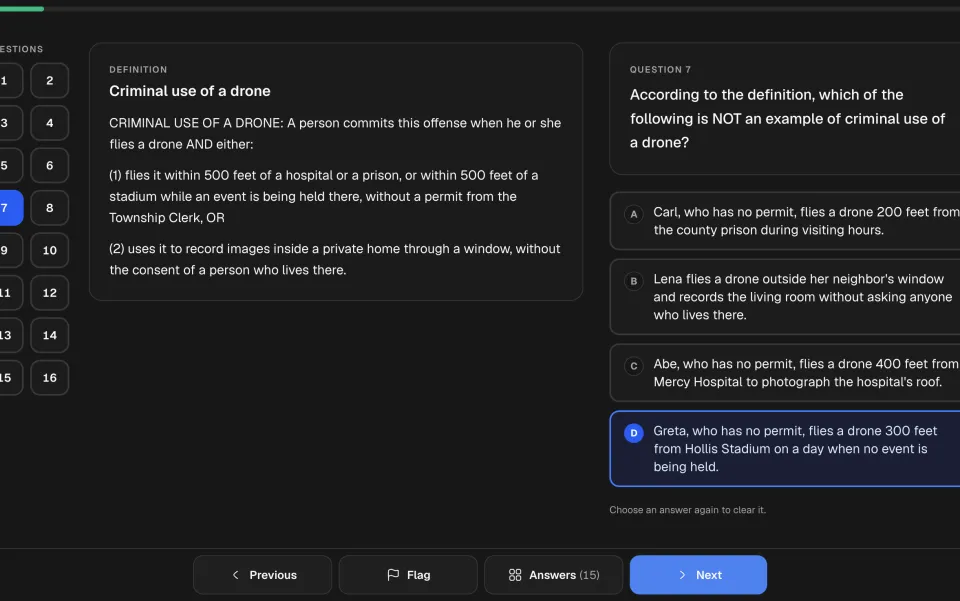
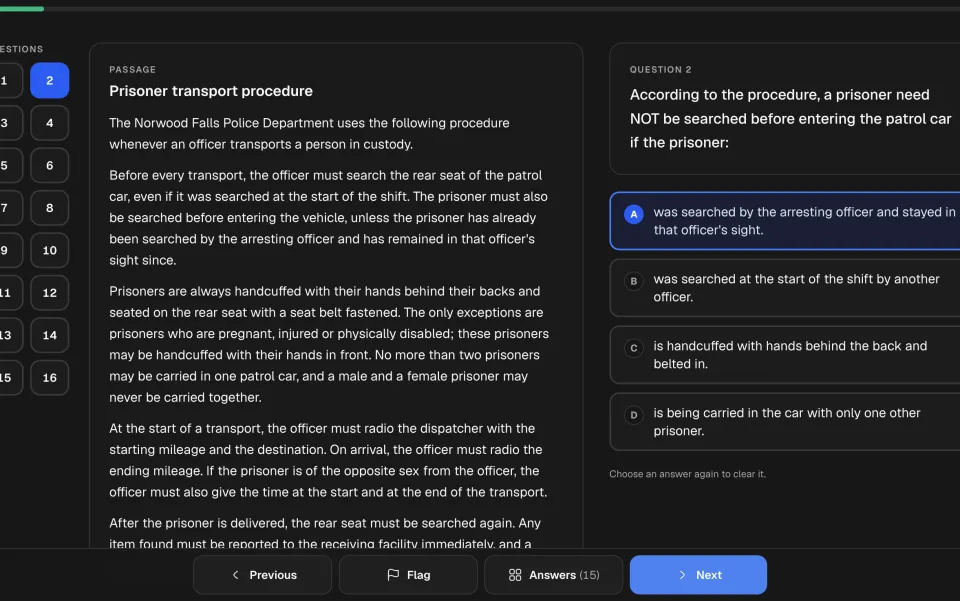
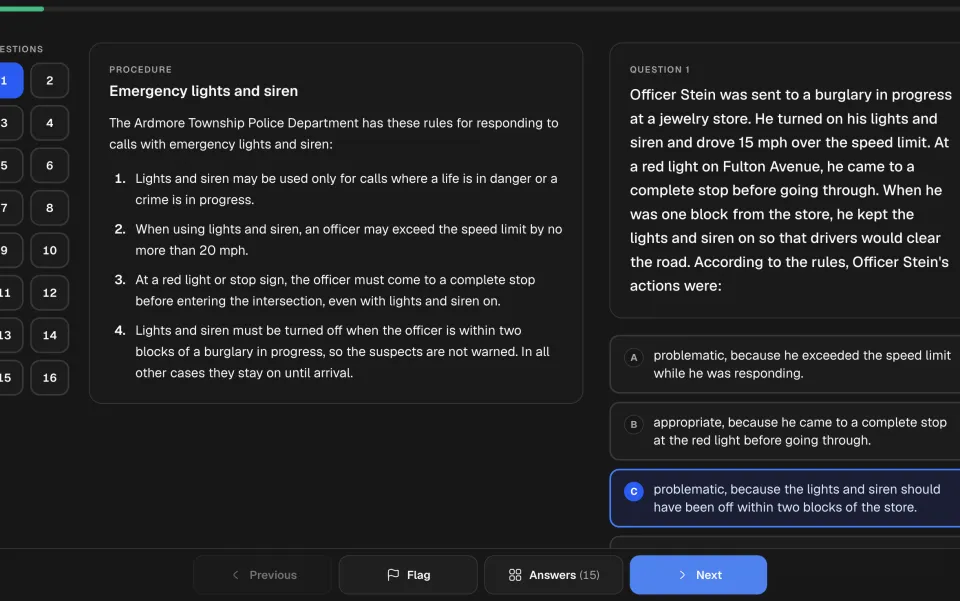
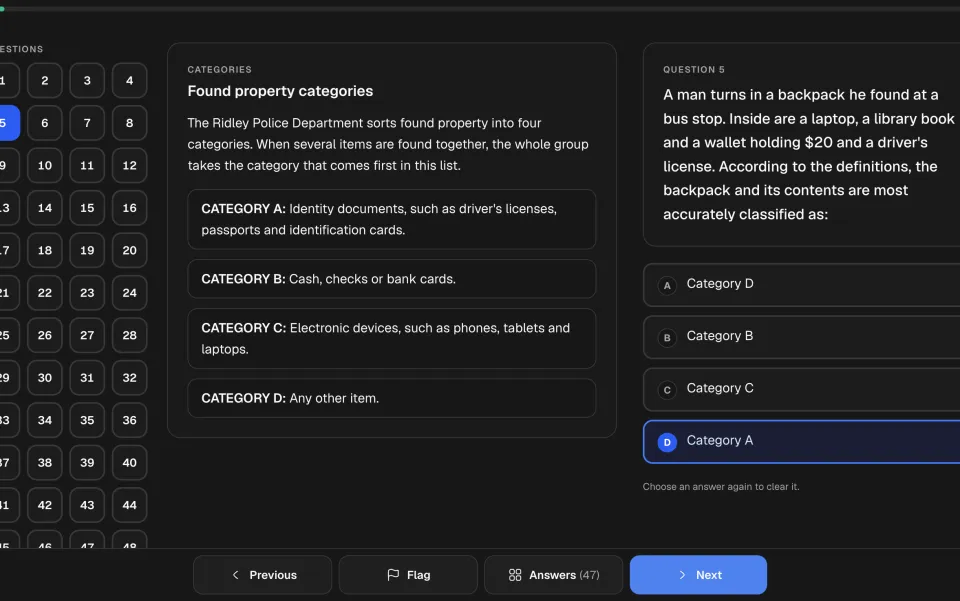
- The Ability Test.The publisher's guide describes 48 questions with four options each, on six abilities. This is the part you can practise.
- The Work Styles Questionnaire. 74 statements about yourself, each rated from Strongly Disagree to Strongly Agree.
- The Life Experience Survey. 47 questions about your school and work history, each with five options.
In the publisher's format the three parts share one clock of at least 2 hours 15 minutes, with about 90 minutes suggested for the Ability Test. New Jersey does not publish its own counts or times, and you may meet different figures elsewhere, so treat these as a guide to pacing rather than a promise.
The six abilities
Every fact you need is in the question, and the rules and policies are invented, so you need no knowledge of law or police work. Each ability has its own kinds of question:
- Written Expression: choosing the clearest, most accurate wording for a fact, and putting report sentences in order.
- Written Comprehension: answering questions on passages about incidents and procedures.
- Problem Sensitivity: finding the witness account that does not fit, or the most serious departure from a procedure.
- Deductive Reasoning: applying rules, fee tables, categories and offence definitions to a case.
- Inductive Reasoning: matching suspect descriptions across incidents and finding patterns in an incident log.
- Information Ordering: finding the next step of a procedure, or putting its steps in order.
How the day works
You sit the LEE on paper at a state test centre, at the date, time and place you are assigned; changes are not allowed. Bring photo ID and arrive early, because nobody is admitted late. You get a booklet you may write in, a scannable answer sheet and two Number 2 pencils, and only the answer sheet is scored.
Leave your phone behind. Any electronic device seen at any time, even switched off, means disqualification. You sign a pledge not to discuss the content, and there is no review of the test material afterwards.
After the test: the pool and the list
No pass point is published. If you pass, you join a statewide eligible pool for each title area you chose, for at least a year. You have no rank yet. A rank appears only when a jurisdiction asks for a list of candidates for a title.
On that list, disabled veterans and then veterans come first, grouped by status, and everyone else follows by final average. There are no extra points, ties are not broken, and a residency preference can reorder a jurisdiction's list. So every mark you add on the Ability Test can move you up. Scores from an earlier LEE do not carry over, so each year you sit it again from scratch.
Age and eligibility
You must be at least 18 by the closing date. For municipal police officer you must also be under 35, with exceptions for some prior service. After the LEE come certification, the background investigation, medical and psychological checks and the academy.
How to prepare
Spend your practice time on the Ability Test, because it is the only part practice improves. Learn the kinds of question for each ability first, then practise them two abilities at a time on a clock, then sit a full 48-question paper in 90 minutes to get the pacing right: under two minutes a question, short standalone questions first, long passages after.
The two questionnaires are different. Both are built to detect dishonest answers, and the Life Experience Survey is checked in the background investigation, so the preparation is to answer as you are and to look over your school and work records beforehand so your answers are accurate.
Practise the Ability Test
Our NJ LEE practice tests follow the Ability Test as its publisher describes it: three drills of two abilities each, 16 questions in 30 minutes, and the full 48 questions in 90 minutes on one clock, with free movement, flags and no time warnings. Deductive reasoning and information ordering is free to start. If you are tempted by a shortcut, read why there is none on the NJ LEE first.