
NJ LEE Practice Test (LEAB Police Exam)
New Jersey's Civil Service Commission runs one Entry-Level Law Enforcement Examination a year for municipal police, county police, sheriff's officer and correctional police candidates, and the written test inside it is the LEAB. Practise its Ability Test: six abilities, four options a question, nothing taken off for a wrong answer, and one clock with no time warnings.
Also called the New Jersey Law Enforcement Examination, the LEE exam, S9999H or the NJ civil service police exam. The test inside it is the Law Enforcement Aptitude Battery, built by EB Jacobs and now sold by PSI.
Unlimited practice on all 4 tests for £15. One-time payment, no subscription.
Free Test
Free to try with a free account. Unlock this provider for unlimited practice.
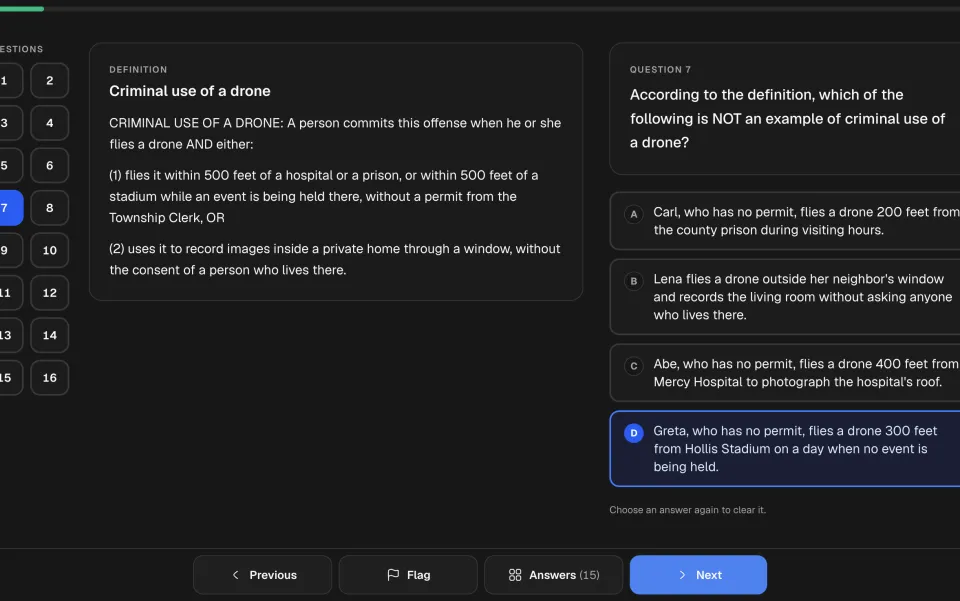
LEAB Deductive Reasoning and Information Ordering
Two of the six LEAB abilities, as on the NJ LEE: 16 questions in 30 minutes. Apply written rules, fee tables, categories and offence definitions to a case, then find the next step in a procedure or put its steps in order.
Premium Tests
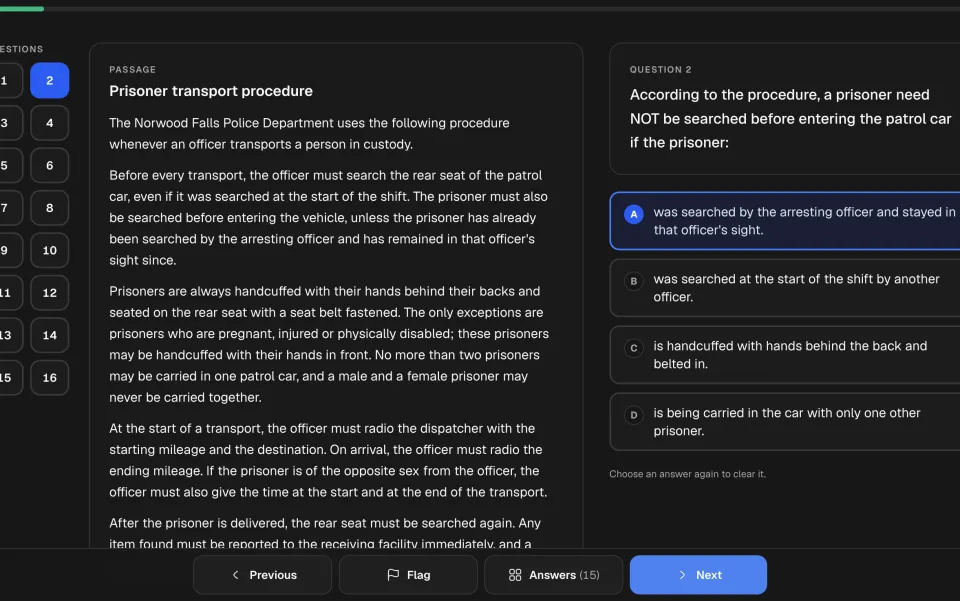
LEAB Written Expression and Comprehension
Two of the six LEAB abilities: 16 questions in 30 minutes. Choose the clearest and most accurate way to record a fact, put report sentences in order, and answer questions on passages about incidents and procedures.
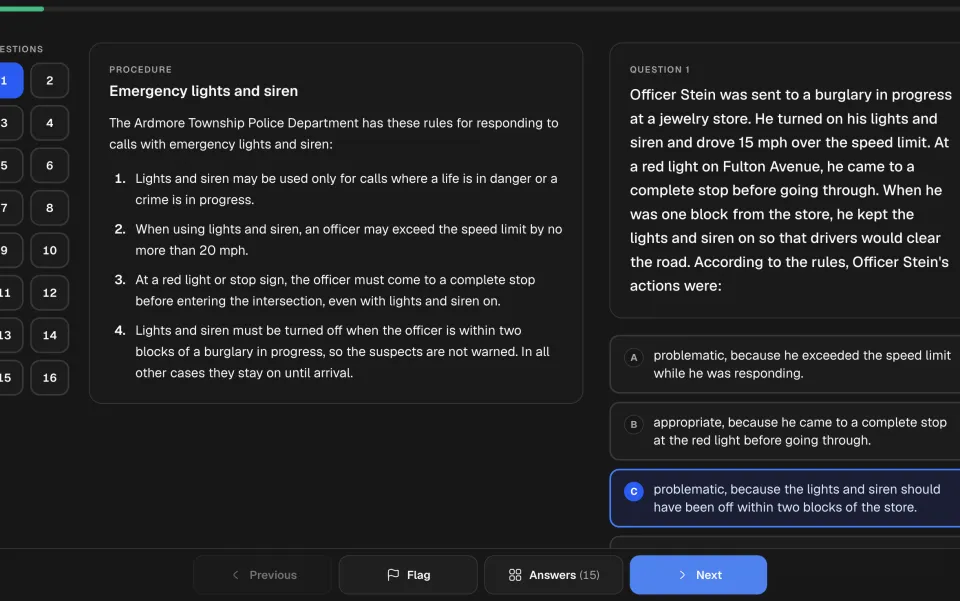
LEAB Problem Sensitivity and Inductive Reasoning
Two of the six LEAB abilities: 16 questions in 30 minutes. Spot the witness account that does not fit and the most serious departure from a procedure, match suspect descriptions across incidents and find the pattern in an incident log.
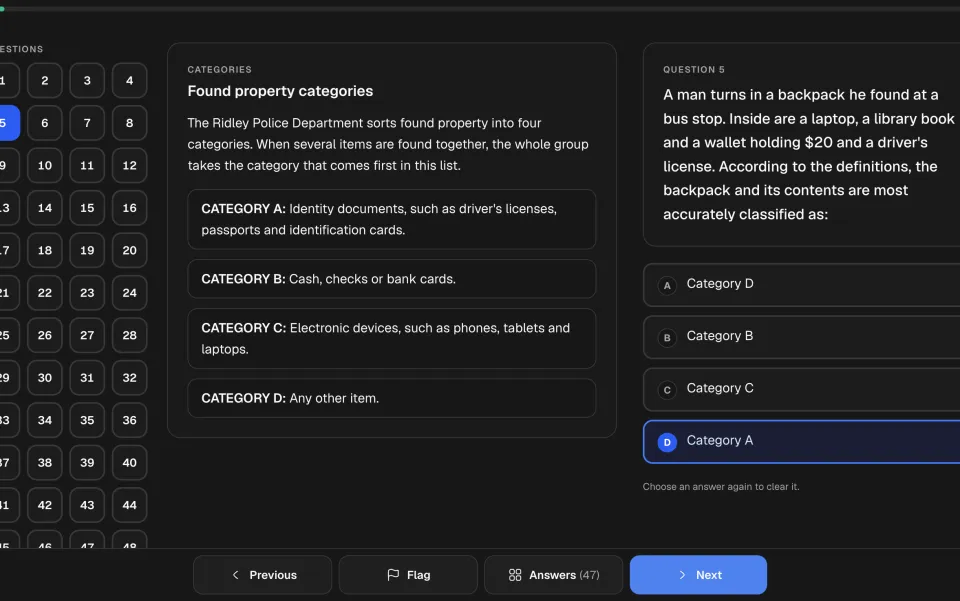
What is on the NJ LEE
Three parts on one answer sheet, sat on paper in one sitting of at least 2 hours 15 minutes, as the battery's publisher describes it. The parts are not timed separately: you share the time between them yourself, and they may come in a different order. All three are scored and combined. New Jersey does not publish its own counts or times.
Ability Test
48 multiple-choice questions with four options each, on six abilities. Every fact you need is in the question, and any police term is defined for you.
Practise it. This is the part our tests simulate, question type by question type.
Work Styles Questionnaire
74 short statements about yourself, each rated from Strongly Disagree to Strongly Agree, on how you approach work, rules and other people.
Answer as you are, quickly and consistently. There is nothing to learn for it.
Life Experience Survey
47 questions about your past at school and work, each with five options, such as how often you were late or how a supervisor would describe you.
Look over your school and work records first so your answers are accurate. They are checked later.
The six abilities in the Ability Test
Each ability has its own kinds of question. The rules and policies in them are invented, so outside knowledge of law or police work is a trap: answer from what the question gives you.
Written Expression
Choose the clearest, most accurate way to record a fact, with nothing added or left out, and put report sentences in order.
Written Comprehension
Read a passage of half a page to a page about an incident or a procedure and answer questions from it alone.
Problem Sensitivity
Find the witness account that does not fit the others, or the most serious departure from a procedure.
Deductive Reasoning
Apply a written rule, a fee table, a set of categories or an offence definition to a case. Every condition counts.
Inductive Reasoning
Decide which suspect descriptions could be the same person, or find the place and time pattern across incidents.
Information Ordering
Follow a procedure to find the next step, or put its steps in the most logical order.
How the sitting works, and how the list is ranked
Paper, pencils and your own watch
You sit it at a state test centre on an assigned date, with a booklet, a scannable answer sheet and two Number 2 pencils. Only the answer sheet counts. Nobody warns you about time, so wear a watch. Late arrivals are not admitted, and any electronic device seen at any time, even switched off, means disqualification.
Answer every question
There is no penalty for guessing: on the Ability Test a blank and a wrong answer both score zero. On the two questionnaires a blank can count against you, so fill every line there too.
Pass into a pool, not onto a list
No pass point is published. Passing puts you in a statewide pool for each title area you chose, for at least a year, with no rank yet. Scores from an earlier LEE do not carry over.
Ranked only when a list is requested
When a jurisdiction asks for candidates for a title, disabled veterans and veterans come first, then everyone else by final average. Ties are not broken, and a residency preference can reorder a jurisdiction's list. Every extra mark moves you up it.
How to approach the Ability Test
- Answer the short standalone questions first, then the long passages, and circle what you skip in the booklet so you can find it again.
- Pace yourself at under two minutes a question, and remember the clock is shared with the two questionnaires.
- For any rule or definition, number its conditions in the margin before you read the options. A case fits only when every condition is met.
- When choosing how to word a report, reject any option that adds a fact the scenario does not state, even one that is probably true.
- In the last minute, fill every blank on the answer sheet.
How our practice works
The publisher's format. The full test is 48 questions in 90 minutes on one clock, the Ability Test as its publisher describes it. The split of eight questions on each ability is ours. The three drills take two abilities each, 16 questions in 30 minutes.
Like the paper booklet. Move freely between questions, flag the ones to come back to and check an answer grid of blanks and flags. As on the day, there are no time warnings.
Feedback by ability. You see what you got right on each ability, which kinds of question cost you marks and what to do about them next time.
Every question is our own. Rule tables, witness accounts, suspect matches and procedures are generated fresh, and the passages and wording questions are written for practice. Questions are in American English, as the real test is. We do not simulate the two questionnaires: their keys are not published and both are built to catch faking.
Frequently Asked Questions
What is on the NJ LEE?
The Law Enforcement Aptitude Battery (LEAB): an Ability Test, a Work Styles Questionnaire and a Life Experience Survey, all multiple choice, answered on paper in one sitting.
How many questions are on the NJ LEE, and how long is it?
New Jersey does not publish its count or time. The battery’s publisher describes 48 ability questions, 74 work-style statements and 47 life-experience questions, in one sitting of at least 2 hours 15 minutes, with about 90 minutes suggested for the Ability Test. Other counts are reported.
Is the sheriff’s officer or county police exam different?
No. In Civil Service jurisdictions municipal police, county police, sheriff’s officer and correctional police candidates all sit the same LEE. One application, with one $70 fee, covers any or all of the title areas.
What score do I need on the NJ LEE, and how is the list ranked?
No pass point is published. Passing puts you in a statewide pool for each title area you chose. You have no rank until a jurisdiction asks for a list for a title; then disabled veterans and veterans come first, then everyone else by final average, and ties are not broken.
When is the next NJ LEE?
The LEE is announced once a year. The 2026 exam was sat between 11 July and 11 August 2026, with results due in the late autumn. Watch the Civil Service Commission’s announcements for the next filing window.
Can I prepare for the Work Styles Questionnaire and Life Experience Survey?
Not by practice. Answer honestly and consistently: both are built to detect faking, and Life Experience answers are checked in the background investigation. Looking over your school and work records first helps you answer accurately.
Is there an age limit for the NJ LEE?
You must be at least 18 by the closing date. For municipal police officer you must also be under 35, with exceptions for some prior service.
My town is not a Civil Service town. Do I sit the LEE?
No. Towns outside Civil Service run their own written test, physical test and interviews, so check the town’s own posting.
Wondering whether there is a shortcut? Read can you cheat the NJ LEE.
Companies That Use LEAB (NJ LEE)
In New Jersey the LEAB is not bought department by department. The Civil Service Commission runs one Entry-Level Law Enforcement Examination a year for municipal police, county police, sheriff's officer and correctional police titles in every Civil Service jurisdiction, and the LEAB is the test inside it.
New Jersey Civil Service Commission
Government & Public SectorUses the Law Enforcement Aptitude Battery as the written test of the Entry-Level Law Enforcement Examination (LEE) for municipal police officer, county police officer, sheriff's officer, campus and park police and correctional police officer titles.
Towns outside Civil Service run their own written test, physical test and interviews instead. The battery is also sold to agencies in other states, so check the posting for the agency you are applying to.
Guides and Tips
Read up before you practise: what the tests reward, what catches candidates out, and why shortcuts do not work.
NJ LEE deductive reasoning and information ordering: how it works
Two of the six abilities on the Law Enforcement Aptitude Battery: applying a written rule to a case, and putting the steps of a procedure in order.
Can You Cheat the NJ LEE? Paper, Pledge, Checks
A proctored paper sitting, disqualification for any device seen, and questionnaires built to catch faking. Why no shortcut survives the NJ LEE.
NJ LEE written expression and comprehension: how it works
Two of the six abilities on the Law Enforcement Aptitude Battery: recording facts clearly and accurately, and understanding what a passage says.
NJ LEE Guide: Police and Sheriff’s Officer Exam
New Jersey runs one Entry-Level Law Enforcement Examination a year for municipal police, county police and sheriff’s officer candidates. The test inside it is the LEAB: an Ability Test and two questionnaires.
NJ LEE problem sensitivity and inductive reasoning: how it works
Two of the six abilities on the Law Enforcement Aptitude Battery: noticing that something is wrong, and finding the link across separate incidents.
Practice by Test Type
Compare the same format across every provider that uses it, and see what each one is really measuring.
Verbal Reasoning Test Practice
Short dense passages and true, false or cannot say answers. Judged on what the text supports, never on what you already know.
Inductive Reasoning Test Practice
Spot the rule in a set of examples, then use it: the next frame, the odd one out, or which group a new figure joins.
About CogniPrep NJ LEE Practice
CogniPrep provides practice for the Ability Test of the Law Enforcement Aptitude Battery (LEAB), the written test in the New Jersey Entry-Level Law Enforcement Examination (LEE), announced as the Law Enforcement Series, S9999H. Candidates search for it as the NJ LEE, the NJ police exam, the New Jersey police test, the NJ sheriff's officer exam or the NJ county police exam. CogniPrep is not affiliated with the New Jersey Civil Service Commission, EB Jacobs or PSI.
- 4 practice tests: LEAB Deductive Reasoning and Information Ordering, LEAB Written Expression and Comprehension, LEAB Problem Sensitivity and Inductive Reasoning, Full LEAB Ability Test
- Ability Test: four options a question, a blank scored as wrong, no penalty for guessing
- Paper sitting at a state test centre, one clock, no time warnings
- Titles: municipal, county, campus and park police officer, sheriff's officer and correctional police officer
Ready to Start Practising?
Sign up for free to try deductive reasoning and information ordering, or unlock all 4 practice tests, including the full 48-question Ability Test, with unlimited sessions.