Secret Service SAEE: Special Agent Exam Guide
The Secret Service Special Agent Entrance Exam explained: the five sections, how Detail Observation works, the inventories, the day and how to prepare.
If you have applied to be a Secret Service Special Agent and your resume has been accepted, the next step is the Special Agent Entrance Exam, the SAEE. It is a computer-based, multiple-choice exam with one section, Detail Observation, that few candidates have met anywhere else. Here is what is on it, how the day works and what comes after.
Where the SAEE sits in the application
The SAEE is the first test after the qualifications and resume review. A pass moves you on to the Applicant Physical Abilities Test, the SUPER interview and a hiring panel. After those come a security interview, a polygraph, a medical and psychological exam and a background investigation of 6 to 9 months.
You must be a US citizen, at least 21 when you apply and under 40 when you are referred, with some exceptions. A degree is not required.
What is on the exam
Five sections, always in this order, each timed separately:
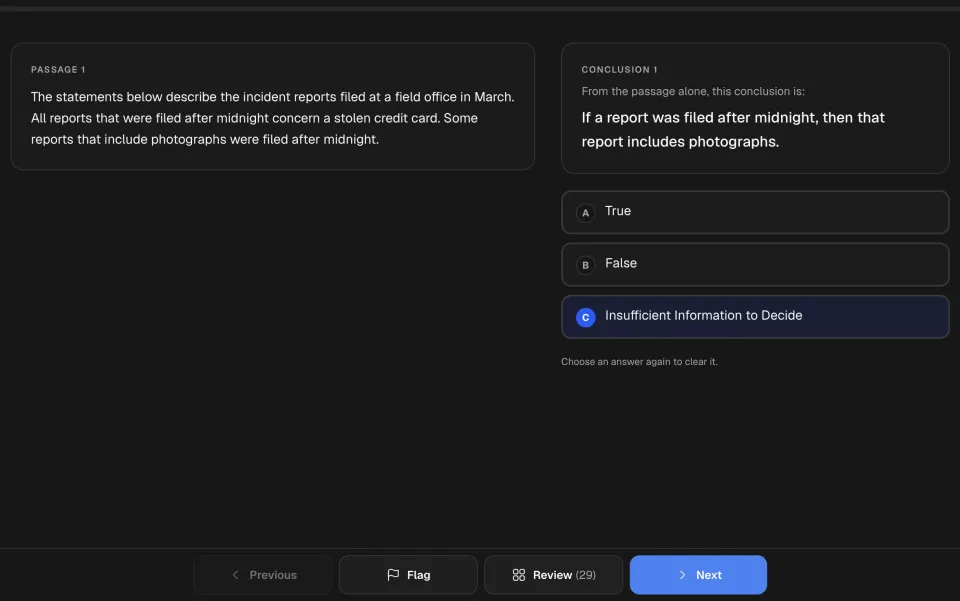
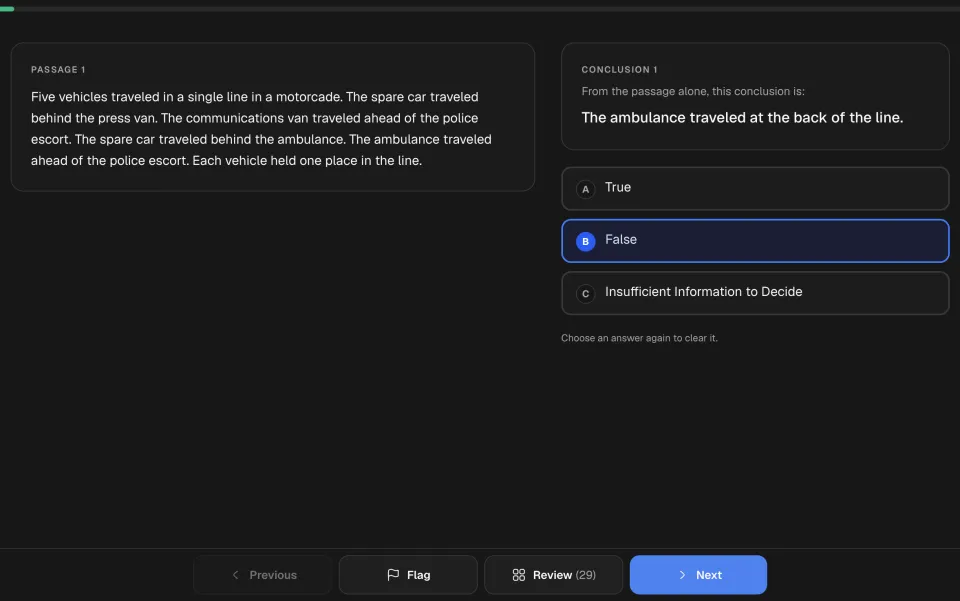
- Logic-Based Reasoning (30 questions in 40 minutes): conclusions from short passages, each judged True, False or Insufficient Information to Decide.
- Experience Inventory Part 1 (64 statements in 20 minutes): situations you may have met, rated from Never to Frequently or Routinely.
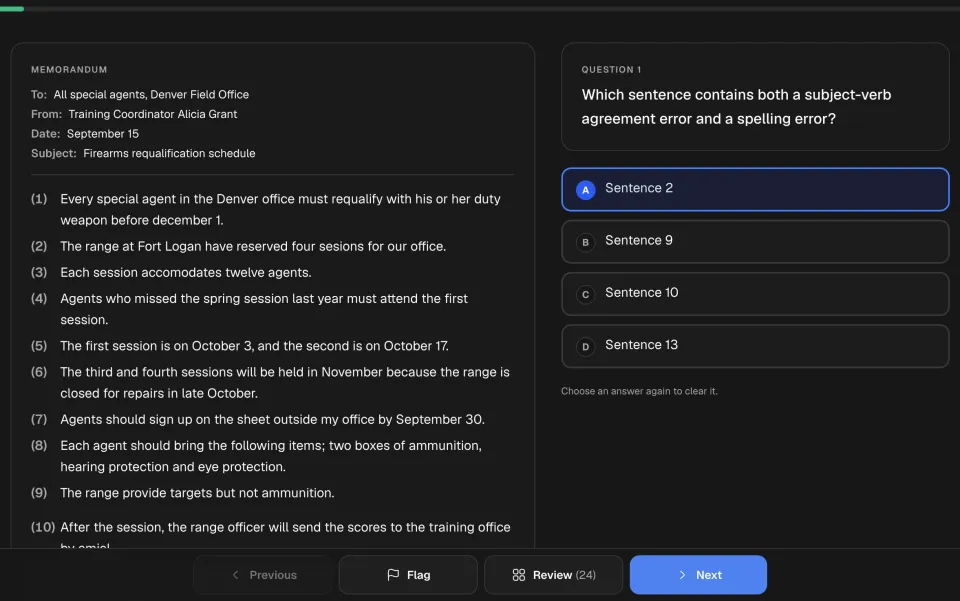
- Language Usage (25 questions in 40 minutes): errors in memoranda and summary reports with numbered sentences.
- Experience Inventory Part 2 (96 statements in 30 minutes): how your past supervisors or teachers would describe you, rated from Strongly disagree to Strongly agree.
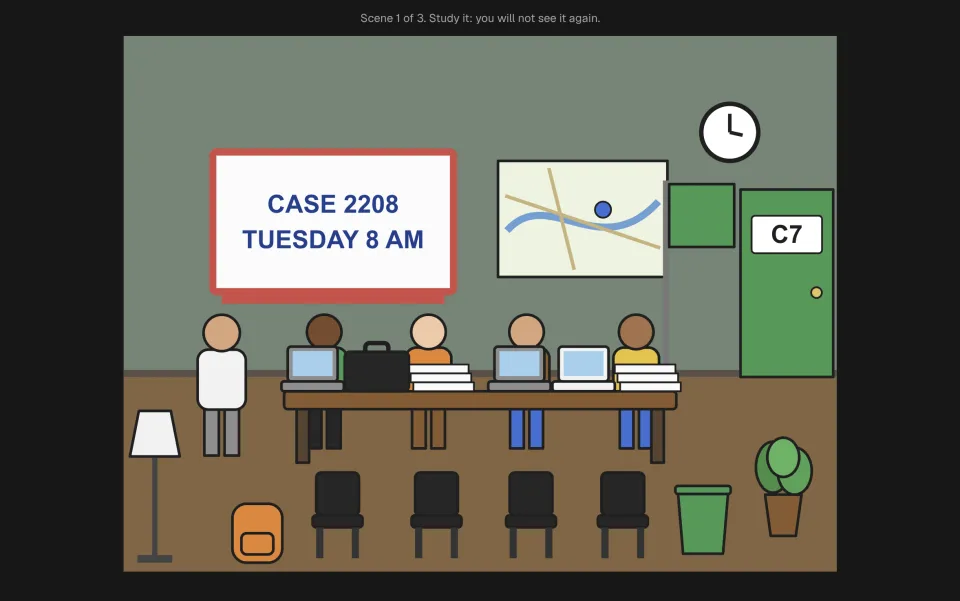
- Detail Observation (three photographs in about 40 minutes): study a scene, work through unrelated sentences, then answer questions on it from memory.
Three sections have right answers and can be practised. The two Experience Inventories describe you, and the Secret Service says there is no way to study for them. Wrong answers are not penalised anywhere, so answer every question.
Logic-Based Reasoning
Twelve short passages, each followed by one to four conclusions. You decide from the passage alone whether each conclusion is True, False or there is Insufficient Information to Decide. The passages are built from a handful of statement types: all, no, some, if-then and only. The skill is knowing exactly what each one allows. “All A are B” does not mean all B are A, and “some” means at least one, perhaps all.
Language Usage
You read memoranda and summary reports of up to sixteen numbered sentences with errors put in on purpose: spelling, agreement, apostrophes, semicolons and colons, capitals, plurals, word usage, tense, pronouns and sentence structure. Commas are not tested. Questions ask which sentence has no errors or a set number of them, where a paragraph should break and which sentence could be deleted with the least harm.
Detail Observation
For each of three colour photographs, a short description is read, then you study the scene for 2½ minutes with no notes. Next come 5 minutes of unrelated sentences, each cut into four parts, where you count the parts with an error. You cannot leave them early. Then you have 6 minutes of four-option questions about the photograph, which you do not see again.
The Experience Inventory
Part 1 asks how often you have been in a situation; Part 2 asks how your past supervisors or teachers would describe you. Some statements are there to detect inaccurate self-description, and the guide warns that your answers can be verified by others. The only preparation is to answer honestly, quickly and consistently.
How the day works
Pearson VUE emails an exam authorisation with a testing window, and you book a seat inside it. To reschedule or cancel, give at least 48 hours' notice. Arrive 30 minutes early with two current photo IDs, at least one signed. Phones, watches, bags, wallets and weapons stay out of the room.
Arriving more than 15 minutes late, giving less notice or missing the exam counts as a no-show: you are removed from consideration and must wait six months to test again.
Results and retakes
The result is pass or fail and appears on screen when you finish. No cut score is published. A pass stays valid unless the exam changes significantly. After a fail, the Secret Service lists a wait of three months and Pearson VUE six months, so follow the date in your own result notice, and you will need to apply again.
How to prepare
Start with Logic-Based Reasoning, because its statement types are learnable and the section comes first. Then work on Language Usage until you check every sentence in the same order. Practise Detail Observation on the real clocks, since the locked 5-minute interval is what makes recall hard. Finish with a full run of the three sections in exam order.
Practise the SAEE
Our Secret Service SAEE practice tests follow the exam as the Secret Service describes it: 30 conclusions in 40 minutes, 25 Language Usage questions in 40 minutes, Detail Observation on the 2½, 5 and 6 minute clocks, and the three together in exam order. Logic-Based Reasoning is free to start. If you are tempted by a shortcut, read why there is none on the SAEE first.