NYPD Memorization Test: A Ten-Minute Method
The NYPD exam shows you a street picture for ten minutes, then takes it away. How the questions work and a four-pass method to remember what they ask.
Of the nine abilities on the NYPD Police Officer exam, Memorization is the one candidates worry about most. You get a picture of a street, ten minutes and nothing to write with. Then the picture goes, and the questions start. It is also the most trainable part of the exam, because what it asks is predictable even when the picture is not.
How the picture questions work
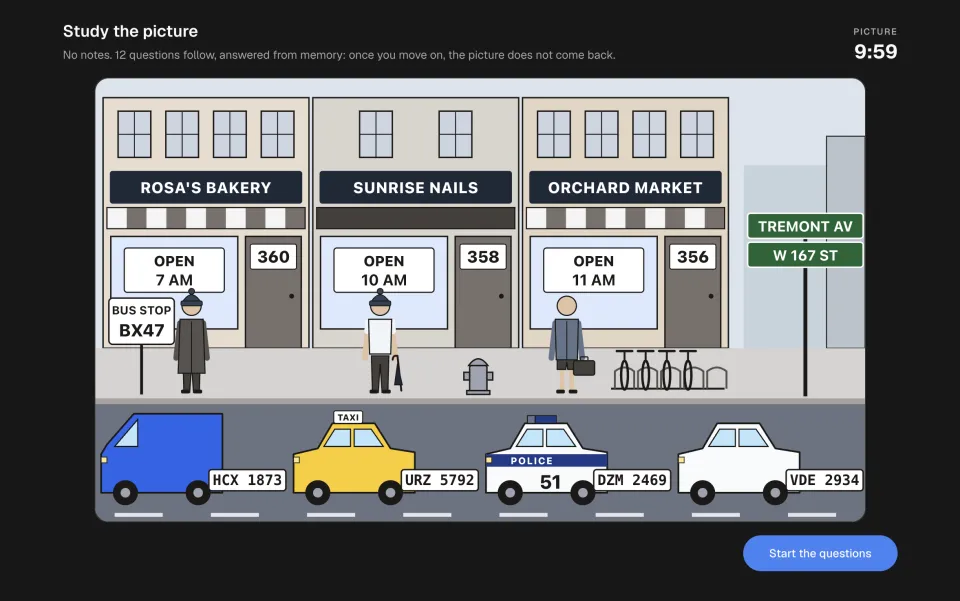
The NYPD's own exam tutorial shows the format. It tells you to study the picture for the next ten minutes, says you may not take notes or write anything, and asks the questions "without looking back at the picture". The picture is a photograph of a street scene: vehicles, people, signs and buildings.
DCAS does not publish how many memory questions the real exam has, or whether there is more than one picture. The tutorial has four questions on its one picture. Treat any figure you read elsewhere as a guess.
A warning about other advice: the five-minute written story some guides describe belongs to the New York State police exam, a different test. The NYPD exam uses a picture.
What the questions ask
The tutorial's questions ask for two things: counts, such as how many tyres or helmets you could see, and numbers printed in the scene, such as a precinct number. The wrong options are near misses. If the bus sign read M14, expect M41, M15 and M114 beside it: two digits swapped, one changed, one added. A rough impression will not separate them. You need the exact characters.
Beyond the tutorial, it is sensible to be ready for anything a police officer would note at a scene: words on signs and shop fronts, licence plates, where things stood in relation to each other, colours, and what each person was wearing and carrying.
A four-pass method for the ten minutes
The point of a method is that you do not decide what to look at while the clock runs. Sweep the picture the same way every time:
- Layout, left to right. Name every building, vehicle, sign and person in order, in your head. This gives you a map to hang the details on.
- Numbers and words. Read every number twice, digit by digit, and every sign word for word. Plates, door numbers, route numbers, precinct numbers and opening hours are the favourite targets because their near misses are easy to write.
- Counts. Count vehicles, people, bikes, windows and anything else that repeats, on purpose, and say the totals to yourself.
- People. Describe each person from top to bottom: hat, top, bottom, what they carry, and where they stand.
Then use whatever time is left to test yourself while the picture is still there: look away, recall one section, look back and check. Every miss you catch now is one you will not make in the questions.
How to practise
Remembering one picture well does not train the sweep. What improves your score is doing the four passes on many new scenes, under the same rules: ten minutes, no notes, then questions without looking back. Keep a note afterwards of which kind of detail you missed. You will usually find one weak spot, often the exact digits of a plate or the count of people, and that is where the next marks are.
The rest of the exam matters as much. Memorization is one of nine abilities, alongside deductive and inductive reasoning, problem sensitivity, information ordering, spatial orientation, Visualization, written comprehension and written expression. You need 70% to pass, and passers are ranked by score, so the marks you gain on the picture count exactly as much as any other.
Practise the picture study
Our free NYPD memorization drill draws a new street scene each sitting, with shops, a police car and its precinct number, plates, bikes and people, then asks 12 questions without it. You can see how long you studied and which kinds of detail you missed. When the picture feels comfortable, the full NYPD practice exam puts it a third of the way into a long paper, with the study on the same clock. If you are tempted by a shortcut, read why there is none on the NYPD exam first.