Back to Blogs
Guide7 min read

Fast Stream Work-Based Scenarios: How to Rate Each Action

How the Fast Stream work-based scenarios test works, what the four ratings mean, the published example taken apart, and a method for rating each action.

The short version
Work-based scenarios is one of the two Fast Stream online tests for 2027 entry, alongside the Case Study assessment.
You watch 12 short video scenarios and rate several possible actions in each, from Counterproductive to Effective.
It measures interpersonal skills, so the rating follows how an action treats other people as much as whether it fixes the problem.
It is untimed, you have seven days, and everyone gets feedback.

The work-based scenarios test is the half of the Fast Stream online stage that looks most like an ordinary situational judgement test, and that is where candidates lose marks. It is not asking which action is best. It asks you to rate every action on its own, and the Fast Stream says plainly what it is measuring: interpersonal skills.

How the test works

What you see
Short videos of work situations, with the characters speaking to you. Each one is a problem involving other people: a colleague, another team, a manager.
What you do
Rate the effectiveness of several possible actions for each scenario. Every action gets its own rating, so two actions can share one.
How many
12 scenarios.
Time
Untimed. Both online tests are released together, some days after you apply, and must be finished within seven days.
Results
Due in December 2026 for 2027 entry, with individual feedback for every candidate.

What the four ratings mean

The scale, in the Fast Stream's wording
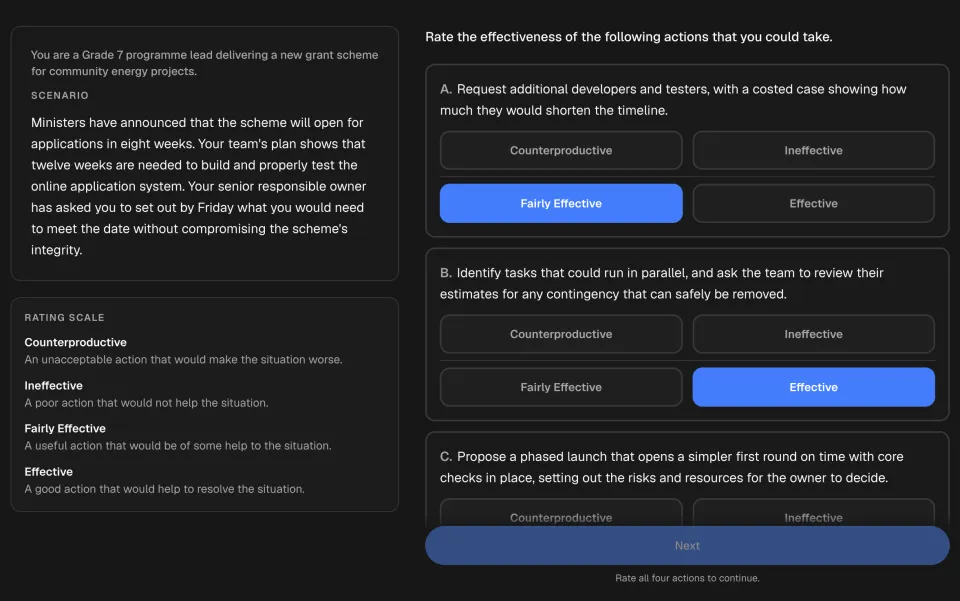
Counterproductive: an unacceptable action that would make the problem worse. Ineffective: a poor action that would not help. Partially effective: a useful action that would be of some help. Effective: a good action that would help resolve the situation.

Read the definitions as two questions. Does the action make things worse? If so, it is Counterproductive, however well meant. If not, how much does it help? Not at all is Ineffective, some help is Partially effective, and resolving the situation is Effective. The line most candidates blur is the first one: an action that does nothing is Ineffective, and only one that actively damages the situation or a relationship is Counterproductive.

The published example, taken apart

The Fast Stream publishes one worked item, written rather than filmed. You lead a team on a National Survey project that shares IT equipment with another department. A team member, Kamala, tells you the other department has taken on more work and booked far more time on the equipment, and that other teams have similar equipment sitting unused. The four actions and their published ratings:

Ask the other manager to find other equipment
Ineffective. It pushes the problem back to the other team without looking for a solution together.
Talk to the other manager and share a contact with spare equipment
Effective. An open conversation plus a practical alternative that works for both teams.
Ask colleagues to tell the other manager your project comes first
Ineffective. It might free some time, but it hands the burden to your colleagues instead of dealing with it yourself.
Ask colleagues to book as much time as they can
Counterproductive. It limits the other team, avoids the conversation and creates conflict.

Three of the four actions would get your team more time on the equipment. Only one is rated Effective, and it is the one that combines talking to the person directly with a solution that costs the other side nothing. The two Ineffective actions fail differently, one by avoiding collaboration and one by delegating a conversation that is yours to have. The Counterproductive one wins the resource by taking it.

A method for rating each action

1
Name the problem and who it affects
Before looking at the actions, say in one sentence what is wrong and whose interests are involved. In the example: your project is short of equipment time, and the other department has a genuine need too.
2
Rate each action on its own
Do not rank the list. Imagine each action is the only thing you do, and ask what happens next. Several actions can be Effective, and none might be.
3
Check the people cost first
Does the action damage a relationship, shift work onto someone else, go round a person rather than to them, or ignore someone’s legitimate need? Any of those pulls the rating down, often to Ineffective or below.
4
Then check how much it solves
An action that is decent but only addresses part of the problem, such as gathering information without acting on it, is usually Partially effective. Effective needs both a fair approach and a real route to resolving the situation.
5
Separate doing nothing from doing harm
Waiting, ignoring or a vague promise is usually Ineffective. Escalating a minor issue, taking unilateral control of a shared resource or publicly blaming someone tends to make things worse, which is Counterproductive.
6
Answer as you would act
The Fast Stream’s own advice from a current fast streamer is to respond to the scenarios as you would in real life. A consistent, honest pattern of judgement reads better than guessing what each item wants.

Patterns that tend to move a rating

Usually higher
Going to the person directly
A conversation with the person who owns the problem, held early and openly, is the backbone of most Effective actions.
Usually higher
Offering something, not just asking
An action that brings an alternative, a compromise or information the other side lacks beats one that only states your need.
Usually lower
Passing the problem on
Asking colleagues to deal with it, or bouncing it to the other team to solve, rarely rises above Ineffective.
Usually lowest
Winning by taking
Grabbing a shared resource, overriding someone or escalating to force an outcome tends to create conflict, the mark of Counterproductive.

Try one

This scenario is ours, not a Fast Stream item, but it is built the same way. You are finishing a briefing for a deadline tomorrow. A new colleague, Tom, has sent you his section late and it contains several factual errors. He mentions in passing that he has been struggling to find his feet. Rate each action before reading on.

A. Fix the errors yourself and say nothing
Partially effective. The briefing is saved, but Tom learns nothing and the same thing will happen next time.
B. Sit down with Tom, go through the errors together and agree how to check his next piece
Effective. It meets the deadline, deals with the cause and treats him fairly as someone new.
C. Forward his section to your manager and ask them to deal with it
Ineffective. It escalates something you can handle and leaves the deadline at risk.
D. Point out his errors in the team chat so everyone avoids them
Counterproductive. It embarrasses a struggling colleague in public and damages trust in the team.

If you rated A as Effective, that is the commonest slip in this format: an action that solves the task but ignores the person is only part of an answer in a test of interpersonal skill.

What to do, and what to avoid

Do
Watch the whole video before rating anything. Tone and what characters leave unsaid carry information.
Rate every action independently, and expect more than one to share a rating.
Ask who bears the cost of each action, not only whether it gets the job done.
Sit the tests on a laptop in one quiet session, using the untimed format to think.
Do not
Do not treat the list as a ranking with one right answer.
Do not rate an action Counterproductive just because it is weak. Weak is Ineffective.
Do not guess what the Civil Service wants to hear. Answer as you would act.
Do not use generative AI while sitting the test.

How to practise

Nobody outside the Civil Service has the Fast Stream test, and we do not simulate it. The closest format we offer is the Civil Service Judgement Test, which also asks you to rate four actions per scenario on a four-point scale running from Counterproductive to Effective, though in written scenarios built around the Civil Service behaviours rather than on video. Our guide to situational judgement answer formats explains why rating each action is scored differently from picking a best answer.

The other online test works quite differently: read our guide to the Fast Stream case study assessment. For the whole process, from application to Final Selection Board, see the Fast Stream stage by stage, and for the next step if you pass, our Fast Stream Assessment Centre guide.

Frequently asked questions

Is the Fast Stream work-based scenarios test timed?

No. Both Fast Stream online tests are untimed. You have seven days from the moment they are released to complete them, and the Fast Stream guidance video puts the two tests together at around an hour and a half.

What is the pass mark for the work-based scenarios test?

Not published. The Fast Stream says the process is highly competitive and that your feedback describes your performance rather than whether you will progress.

Do you get feedback on the Fast Stream online tests?

Yes, whether or not you are successful. The feedback reflects your individual performance, highlights your strengths and gives tips for the future. Results for 2027 entry are due in December 2026.

Is it the same as the Civil Service Judgement Test?

No. The Civil Service Judgement Test is used for ordinary Civil Service Jobs vacancies and is built around the behaviours on the job advert. The Fast Stream test is its own, uses video, and is aimed at interpersonal skills. The answer format, rating every action on a four-point scale, is very similar.

Can I use ChatGPT or another AI tool during the test?

No. The Fast Stream allows generative AI for preparation but not while you complete any test or assessment, and says an application may be withdrawn if it suspects AI was used.
Ready to Start Practicing?

Apply these strategies with our comprehensive practice platform

Start Practising Free