Fast Stream Case Study Assessment: How the Evolving Scenario Works
How the Fast Stream case study assessment works: the background pack, the evolving situations, both answer formats, and a method for keeping track.
The name misleads people. The Fast Stream case study assessment is not a written case study and not a case interview. It is a situational judgement test in which every question belongs to the same story, and the story moves. What you read at the start keeps mattering after new facts arrive, which is exactly the skill being measured.
How the test works
Why the evolving scenario changes how you answer
In a standard judgement test each scenario starts from nothing, so a mistake on one costs you that item only. Here the situations build on each other and on the background pack. A deadline mentioned in the second document, a stakeholder's stated priority, or a budget limit can decide which response is effective twenty situations later. Candidates who skim the background and then judge each situation on instinct give answers that would be reasonable in isolation and wrong in context.
Adapting is the other half. When a situation tells you something has changed, such as a minister's new priority, a partner pulling out or a figure turning out to be wrong, the effective response usually acknowledges the change and adjusts the plan rather than defending the earlier one. Sticking to a decision after its basis has gone is the commonest way to pick the least effective option as your most effective.
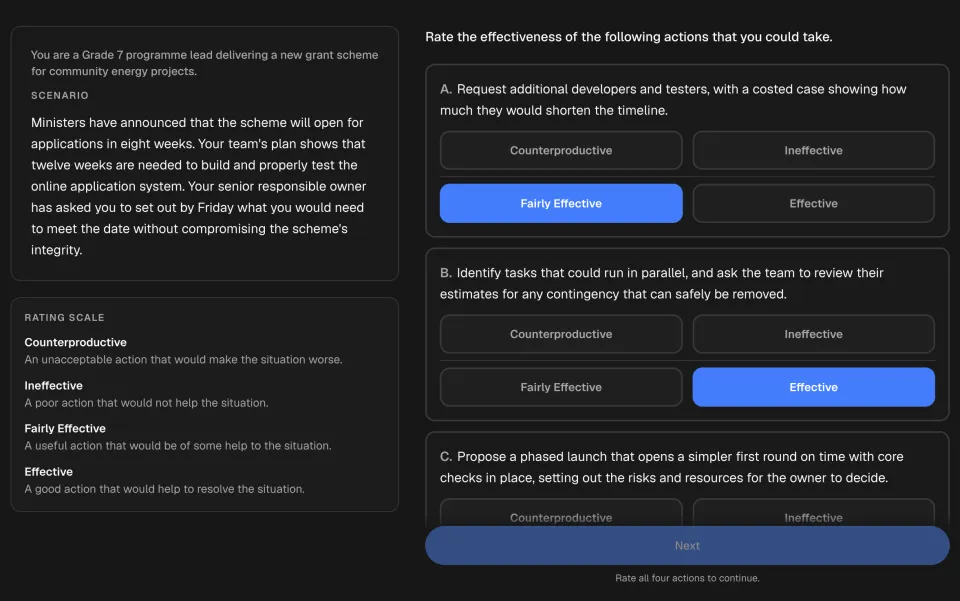
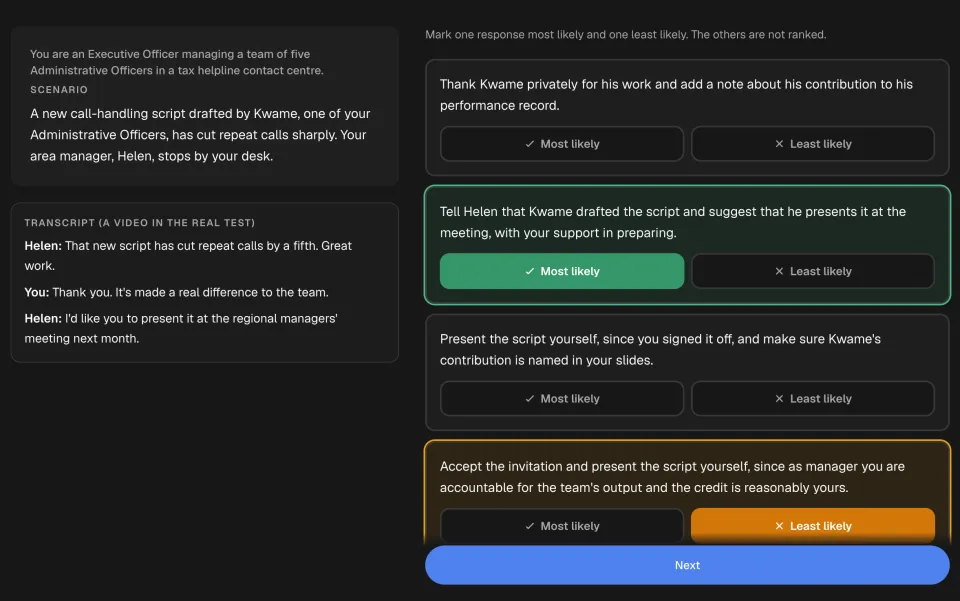
Two answer formats in one test
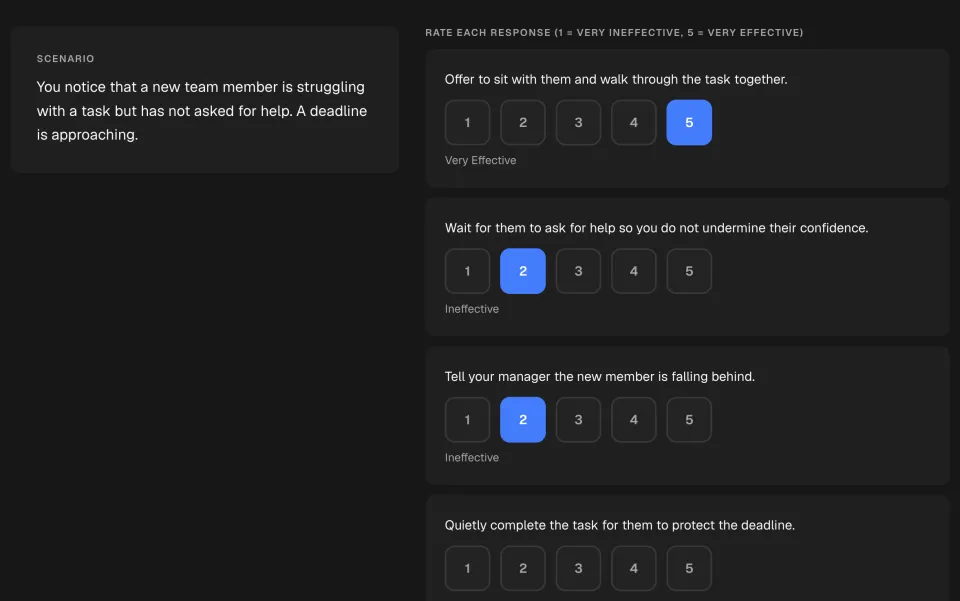
The rating scale and its definitions are the same ones used in the work-based scenarios test, so the habits you build for one carry over. The difference is the reason behind the rating: there it is mostly how an action treats people, here it is mostly whether the decision fits the goals, constraints and latest facts of the case.
A method for the whole test
What goes on the case sheet
Try one
This is our own situation, not a Fast Stream item. The background told you that you are coordinating a pilot of a new online service, due to launch in six weeks, and that the project sponsor has said accessibility must not be compromised. Situation 9: user testing shows that screen-reader users cannot complete the main form. The supplier says a fix will take four weeks. Choose the most and least effective response.
Most effective: B. It respects the constraint the background set, involves the person who owns the decision, and still moves the project. Least effective: A. It knowingly breaks the one condition the sponsor stated. C is a reasonable start but leaves the sponsor in the dark on a risk to the launch, and D delays the real decision without a reason to doubt the result.
What to do, and what to avoid
How to practise
We do not simulate the Fast Stream case study assessment, and nothing public reproduces an evolving 24-situation scenario. The two answer formats can be practised separately: the Civil Service Judgement Test uses the same rate-each-action format on a four-point scale, and the Management Judgement Test asks for a most and least choice, though it asks what you would be most and least likely to do rather than what is most and least effective. Our guide to situational judgement answer formats explains how the formats are scored.
For the rest of the process, see the Fast Stream stage by stage and, if you pass the online tests, our Fast Stream Assessment Centre guide.
Frequently asked questions
What is the Fast Stream case study assessment?
One of the two Fast Stream online tests. You take on an imaginary role, read seven pieces of background information, then respond to 24 situations in one evolving scenario. It assesses decision-making and your ability to adapt to changing circumstances.
Is the Fast Stream case study the same as the assessment centre written exercise?
No. The case study assessment is an online situational judgement test at the first stage, answered by choosing and rating responses. The Written Exercise comes later, at the Fast Stream Assessment Centre, where you write your own answers to a set of tasks in 55 minutes.
How long does the case study assessment take?
It is untimed. You have seven days to complete both online tests, and the Fast Stream guidance video puts the two together at around an hour and a half.
Can I use AI tools during the case study assessment?
No. The Fast Stream allows generative AI for preparation but not during any test or assessment, and an application may be withdrawn if it suspects AI was used.
What is the pass mark?
Not published. Everyone receives feedback on their performance, but the feedback does not say whether you will progress, because the process is highly competitive.