Border Patrol Entrance Exam: What to Expect
The Border Patrol Agent exam is an Experience Record and a 120-minute adaptive Logical Reasoning Test. What is on it, how it is scored and how to prepare.
If you have applied to be a Border Patrol Agent, your first scored step is the Border Patrol Agent entrance exam, set by US Customs and Border Protection. It is shorter than many candidates expect: two parts, no maths and, these days, no language test. Here is what is on it, how the adaptive reasoning test works and how to prepare.
Two parts, sat separately
The exam starts with the Experience Record, up to 40 minutes online at home, which you must complete within a few days of the invitation email. Check the email for your exact deadline. It asks about your background and experience, not about the job, and CBP says you do not need to know how to do the job to sit it.
Then comes the Logical Reasoning Test, up to 120 minutes. You have 14 days to schedule and complete it, at home or at a test centre. CBP suggests allowing about four hours for the whole appointment. If you take it at home, once you click the link you cannot reschedule or cancel, so open it only when you are ready to finish.
No Spanish test and no maths
You may read about a Spanish Language Proficiency Test or an Artificial Language Test. Both belong to the old paper exam. Border Patrol work does need Spanish, but you learn it and are tested on it at the academy, not in the entrance exam. There is no arithmetic section either: the scored test is reasoning only.
What the Logical Reasoning Test asks
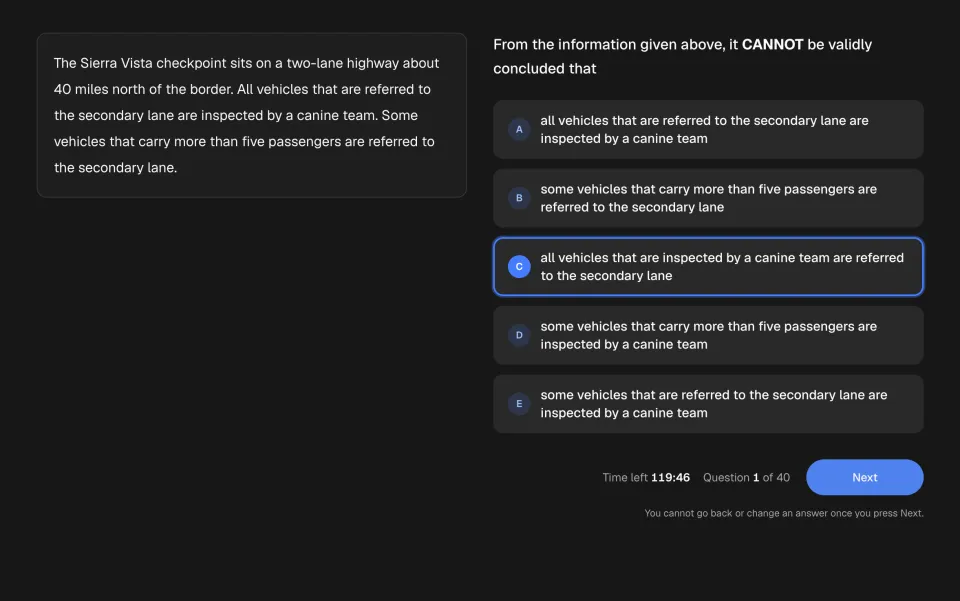
Every question is a short paragraph, often on border, customs, weapons or agency rules, followed by a lead-in and five options. The usual lead-in is "From the information given above, it can be validly concluded that", and you choose the one option that must be true. Some questions say "it CANNOT be validly concluded that", and you choose the one that does not follow.
You must use only the paragraph and accept every fact in it as true. The test is about how statements behave: "all" never reverses, "no" always does, "some" never names a particular person or thing, and an if-then statement gives you its contrapositive but not its converse. It is the same kind of question CBP Officer candidates sit, on a longer clock. Our CBP Logical Reasoning Test guide has a worked example and a method.
How the adaptive test works
The first question is of average difficulty. After each answer the test updates its estimate of you and picks the next question to match. You cannot go back to a submitted answer, and you cannot skip: you must give your best guess to move on. There is no penalty for guessing.
How many questions, and how to pace them
CBP does not publish the number of questions. Its pacing advice is about three minutes a question, which points to about 40 in the 120 minutes. A 2018 guide gave 31. Either way, the plan is the same: keep near three minutes a question, and when one runs long, rule out what you can and choose.
Scoring and what comes next
You need a score of at least 70 to go on, on a scale CBP does not publish, so it is not 70% correct. If you fail, you can sit the exam again after 90 days. After the exam come the later stages, including fitness tests, a medical, a polygraph and a background investigation, and then about six months at the academy in Artesia, New Mexico.
How to prepare
Spend your time on the Logical Reasoning Test, because it is the part practice improves. Learn the rules for "all", "no", "some" and if-then statements first, then practise whole paragraphs on a clock until you can work through one in about three minutes. Practise the negative lead-in too: missing the word CANNOT is the easiest way to lose a mark you had earned.
For the Experience Record there is nothing to learn. Answer accurately and consistently, and have your dates and job history to hand.
Practise the Logical Reasoning Test
Our CBP Officer and Border Patrol practice testhas a Border Patrol Agent version: 40 questions in 120 minutes, a count that is ours from CBP's pacing advice, adaptive, with no going back or skipping and more border and patrol paragraphs. It is free to start, and you get our estimated score out of 100, which is not CBP's score, with feedback on which kinds of statement cost you marks. If you are tempted by a shortcut, read why there is none on the CBP exams first.