
Free CBP Officer and Border Patrol Practice
US Customs and Border Protection sets one entrance exam for CBP Officers and one for Border Patrol Agents. Since February 2024 there is no maths: both are about reading a short paragraph and deciding what follows from it, and CBP Officer candidates also sit a writing test first. Both tests are adaptive, so you cannot go back or skip, and you need a score of at least 70 to go on.
Also called the CBP entrance exam, the CBPO exam, the CBP POEE, the customs officer exam, the Border Patrol test or the BPA exam.
Free CBP Practice Test
Free to try with a free account, in either the CBP Officer or the Border Patrol Agent version. Unlock this provider for unlimited practice.
Premium CBP Practice Test
What Is on the CBP Entrance Exam?
Each part is sat on its own, days apart, and each deadline runs from the last part, so check every email for your window. All parts can be taken online at home or at a test centre. The times are maximums, and many candidates finish sooner.
CBP Officer
1. Candidate Experience Record
Up to 60 minutes at home, within a few days of the invitation email. Questions about your background and experience.
2. Writing Skills Test
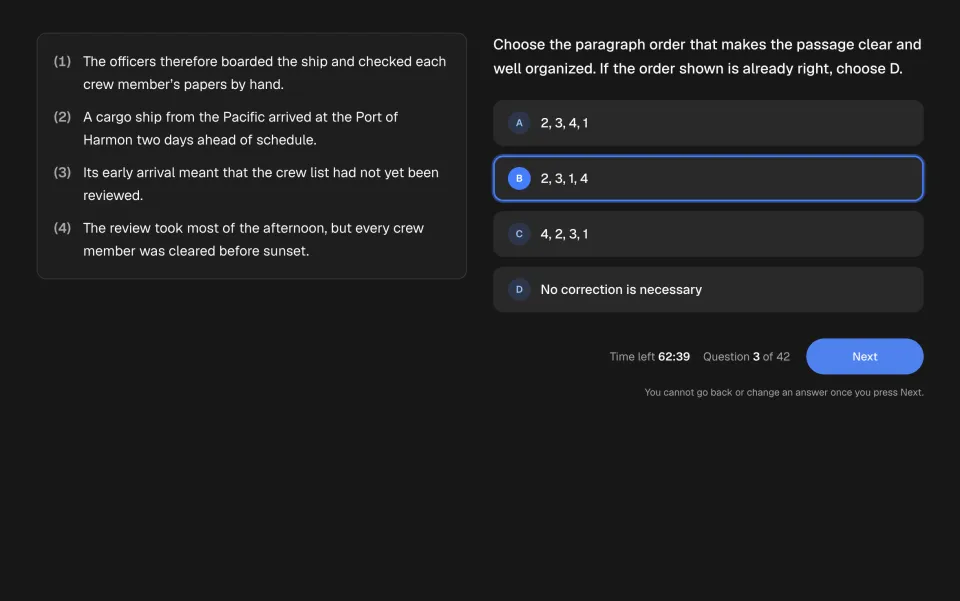
Up to 63 minutes, adaptive, four options. Grammar, punctuation, sentence choice and paragraph order. A gate: fall short and you are not invited to the last part.
3. Logical Reasoning Test
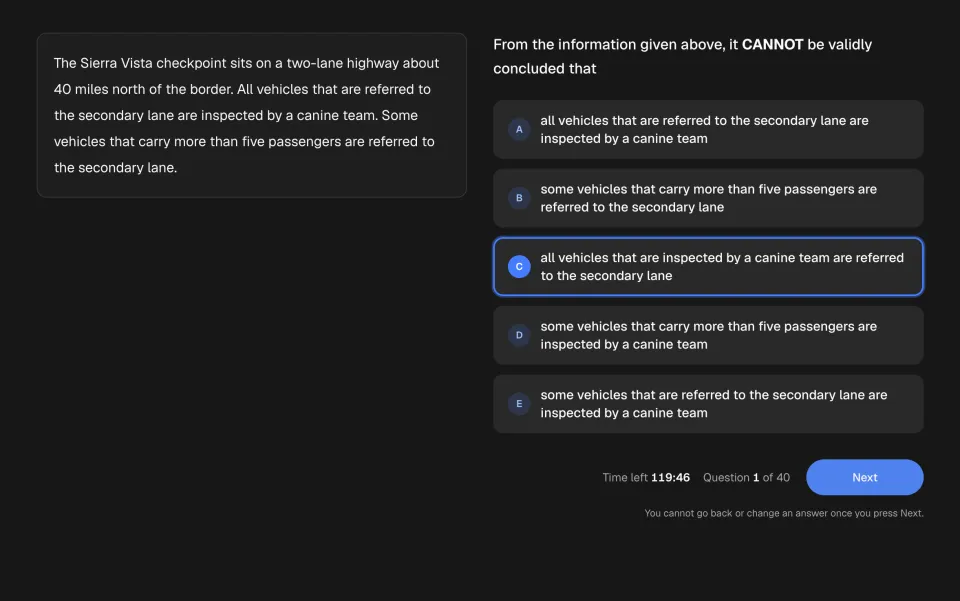
Up to 83 minutes, adaptive, five options. A short paragraph, then the one conclusion that follows, or the one that does not.
Border Patrol Agent
1. Experience Record
Up to 40 minutes at home, within a few days of the invitation email. Questions about your background and experience.
2. Logical Reasoning Test
Up to 120 minutes, adaptive, five options. The same kind of question as the CBP Officer test, on a longer clock.
How the CBP Adaptive Tests Work
Each answer sets the next question
The first question is of average difficulty. After each answer the test updates its estimate of you and picks the next question to match, so two candidates rarely see the same set. Do not judge how you are doing by how hard the questions feel.
No going back, no skipping
You cannot return to a question once you submit it, and you must answer each one to move on. There is no penalty for guessing, so a reasoned guess always beats running out of time.
Writing Skills is a gate
CBP Officer candidates who do not score high enough on the Writing Skills Test are removed from the process and never sit the Logical Reasoning Test. Border Patrol Agent candidates do not sit a writing test.
A score of 70, then a category
You need a score of at least 70 on a scale CBP does not publish, so it is not 70% correct. Passing candidates are placed in referral categories, with veterans' preference applied within them. If you fail, you can retest after 90 days.
The CBP Candidate Experience Record
The first part of both exams asks about your background and experience, not about the job. CBP says you need no knowledge of the work and do not need to prepare. It is sat online at home, and you can leave and come back to it within its window.
We do not offer practice for it. Its scoring key is not published, and a made-up key would coach you towards answers that may not be right for you. Answer accurately and consistently, as you would describe yourself in an interview, and keep your dates and job history to hand.
How to read a Logical Reasoning paragraph
Accept every statement in the paragraph as true, even if it sounds wrong, and use nothing you know from outside it. Then read the lead-in: "it can be validly concluded that" wants the one option that must follow, and "it CANNOT be validly concluded that" wants the one that does not. Most questions turn on these five rules.
"All" and "every"
Never reverse. "All inspected trucks are logged" does not mean every logged truck was inspected. The contrapositive does follow: an unlogged truck was not inspected.
"No" and "none"
Always reverse. "No sealed container is opened at the dock" means no container opened at the dock is sealed.
"Some"
Means at least one, and says nothing about the rest. "Some" never tells you about a named person or item, and "some are" does not mean "some are not".
If-then
Works like "all". The contrapositive follows; the converse and the inverse do not.
"Only", "unless" and double negatives
Rewrite them as plain if-then statements before you read the options. "Only travelers with a permit may enter" means: if a traveler enters, the traveler has a permit.
A worked example
All cargo containers arriving at the Port of Harmon from a foreign port must be scanned before release. Some containers that are scanned are also opened for physical inspection. No container that has been opened for physical inspection may be released on the day it arrives. Container 4417 arrived at the Port of Harmon from a foreign port this morning.
From the information given above, it can be validly concluded that
- A) container 4417 will be opened for physical inspection
- B) container 4417 must be scanned before it is released
- C) some containers released on the day they arrive were opened for physical inspection
- D) every container that is scanned arrived from a foreign port
- E) container 4417 will not be released today
The answer is B. A treats "some" as if it named this container. C contradicts the "no" statement. D reverses an "all" statement. E would follow only if the container were opened, which the paragraph does not say.
CBP Entrance Exam Tips
- Read the lead-in before the options, and check the word CANNOT every time. Missing it turns a right method into a wrong answer.
- Pace at about three minutes a Logical Reasoning question and about a minute and a half a Writing Skills question. When you pass that mark, rule out what you can and choose.
- The old advice to avoid options with "all" or "none" in them is wrong here. Judge every option against the paragraph.
- On Writing Skills, "No correction is necessary" is a real answer. Check agreement, pronouns and commas before you choose it, and do not invent an error to fix.
- At home, sit alone in a quiet room on a desktop, laptop or tablet. Once you open the Writing Skills or Logical Reasoning Test, you must finish it.
CBP Entrance Exam FAQs
Is there maths on the CBP Officer exam?
No. The Arithmetic Reasoning test was dropped when the new exam took effect on 1 February 2024. The CBP Officer exam is now the Candidate Experience Record, the Writing Skills Test and the Logical Reasoning Test.
What are the parts of the CBP exam, and how long is each?
For CBP Officer: the Candidate Experience Record (up to 60 minutes), the Writing Skills Test (63 minutes) and the Logical Reasoning Test (83 minutes). For Border Patrol Agent: the Experience Record (40 minutes) and the Logical Reasoning Test (120 minutes). Many candidates finish each part in less time.
How many questions are on the CBP entrance exam?
Not published. CBP’s pacing advice of about three minutes a question points to about 28 Logical Reasoning questions for CBP Officer and about 40 for Border Patrol Agent, and about a minute and a half a question points to about 42 Writing Skills questions.
What score do I need to pass the CBP exam?
A score of at least 70. CBP does not publish the scale, so it is not the same as 70% correct. Passing places you in a referral category; it does not guarantee selection.
Can I go back or skip questions?
No. Both tests are adaptive: you cannot return to an answer once submitted, and you must answer each question to move on. There is no penalty for guessing, so when you are stuck, rule out what you can and choose.
Can I take the CBP exam at home?
Yes. All parts can be taken online at home, alone and with no outside aids, or at a test centre if you switch at least 24 hours before your appointment. Once you open the Writing Skills or Logical Reasoning Test, you must finish it.
How do I prepare for the Candidate Experience Record?
CBP says you do not need to. It asks about your background and experience, not what you know about the job. Answer accurately and consistently; there is nothing to learn for it.
If I fail the CBP exam, when can I retake it?
After 90 days. Results from before 1 February 2024 are no longer valid, so anyone who sat the older exam takes the current one.
Do Border Patrol applicants still take a Spanish test?
Not in the entrance exam. Border Patrol agents learn Spanish and are tested on it at the academy. The Artificial Language Test belongs to the old paper exam and is no longer part of it.
Applying to the Border Patrol? Read our Border Patrol Agent entrance exam guide. Wondering whether there is a shortcut? Read can you cheat the CBP entrance exam.
How Our CBP Exam Practice Works
The real rules. Both tests are adaptive, start at average difficulty, and let you neither go back nor skip. CBP does not publish its question counts, so ours come from its pacing advice: Logical Reasoning is 28 questions in 83 minutes for CBP Officer or 40 in 120 minutes for Border Patrol Agent, and Writing Skills is 42 questions in 63 minutes.
An estimate, not CBP's score. You get our estimated score out of 100. It is not CBP's score, and CBP's pass mark of 70 is on a scale it does not publish, so we draw no pass line. Feedback shows which kinds of statement or writing error cost you marks and what to do about them.
Every question is our own. Logical Reasoning paragraphs are generated fresh each sitting, about cargo, ports, patrols and travelers, with every option checked by a logic solver. Writing Skills sentences and passages are written for practice. Questions are in American English, as the real tests are.
Companies That Use CBP Officer and Border Patrol
These exams belong to one employer. US Customs and Border Protection sets them for its two frontline jobs: CBP Officers at ports of entry and Border Patrol Agents between them.
US Customs and Border Protection
Government & Public SectorUses the CBP Officer Entrance Exam (Writing Skills, Logical Reasoning and the Candidate Experience Record) for CBP Officer applicants, and the Border Patrol Agent Entrance Exam (Logical Reasoning and an Experience Record) for Border Patrol Agent applicants.
Some higher-grade CBP Officer announcements use written questions about your experience instead of the exam, so check the announcement you are applying to.
Guides and Tips
Read up before you practise: what the tests reward, what catches candidates out, and why shortcuts do not work.
CBP Logical Reasoning Test: how it works
The reasoning test in both CBP entrance exams: a short paragraph, five conclusions, and the one that must follow from it, or the one that does not.
Can You Cheat the CBP Entrance Exam?
Adaptive questions with controlled exposure, no going back and no outside aids. Why no shortcut survives the CBP Officer or Border Patrol exam.
CBP Writing Skills Test: how it works
The CBP Officer exam’s writing test, and its gate: grammar, punctuation, sentence choice and paragraph order, four options a question.
Border Patrol Entrance Exam: What to Expect
The Border Patrol Agent entrance exam is two parts: an Experience Record at home, then an adaptive Logical Reasoning Test of up to 120 minutes. No Spanish test and no maths.
Practice by Test Type
Compare the same format across every provider that uses it, and see what each one is really measuring.
Verbal Reasoning Test Practice
Short dense passages and true, false or cannot say answers. Judged on what the text supports, never on what you already know.
Logical Reasoning Test Practice
The umbrella name on many invitations. Covers the four rule-based formats and how to tell which one you have actually been sent.
About CogniPrep CBP Exam Practice
CogniPrep provides practice for the Logical Reasoning Test and the Writing Skills Test of the US Customs and Border Protection entrance exams: the CBP Officer Entrance Examination and the Border Patrol Agent Entrance Examination. Candidates search for them as the CBP entrance exam, the CBPO exam, the CBP POEE, the customs officer exam, the Border Patrol test or the BPA exam. CogniPrep is not affiliated with US Customs and Border Protection, OPM or Talogy.
- 2 practice tests: CBP Logical Reasoning Test, CBP Writing Skills Test
- Logical Reasoning: five options, positive and negative lead-ins, adaptive
- Writing Skills: four options, corrections, correct sentences and paragraph order
- Roles: CBP Officer (GS-5 and GS-7) and Border Patrol Agent (GL-5 and GL-7)
Ready to Start Practising?
Sign up for free to try the Logical Reasoning Test in the CBP Officer or Border Patrol Agent version, or unlock the Writing Skills Test as well, with unlimited sessions.