
UCAT Practice Test and Full Mock
The UCAT is the admissions test for most UK medical and dental schools, and as UCAT ANZ for medicine, dentistry and clinical science degrees in Australia and New Zealand. It is four separately timed subtests, 184 questions in just under two hours, with no negative marking. Practise each subtest at its real length and timing, or sit the full mock.
Also sat as UCAT ANZ in Australia and New Zealand, and formerly called the UKCAT. This is the medical and dental admissions UCAT, not Criteria's Universal Cognitive Aptitude Test, an employer test.
Free Test
Free to try with a free account. Unlock this provider for unlimited practice.
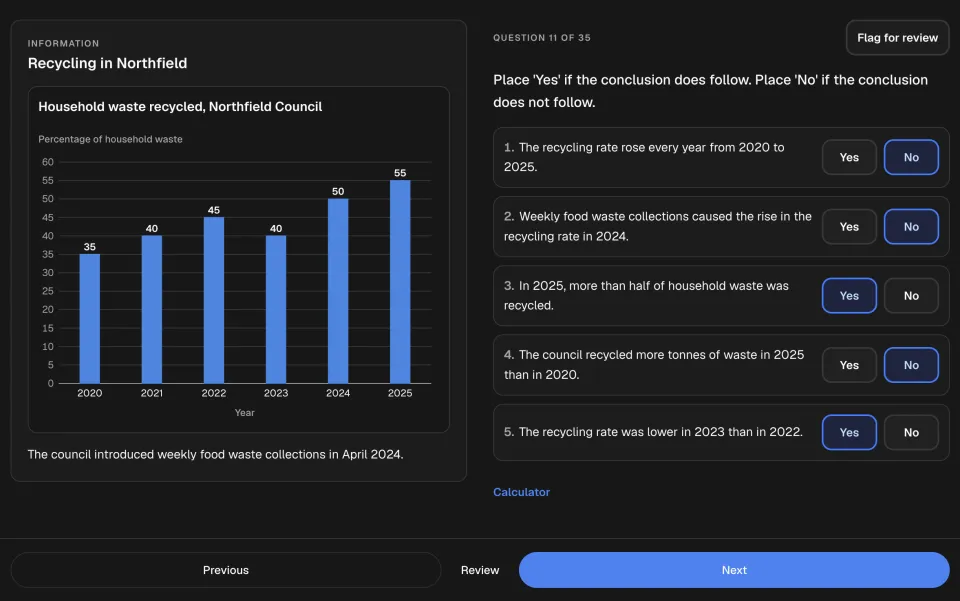
UCAT Decision Making
The UCAT Decision Making subtest: 35 questions in 37 minutes on syllogisms, interpreting information, logical puzzles, statistical reasoning, the strongest argument and Venn diagrams, with a basic on-screen calculator. Five-statement questions score 2, 1 or 0.
Premium Tests
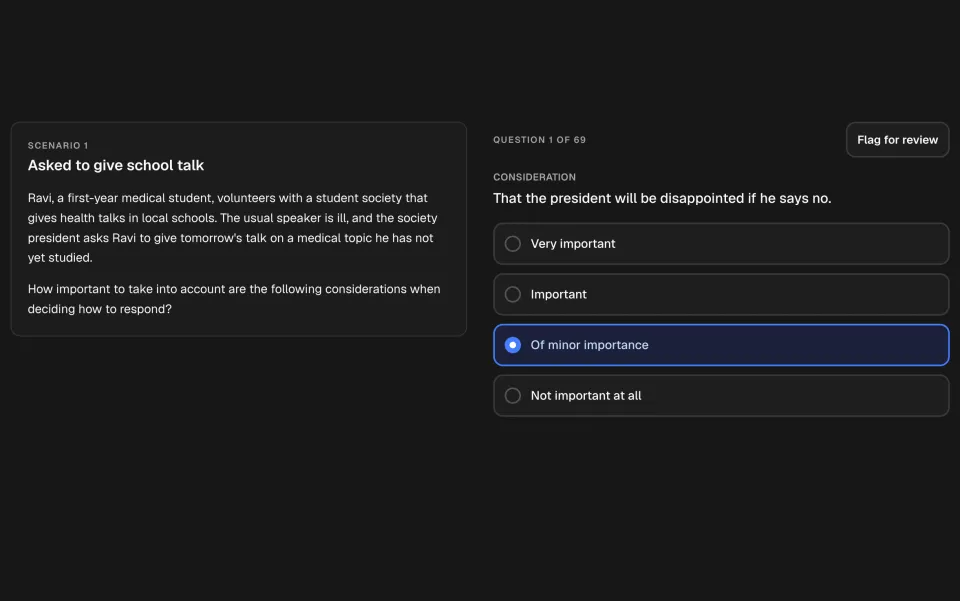
UCAT Situational Judgement
The UCAT Situational Judgement subtest: 69 questions in 26 minutes on scenarios from medical and dental training. Rate how appropriate an action is or how important a consideration is, or pick the most and least appropriate of three.
The UCAT in 2026
Four multiple-choice subtests, sat in this order on a computer, mostly at a Pearson VUE test centre. Each has its own clock and opens with a short timed instruction screen. Once the test starts it cannot be paused.
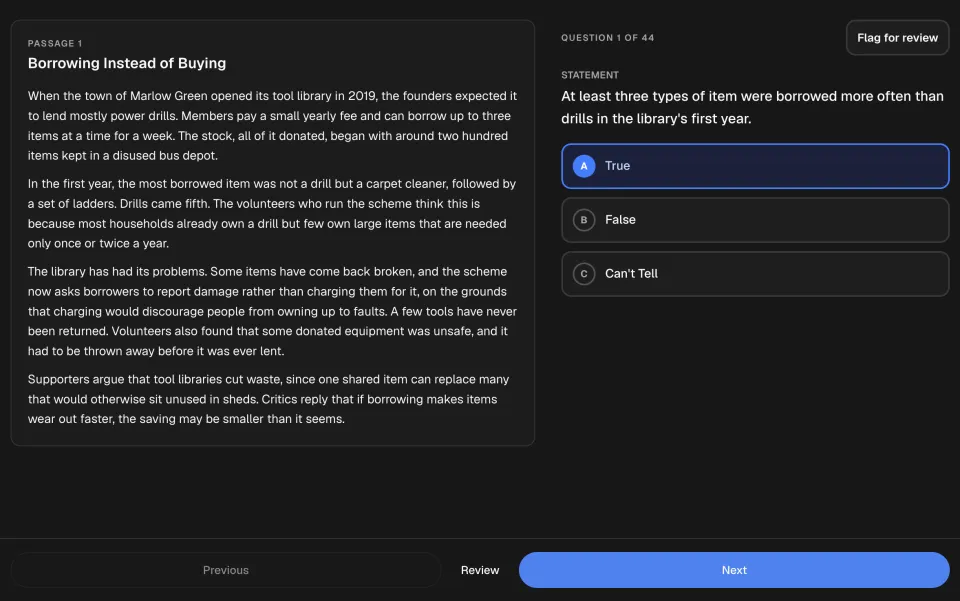
Verbal Reasoning
44 questions in 22 min
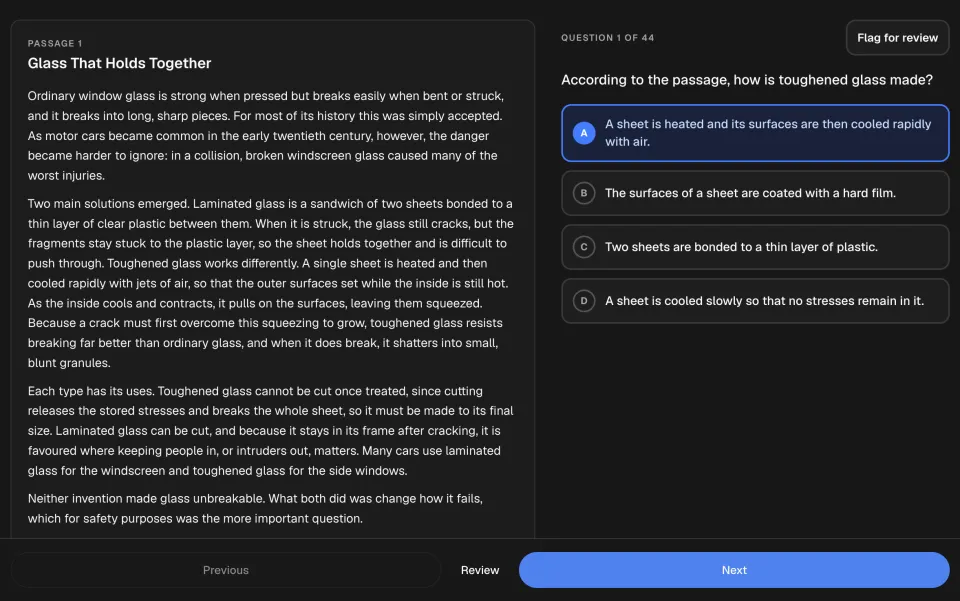
Eleven passages with four questions each. Most questions have four options; some ask whether a statement is True, False or Can't Tell from the passage alone. No outside knowledge is needed.
Decision Making
35 questions in 37 min
Syllogisms, interpreting information, logical puzzles, statistical reasoning, recognising the strongest argument and Venn diagrams. Some questions have one answer; others ask Yes or No against five statements.
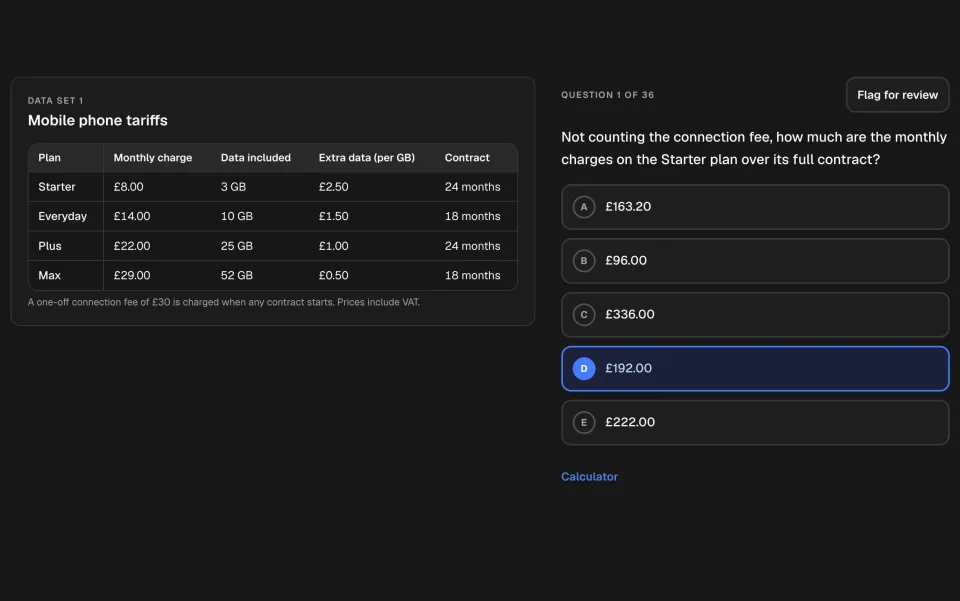
Quantitative Reasoning
36 questions in 26 min
Questions mostly in sets of four on one table or chart, plus a few that stand alone. The consortium says it is less about number skills and more about problem solving.
Situational Judgement
69 questions in 26 min
Scenarios from medical and dental training. Rate how appropriate an action is or how important a consideration is, or pick the most and least appropriate of three. No medical knowledge is needed.
A basic on-screen calculator is available in Decision Making and Quantitative Reasoning. You can flag any question, move back and forth within a subtest, and use a review screen to return to flagged or unanswered questions before the clock runs out. The test is not adaptive: how you answer one question does not change which questions come next. The UK and ANZ tests are identical in content.
UCAT timings, including extra time
The consortium publishes four timing versions: standard, and 25%, 33% or 50% extra time for candidates with approved access arrangements. The instruction screens stay the same length in every version.
| Subtest | Questions | Standard | +25% | +33% | +50% |
|---|---|---|---|---|---|
| Verbal Reasoning | 44 | 22 min | 27 min 30 s | 29 min 20 s | 33 min |
| Decision Making | 35 | 37 min | 46 min 15 s | 49 min 20 s | 55 min 30 s |
| Quantitative Reasoning | 36 | 26 min | 32 min 30 s | 34 min 40 s | 39 min |
| Situational Judgement | 69 | 26 min | 32 min 30 s | 34 min 40 s | 39 min |
| Questions in total | 184 | 111 min | 138 min 45 s | 148 min | 166 min 30 s |
| Whole sitting | 117 min 30 s | 145 min 15 s | 154 min 30 s | 173 min |
The whole sitting adds 6 min 30 s of instruction screens: 1 min 30 s before Verbal Reasoning, Decision Making and Situational Judgement, and 2 min before Quantitative Reasoning. Rest breaks of 20, 25 or 30 minutes can also be approved. Every test here lets you pick any of the four versions before you start. Read more on getting extra time on the UCAT.
What a UCAT score means
Verbal Reasoning, Decision Making and Quantitative Reasoning are each scored from 300 to 900, and the three add up to a total from 900 to 2,700. Situational Judgement is reported separately: as Band 1 to 4 in the UK, Band 1 the best, and as a score from 300 to 900 in UCAT ANZ. Here is where 2026 UK scores fell, from 42,359 tests.
| Decile | Total | VR | DM | QR |
|---|---|---|---|---|
| 1st | 1,590 | 500 | 520 | 530 |
| 2nd | 1,700 | 540 | 560 | 580 |
| 3rd | 1,780 | 560 | 590 | 600 |
| 4th | 1,850 | 580 | 620 | 640 |
| 5th (median) | 1,920 | 600 | 640 | 670 |
| 6th | 1,980 | 620 | 670 | 700 |
| 7th | 2,050 | 640 | 690 | 730 |
| 8th | 2,140 | 670 | 710 | 780 |
| 9th | 2,250 | 710 | 760 | 820 |
A total of 2,250 put you in the top 10% in 2026; 1,920 was the middle. The 2026 averages were 1,918 for the total, 602 for Verbal Reasoning, 640 for Decision Making and 675 for Quantitative Reasoning. In Situational Judgement, 15% of UK candidates were in Band 1, 40% in Band 2, 34% in Band 3 and 11% in Band 4.
How universities use it
Most look at the total. Some set a threshold or a cut-off per subtest, others weigh the UCAT alongside your grades, and a growing number use the Situational Judgement band, some ruling out lower bands. Edinburgh, for example, sets a minimum total of 1,850 for 2027 entry and does not consider Band 4. A result counts for one admissions cycle only.
How it is marked
One mark per question in Verbal Reasoning and Quantitative Reasoning. In Decision Making, questions with five statements are worth two marks, with one mark for a partly correct response. In Situational Judgement, an answer close to the correct one earns partial marks. Wrong answers never cost marks.
For what counts as competitive, read what is a good UCAT score.
How our practice works
Real length, timing and tools. Every subtest has its real number of questions and its real clock, at standard time or with 25%, 33% or 50% extra. The timer turns yellow under five minutes, you can flag any question, and a review screen lists every question, the unanswered ones and the flagged ones. Decision Making and Quantitative Reasoning have a basic calculator. The full mock runs all four subtests in order, each opened by its timed instruction screen.
An indicative score, not an official one.You get an indicative score on the real scale: 300 to 900 per subtest, a total out of 2,700 and a Situational Judgement band, shown against the 2026 deciles. It is worked out from the consortium's published averages and is our estimate, not an official UCAT score. The real conversion is not published, and our questions are not calibrated against the real ones.
Where ours differs. In the real test you drag Yes and No into place, the calculator opens in its own window and a passage scrolls in one column. Here you tap Yes or No, the calculator sits under the question on a phone, and on a laptop the passage sits beside the questions. The real test also includes a few unscored questions; we score every one.
One payment, no subscription. Unlocking the UCAT gives you unlimited practice on all 5 tests for a single payment, with no monthly fee to cancel.
Frequently Asked Questions
Is Abstract Reasoning still in the UCAT?
No. Abstract Reasoning was removed from the UCAT in 2025. Most of its time went to Decision Making, which grew to 37 minutes, and the total score is now out of 2,700 rather than 3,600, so older scores and guides do not compare directly.
How long is the UCAT?
117 minutes 30 seconds at the standard timing: 111 minutes of questions across the four subtests and 6 minutes 30 seconds of timed instruction screens. With approved extra time the sitting is 145 minutes 15 seconds (25% extra), 154 minutes 30 seconds (33%) or 173 minutes (50%).
Can you use a calculator in the UCAT?
Yes, in Decision Making and Quantitative Reasoning. It is a basic on-screen calculator that cannot perform scientific functions. There is no calculator in Verbal Reasoning or Situational Judgement.
Is there negative marking in the UCAT?
No. A wrong answer costs nothing, so answer every question, even if you have to guess in the last few seconds.
What is the average UCAT score?
In 2026 the average total in the UK was 1,918 out of 2,700, across 42,359 tests: Verbal Reasoning 602, Decision Making 640 and Quantitative Reasoning 675. The median total was 1,920. In UCAT ANZ the 2026 average total was 1,964.
How many times can you sit the UCAT?
Once in any test year, and you cannot sit both the UCAT and UCAT ANZ in the same year. A result counts for one admissions cycle only, so if you apply again you sit it again.
How much does the UCAT cost?
£70 to sit it in the UK and £115 outside the UK. A bursary covers the fee for eligible UK candidates. UCAT ANZ costs AUD 335 in Australia and New Zealand.
When do universities get my UCAT result?
You get your score report at the test centre, and it is in your UCAT account within about 24 hours. The consortium sends results to UK universities in early November; you do not send them yourself.
Planning a second attempt? Read can you resit the UCAT. Wondering whether there is a shortcut? Read can you cheat the UCAT.
Guides and Tips
Read up before you practise: what the tests reward, what catches candidates out, and why shortcuts do not work.
UCAT Verbal Reasoning test: how it works
The first subtest of the UCAT: 44 questions on 11 short passages in 22 minutes, answered from the passage alone, with no marks lost for a wrong answer.
Can You Cheat the UCAT?
A test centre under CCTV, several equated forms picked at random and shuffled questions. Why remembered UCAT questions are worth nothing.
UCAT Decision Making test: how it works
The second subtest of the UCAT: 35 questions in 37 minutes on logic, arguments and data, with a basic on-screen calculator and no marks lost for a wrong answer.
What Is a Good UCAT Score? It Depends Where You Apply
The UCAT total runs from 900 to 2,700, and the 2026 average was 1,918. Whether your score is good enough depends on whether a university sets a threshold, ranks applicants or weighs the UCAT lightly.
UCAT Quantitative Reasoning test: how it works
The third subtest of the UCAT: 36 questions in 26 minutes, most of them in sets of four on one table or chart, with a basic on-screen calculator.
UCAT Situational Judgement test: how it works
The last subtest of the UCAT: 69 questions in 26 minutes on scenarios from medical and dental training, reported as a band rather than added to your total.
UCAT mock test: how it works
A full sitting of the UCAT, the admissions test for medicine and dentistry in the UK, Australia and New Zealand: four subtests on their own clocks in just under two hours.
Questions candidates ask
Short answers to what candidates search before and after the real thing.
Practice by Test Type
Compare the same format across every provider that uses it, and see what each one is really measuring.
Numerical Reasoning Test Practice
Tables, charts, percentages and ratios against the clock. The most common screening test on graduate schemes and analyst roles.
Verbal Reasoning Test Practice
Short dense passages and true, false or cannot say answers. Judged on what the text supports, never on what you already know.
Logical Reasoning Test Practice
The umbrella name on many invitations. Covers the four rule-based formats and how to tell which one you have actually been sent.
Situational Judgement Test Practice
Realistic workplace scenarios scored against an employer competency framework. No maths, no time pressure, and a scoring key you can reason about.
About CogniPrep UCAT Practice
CogniPrep provides practice for the University Clinical Aptitude Test, the admissions test for medicine and dentistry in the UK and, as UCAT ANZ, in Australia and New Zealand. Candidates also search for it by its old name, the UKCAT, and for the extra-time versions as UCATSEN. CogniPrep is not affiliated with the UCAT Consortium or Pearson VUE.
- 5 practice tests: UCAT Decision Making, UCAT Verbal Reasoning, UCAT Quantitative Reasoning, UCAT Situational Judgement, Full UCAT Mock
- Standard timing, or 25%, 33% or 50% extra time
- Flag, review screen and a basic calculator in Decision Making and Quantitative Reasoning
- An indicative score out of 2,700 and a Situational Judgement band, against the 2026 deciles
- For candidates in the UK, Australia, New Zealand and the 130+ countries with UCAT test centres
Ready to Start Practising?
Sign up for free to try UCAT Decision Making, or unlock all 5 practice tests, including the full mock, with unlimited sessions for one payment and no subscription.