
Pearson TalentLens Practice Tests: Raven’s, Bennett and DAT Next Generation
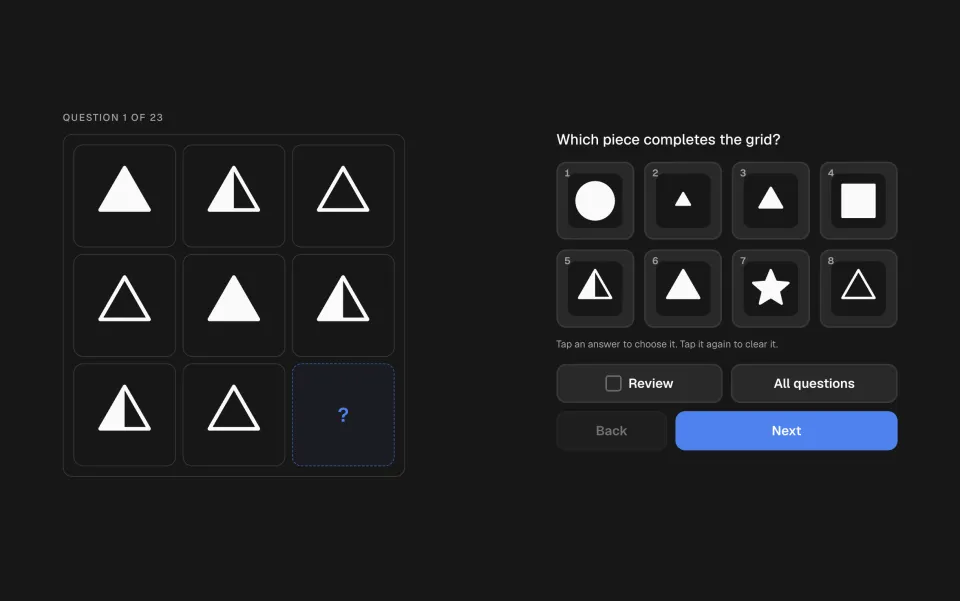
TalentLens is Pearson’s workplace testing arm. Employers send its tests one at a time, so the name on your invitation is the one to practise: Raven’s Adaptive or Raven’s APM-III for pattern reasoning, the Bennett Mechanical Comprehension Test for technical roles, or one or more of the five DAT Next Generation subtests. Each practice test here follows the published length and clock of the real one, with our own questions. Raven’s Adaptive is free to try with a free account.
Also searched as Raven’s Progressive Matrices, Raven’s APM, BMCT-II, the Bennett test and the Differential Aptitude Tests.
Free Test
Free to try with a free account. Unlock this provider for unlimited practice.
Raven's Adaptive
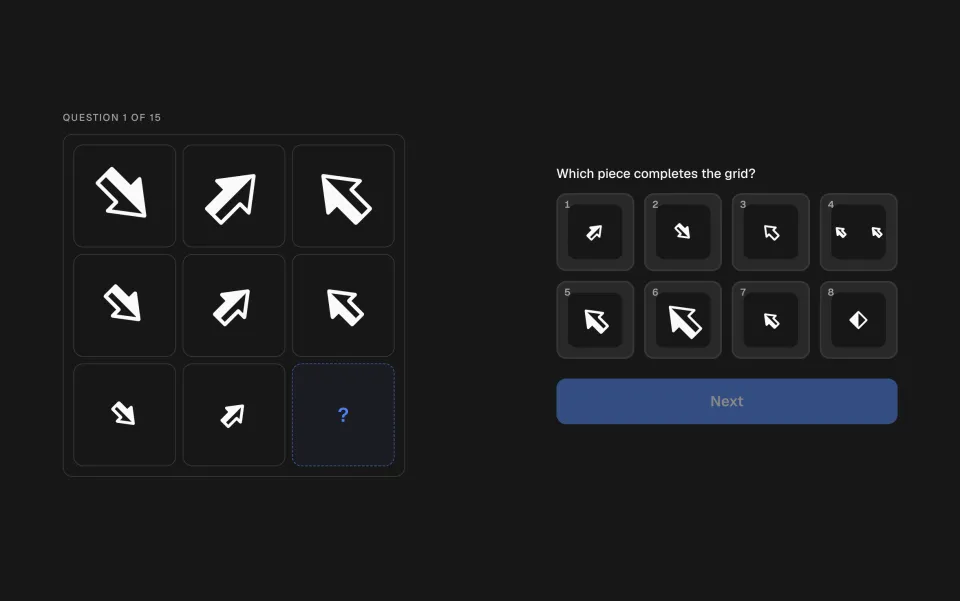
Pearson TalentLens's current Raven's Progressive Matrices test for recruitment: 15 three-by-three pattern grids with eight options each, adaptive and untimed. A right answer brings a harder grid, a wrong one an easier grid.
Premium Tests
Bennett Mechanical Comprehension Test II
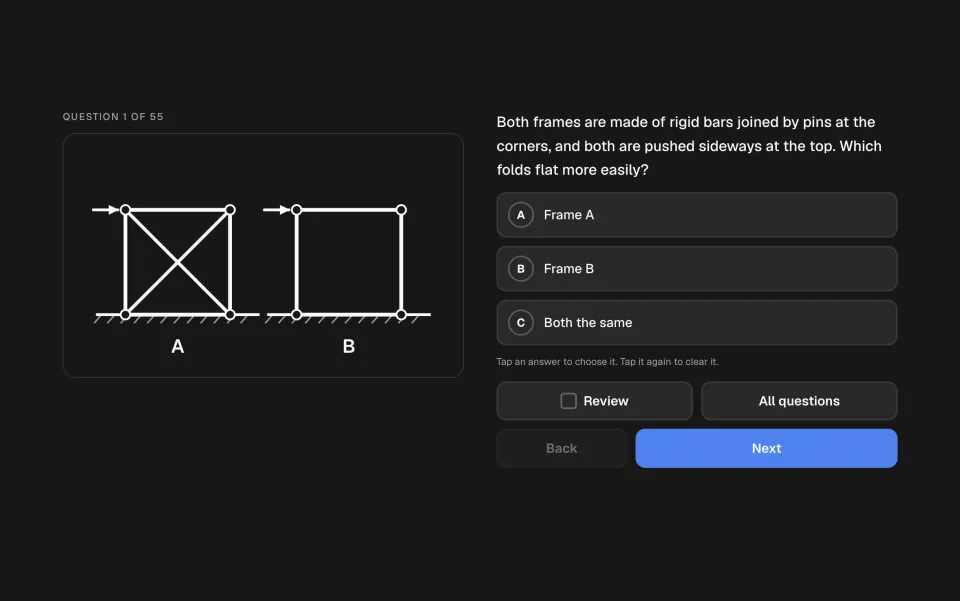
The BMCT-II for engineering, maintenance, production and trade roles: 55 drawn mechanical questions in 25 minutes, three options each (A, B, or C when equal), with a Review mark on every question as on the real screen.
DAT Next Generation Verbal Analogies
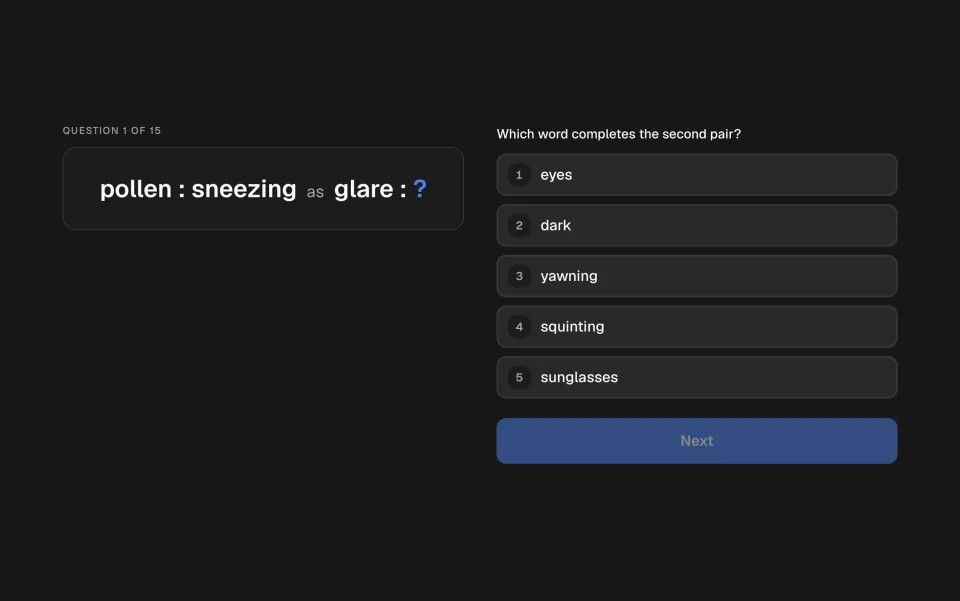
The Verbal Analogies subtest of the Differential Aptitude Tests (DAT Next Generation): 15 adaptive word-pair questions with no time limit. Find how the first two words relate, then complete the second pair.
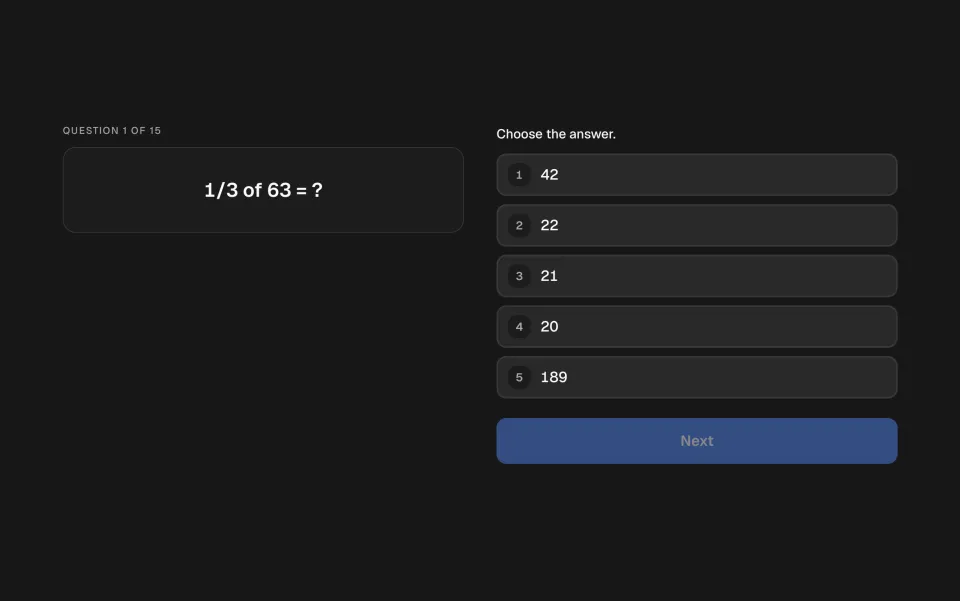
DAT Next Generation Numerical Calculations
The Numerical Calculations subtest of the Differential Aptitude Tests (DAT Next Generation): 15 adaptive sums with no time limit, covering addition, subtraction, multiplication, division, percentages and simple algebra.
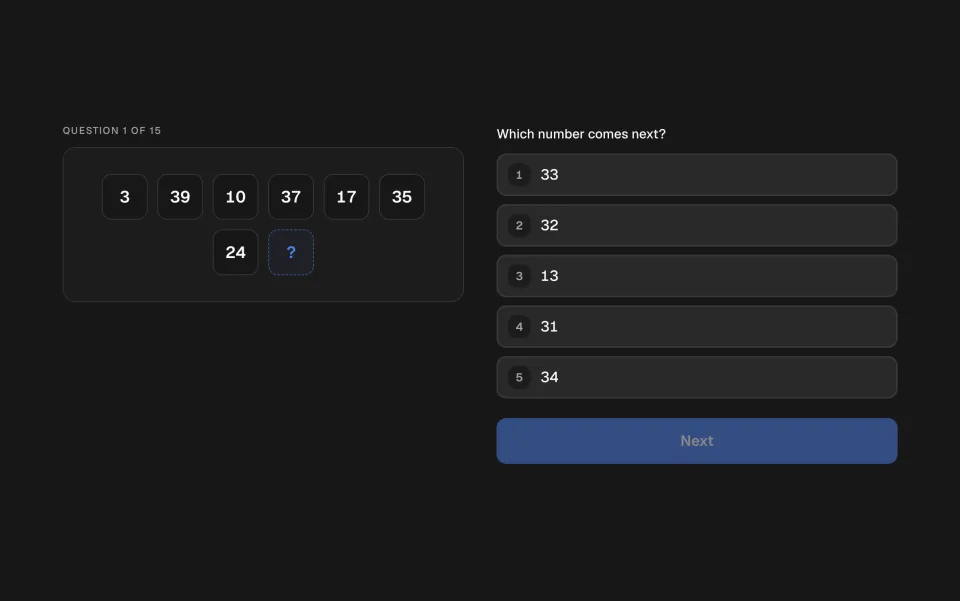
DAT Next Generation Numerical Sequences
The Numerical Sequences subtest of the Differential Aptitude Tests (DAT Next Generation): 15 adaptive number series with no time limit. Find the rule and choose the number that comes next.
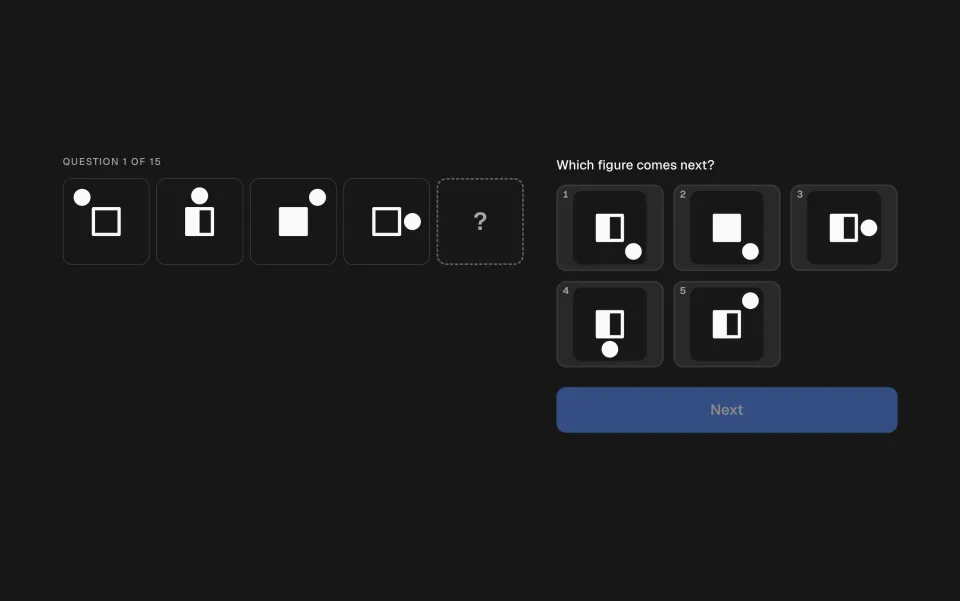
DAT Next Generation Abstract Reasoning
The Abstract Reasoning subtest of the Differential Aptitude Tests (DAT Next Generation): 15 adaptive figure series with no time limit. Four figures change step by step and you choose the fifth.
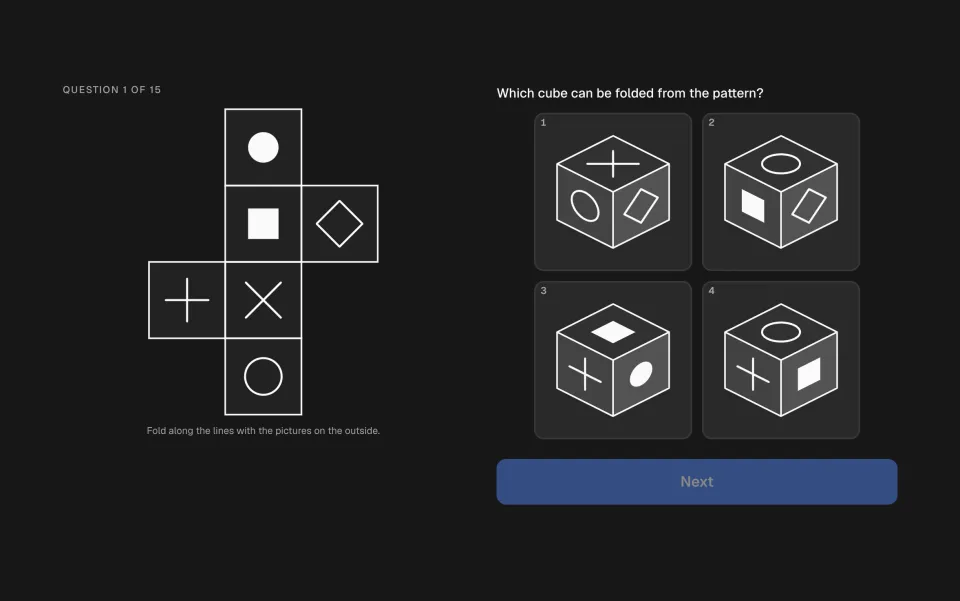
Which TalentLens test have you been sent?
Find the name on your invitation. TalentLens sells each test separately and employers pick the ones that suit the role, so there is no single “TalentLens test” and no need to practise them all.
- Raven’s Adaptive, or just “Raven’s”15 pattern grids with eight options. Adaptive, no time limit, about 12 minutes.Go to the practice test
- Raven’s APM, APM-III or Advanced Progressive Matrices23 pattern grids with eight options in 40 minutes. Also sent by Hogan under licence.Go to the practice test
- Bennett Mechanical Comprehension Test, BMCT or BMCT-II55 drawn mechanical questions in 25 minutes, answered A, B, or C for equal.Go to the practice test
- DAT Next Generation, DAT NG or Differential Aptitude TestsOne or more of five subtests, 15 adaptive questions each, no time limit. The invitation names the ones you have.Go to the practice test
- Watson-GlaserTalentLens’s critical thinking test. It has its own practice page.Watson Glaser practice
- Numerical Data Interpretation Test (NDIT)TalentLens’s test of interpreting numerical data at work. We do not simulate it; numerical reasoning practice is the nearest format.Numerical reasoning tests
Two names that cause confusion: Raven’s SPM (Standard Progressive Matrices) is no longer on TalentLens’s list of cognitive tests, and Raven’s 2 is a clinical edition sold through Pearson’s clinical catalogue, not a recruitment test. If an employer says either, ask which online test the link opens.
Questions and time limits, test by test
These are Pearson’s own figures. An adaptive test picks each question from your last answer. The other two give every candidate a different set of questions of matched difficulty, fixed when you start.
- Raven’s AdaptiveAdaptive15 questionsNo limit, about 12 minutes
- Raven’s APM-IIIDifferent set for each candidate23 questions40 minutes
- Bennett Mechanical Comprehension Test IIDifferent set for each candidate55 questions25 minutes
- DAT Next Generation Verbal AnalogiesAdaptive15 questionsNo limit, 10 to 12 minutes
- DAT Next Generation Numerical CalculationsAdaptive15 questionsNo limit, 10 to 12 minutes
- DAT Next Generation Numerical SequencesAdaptive15 questionsNo limit, 10 to 12 minutes
- DAT Next Generation Abstract ReasoningAdaptive15 questionsNo limit, 10 to 12 minutes
- DAT Next Generation Space RelationsAdaptive15 questionsNo limit, 10 to 12 minutes
On the adaptive tests you must answer all 15 questions to get a score. Raven’s APM-III opens with four practice questions and the Bennett test with two, none of them scored. TalentLens recommends a desktop or laptop for the Bennett test and DAT Next Generation, and a computer or large tablet for APM-III.
How TalentLens scores you
An ability score, not a count
Every question carries its own difficulty. Your answers become an ability estimate that gives more credit for hard questions than easy ones. On Raven’s it runs from -4 to +4. Two people with the same number right can get different results.
A percentile against a chosen group
The employer picks a norm group, such as graduates, managers or people in similar technical roles, and your report shows where you fall in it as a percentile. The same performance earns a different percentile in a different group.
No published pass mark
Pearson sets no pass mark for any of these tests. Each employer decides its own bar, and Pearson advises employers to confirm results from an unsupervised sitting later in the process.
How to prepare for each kind of test
The untimed adaptive tests. Raven’s Adaptive and the DAT Next Generation subtests reward accuracy and nothing else. Check every answer before you confirm, because you cannot go back and a wrong answer brings an easier question that is worth less. Expect to feel stretched: an adaptive test settles on questions you get right about half the time.
Raven’s APM-III. Forty minutes for 23 grids is about 1 minute 45 seconds each, and the later grids need more than that. Move briskly through the early ones, and answer every question, since a blank cannot be right.
The Bennett test. Fifty-five questions in 25 minutes leaves about 27 seconds each, so there is no time to calculate. Name the principle behind each drawing, answer, tick Review if you are unsure and keep moving. Choose C, for equal, only when the physics says the difference does not matter.
Practise the test you were sent. A Raven’s invitation does not call for mechanical revision, and a DAT Next Generation invitation lists its subtests. Start with the test named in your email.
What our practice reproduces, and what it cannot
The published format is the real one. Question counts, time limits, the eight options on Raven’s, the A, B or C answers and Review marks on the Bennett test, and the adaptive rule that a right answer brings a harder question all follow what Pearson publishes. The adaptive games show time taken, not a countdown, because the real tests have no limit.
The questions and their difficulty are ours. Pearson scores with difficulty values measured on real candidates and does not publish them. Our difficulty levels are set by design, so your result is an estimate on the same kind of scale, and the percentile compares you with other CogniPrep users, not with a TalentLens norm group.
Where Pearson publishes nothing, we say so. The number of options and the exact layout of the DAT Next Generation subtests are not published; ours use five options, and Space Relations uses four cubes. The Bennett topic mix is our estimate. Whether APM-III lets you go back is not published; ours does. The unscored practice questions that open APM-III and the Bennett test are left out.
Frequently Asked Questions
What is a Pearson TalentLens test?
TalentLens is Pearson’s workplace assessment arm. Its ability tests are Raven’s Adaptive, the Bennett Mechanical Comprehension Test (BMCT-II), DAT Next Generation, the Watson-Glaser Critical Thinking Appraisal and the Numerical Data Interpretation Test. Employers buy them one at a time, so your invitation names the test or tests you will sit.
Are TalentLens tests timed?
Some are. Raven’s Adaptive and all five DAT Next Generation subtests have no time limit and take about 10 to 12 minutes each. Raven’s APM-III allows 40 minutes for 23 questions, and the Bennett test allows 25 minutes for 55.
How are TalentLens tests scored?
Each test turns your answers into an ability score that takes the difficulty of your questions into account, then reports it as a percentile against a norm group the employer chooses. On the adaptive tests the number you got right means little, because everyone answers 15 questions of different difficulty.
Is there a pass mark?
Pearson publishes none for any of these tests. Each employer decides which norm group to compare you with and what percentile it wants.
Why did my questions keep getting harder?
Raven’s Adaptive and the DAT Next Generation subtests are adaptive. A right answer brings a harder question and a wrong answer an easier one, so harder questions mean you have been answering correctly.
Does the DAT Next Generation include mechanical reasoning?
No. Earlier editions of the Differential Aptitude Tests had a mechanical reasoning test. TalentLens replaced it with the Bennett Mechanical Comprehension Test (BMCT-II), which is sold separately. The five DAT Next Generation subtests are Verbal Analogies, Numerical Calculations, Numerical Sequences, Abstract Reasoning and Space Relations.
Is the DAT Next Generation the Dental Admission Test?
No. DAT here stands for Differential Aptitude Tests, a set of ability tests used in hiring, apprenticeships and career guidance. The Dental Admission Test for US dental schools is unrelated.
Is Raven’s 2 one of these tests?
No. Raven’s 2 is Pearson’s clinical edition of the Progressive Matrices, sold through its clinical catalogue. The Raven’s test TalentLens sells for recruitment is Raven’s Adaptive, with Raven’s APM-III still in use at some employers.
Will my result be checked?
It can be. These tests are usually sat at home early in the process, and Pearson advises employers to confirm unsupervised results later, for example with a supervised re-test.
Are these real TalentLens questions?
No. Every question here is our own, written or generated to the published format of each test. Pearson’s questions and artwork are not reproduced.
Companies That Use Pearson TalentLens
TalentLens is Pearson’s workplace assessment arm. Employers buy Raven’s Adaptive, the Bennett Mechanical Comprehension Test and the DAT Next Generation subtests one at a time and choose which to send, so the name on your invitation is the test to practise.
Liebherr-Aerospace Toulouse
AerospaceDAT Next Generation and Watson-Glaser III for short-listed engineering, support and production candidates.
View Liebherr-Aerospace Toulouse guide →L’Assurance Maladie (CRAMIF)
Public sectorThree DAT Next Generation subtests to screen Case Manager candidates before interview.
View L’Assurance Maladie (CRAMIF) guide →Caisse d’Epargne Normandie
BankingDAT Next Generation verbal, numerical and non-verbal sections in internal and external recruitment.
View Caisse d’Epargne Normandie guide →La Mutuelle Générale
InsuranceDAT Next Generation in its recruitment process, as reported in 2021.
We list an employer only where it or TalentLens says so on a page we have read. The employers below are all French and all use DAT Next Generation; we have no such source for Raven’s or the Bennett test. If your invitation says TalentLens or Pearson and names one of the tests here, that is the evidence that matters.
Guides and Tips
Read up before you practise: what the tests reward, what catches candidates out, and why shortcuts do not work.
Raven’s Progressive Matrices test: how it works
Raven’s Adaptive is the version of Raven’s Progressive Matrices that Pearson TalentLens now sells for recruitment: 15 pattern grids with one piece missing, no time limit, and questions that get harder as you get them right.
Can You Cheat a Pearson TalentLens Test?
No two candidates see the same questions, and the adaptive tests build yours as you answer. Why a leaked Raven’s, Bennett or DAT paper does not exist.
Raven’s APM-III test: how it works
Raven’s APM-III is the Advanced Progressive Matrices in its online form: 23 pattern grids with eight options each, on one 40-minute clock, used for graduate and management hiring.
Raven’s Adaptive, APM-III, SPM or Raven’s 2: Which Raven’s Test Have You Been Sent?
An invitation that says “Raven’s” could mean 15 untimed adaptive questions or 23 against a 40-minute clock. The versions employers send now, the ones they no longer send, and how to tell which is yours.
Bennett Mechanical Comprehension Test: how it works
The Bennett Mechanical Comprehension Test II (BMCT-II) is Pearson TalentLens’s mechanical reasoning test: 55 questions about drawings of everyday mechanisms, 25 minutes, and three possible answers to each.
DAT Next Generation Verbal Analogies test: how it works
Verbal Analogies is the verbal subtest of DAT Next Generation, the current Differential Aptitude Tests from Pearson TalentLens. It asks you to spot how two words are related and find the same relationship in a second pair.
DAT Next Generation Numerical Calculations test: how it works
Numerical Calculations is the arithmetic subtest of DAT Next Generation, the current Differential Aptitude Tests from Pearson TalentLens: 15 sums with no time limit that get harder as you get them right.
DAT Next Generation Numerical Sequences test: how it works
Numerical Sequences is the number-pattern subtest of DAT Next Generation, the current Differential Aptitude Tests from Pearson TalentLens. Each question is a series of numbers that follows a rule you have to find.
DAT Next Generation Abstract Reasoning test: how it works
Abstract Reasoning is the shape-pattern subtest of DAT Next Generation, the current Differential Aptitude Tests from Pearson TalentLens. It measures how well you see sequences in shapes and patterns, with no words or numbers involved.
DAT Next Generation Space Relations test: how it works
Space Relations is the spatial subtest of DAT Next Generation, the current Differential Aptitude Tests from Pearson TalentLens. It measures how well you can picture a flat, two-dimensional shape as a three-dimensional object.
Practice by Test Type
Compare the same format across every provider that uses it, and see what each one is really measuring.
Numerical Reasoning Test Practice
Tables, charts, percentages and ratios against the clock. The most common screening test on graduate schemes and analyst roles.
Verbal Reasoning Test Practice
Short dense passages and true, false or cannot say answers. Judged on what the text supports, never on what you already know.
Logical Reasoning Test Practice
The umbrella name on many invitations. Covers the four rule-based formats and how to tell which one you have actually been sent.
Inductive Reasoning Test Practice
Spot the rule in a set of examples, then use it: the next frame, the odd one out, or which group a new figure joins.
Abstract Reasoning Test Practice
Matrices, figure series and odd-one-out sets sold under the abstract or non-verbal label. No words, no numbers, one missing piece.
Spatial Reasoning Test Practice
Turn, fold, mirror and assemble shapes in your head. Set for engineering, military and aviation roles and inside general ability tests.
Mechanical Reasoning Test Practice
Drawn gears, pulleys, levers and fluids. Predict which way things turn, what balances and what moves fastest.
About CogniPrep TalentLens Practice
CogniPrep provides independent practice for the ability tests Pearson TalentLens sells to employers. CogniPrep is not affiliated with Pearson or TalentLens, whose test names are trademarks of their owners and are used here for identification only. Our questions are our own. The Watson-Glaser Critical Thinking Appraisal, also a TalentLens test, has its own practice page.
- 8 practice tests: Raven's Adaptive, Raven's APM-III, Bennett Mechanical Comprehension Test II, DAT Next Generation Verbal Analogies, DAT Next Generation Numerical Calculations, DAT Next Generation Numerical Sequences, DAT Next Generation Abstract Reasoning, DAT Next Generation Space Relations
- Raven’s Adaptive: 15 adaptive questions, eight options, no time limit
- Raven’s APM-III: 23 questions in 40 minutes, eight options
- Bennett Mechanical Comprehension Test II: 55 questions in 25 minutes, answers A, B or C
- DAT Next Generation: five subtests of 15 adaptive questions each, no time limit
- Scoring: an ability score converted to a percentile against a norm group; no published pass mark
Sources: TalentLens, cognitive assessments; Raven’s Adaptive; Raven’s APM-III guide (TalentLens France); Bennett Mechanical Comprehension Test; DAT Next Generation; DAT Next Generation guide (TalentLens France); Hogan Assessments, Raven’s APM-III.
Ready to Start Practising?
Sign up for free to try Raven’s Adaptive, or unlock all 8 TalentLens practice tests, including Raven’s APM-III, the Bennett test and every DAT Next Generation subtest, with unlimited sessions.