
National Police Officer Selection Test (NPOST) Practice
The written exam from Stanard & Associates that police departments and sheriff's offices across the US set as their first scored step. Practise its three multiple-choice sections on their real clocks, one at a time or back to back, and learn how the hand-marked report writing section is judged.
Also called the POST, the Stanard POST, the police officer selection test or simply the police written exam. Not the California POST test, which is the PELLETB.
Unlimited practice on all 4 tests for £10. One-time payment, no subscription.
Free Tests
Free to try with a free account - unlock this provider for unlimited practice.
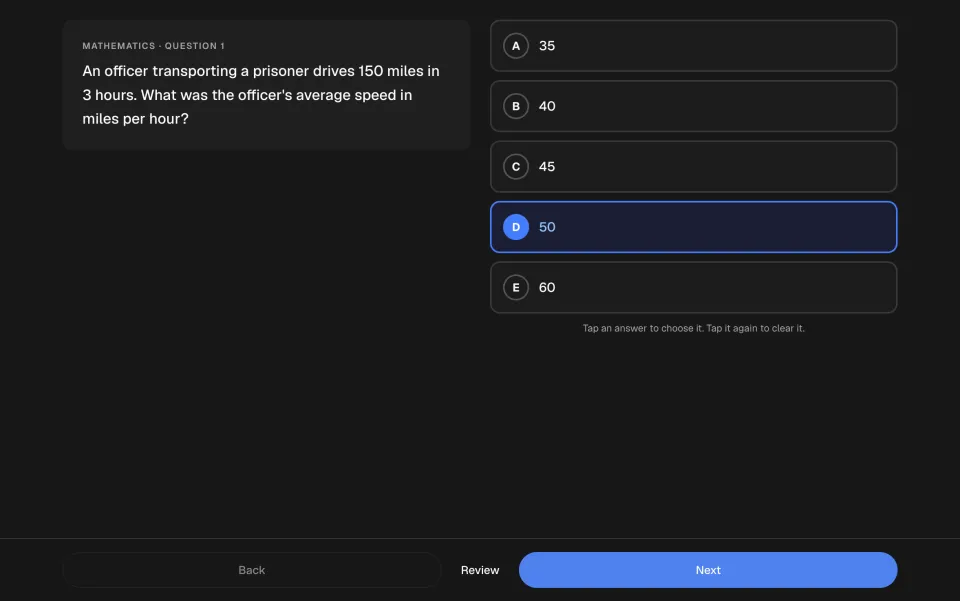
POST Mathematics
Section I of the National Police Officer Selection Test: 20 arithmetic problems in 20 minutes, set in police work. Totals from a property list, differences, averages, rates and percentages, five answers each and no calculator, as on the real test.
Premium Tests
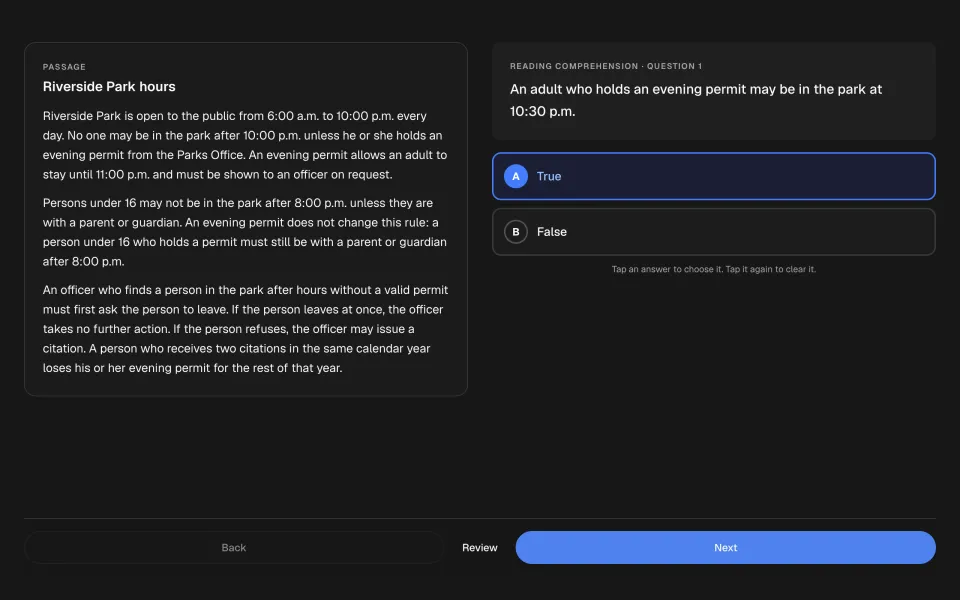
POST Reading Comprehension
Section II of the National Police Officer Selection Test: 25 questions in 25 minutes on short passages of made-up police rules and on incident report forms. True/false statements, questions answered from the passage and sentence completions, with the passage beside the question.
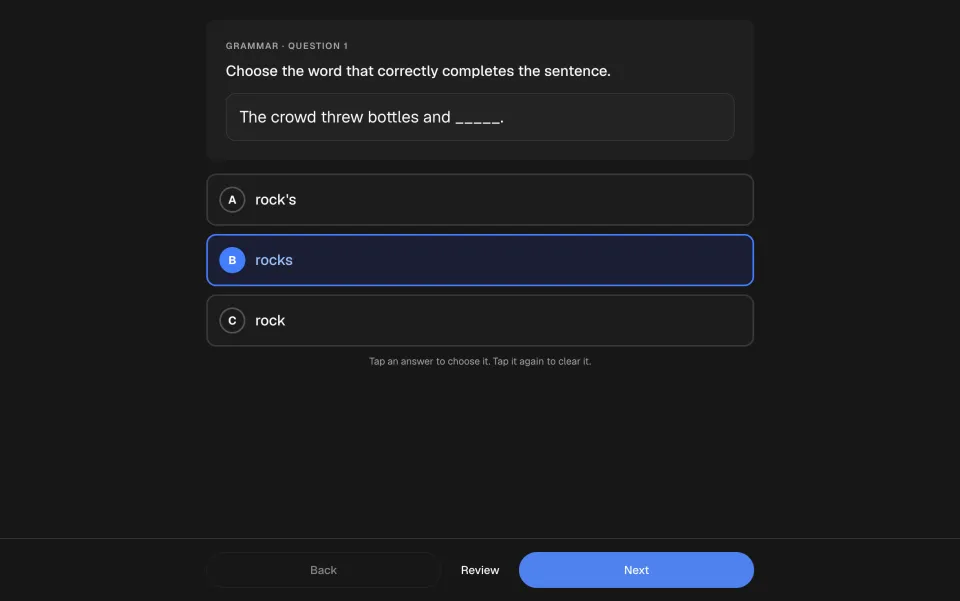
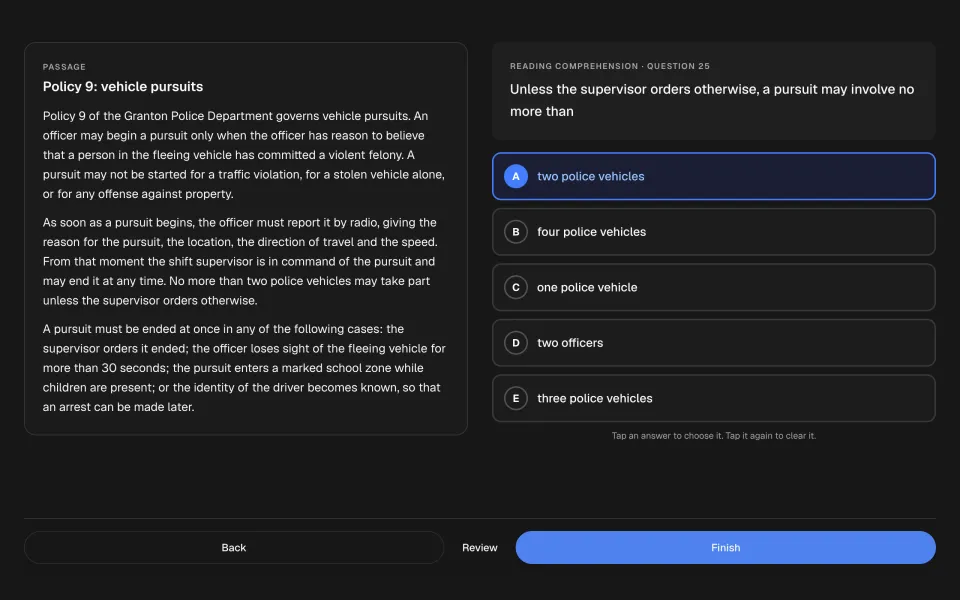
The four sections
From Stanard's study guide and sample test. Each section has its own clock, and you are told when to start and stop. Within a section you can go back and check your work; once it ends, you cannot return to it. Stanard publishes no count or time for report writing on its own: the figures below are what is left of the 75 questions and 1 hour 15 minutes La Crosse Police Department gives for the whole test.
| Section | What you do | Questions | Time | On CogniPrep |
|---|---|---|---|---|
| I. Mathematics | Arithmetic word problems set in police work: totals, differences, averages and rates. Five options, no calculator. | 20 | 20 min | Free drill |
| II. Reading Comprehension | Passages of made-up police rules and incident report forms, with true/false, answer-from-the-passage and sentence-completion questions. | 25 | 25 min | Drill |
| III. Grammar | Choose the word that completes a sentence, or pick out the misspelled word. | 20 | 15 min | Drill |
| IV. Incident Report Writing | Answer questions about an incident in complete sentences, written in the booklet and marked by people. | About 10 | About 15 min | Advice below |
I. Mathematics
Arithmetic word problems set in police work: totals, differences, averages and rates. Five options, no calculator.
- Questions
- 20
- Time
- 20 min
- On CogniPrep
- Free drill
II. Reading Comprehension
Passages of made-up police rules and incident report forms, with true/false, answer-from-the-passage and sentence-completion questions.
- Questions
- 25
- Time
- 25 min
- On CogniPrep
- Drill
III. Grammar
Choose the word that completes a sentence, or pick out the misspelled word.
- Questions
- 20
- Time
- 15 min
- On CogniPrep
- Drill
IV. Incident Report Writing
Answer questions about an incident in complete sentences, written in the booklet and marked by people.
- Questions
- About 10
- Time
- About 15 min
- On CogniPrep
- Advice below
Three things to know first
It is not California's POST test
"POST" also names state commissions on Peace Officer Standards and Training. California's sets its own test, the PELLETB, which has no maths section. If your agency is in California, that is almost certainly the one you will sit.
Each section is scored on its own
Your score is the percentage right in each section, with nothing taken off for a wrong answer. Where an agency sets a minimum per section, as Iowa's state rule does, a strong maths score cannot rescue a weak grammar one.
Online or on paper, depending on the agency
Stanard sells printed forms that agencies administer and score themselves, and Form E, an online version candidates take on their own computer, which Stanard scores. Ask the agency which one it uses.
Section IV: Incident Report Writing
The last section is the only one you write out. Stanard's guide says it "requires you to write out your answers in complete sentences in the spaces provided in the test booklet", and that each answer "must contain the correct information, be grammatically correct and all words should be spelled correctly". It is read and marked by people, at the agency or at Stanard, rather than by a scanner, which is why no practice site can score it for you honestly and why we teach it here instead.
Stanard does not publish sample items for this section, only the standard every answer must meet. Treat those three tests as the marking scheme: the right facts, in correct sentences, spelt correctly. A fluent answer with a wrong time or a misspelt street name loses marks; a plain one with every fact right does not.
How to write each answer
- Answer only the question asked, in one or two complete sentences.
- Start from the question's own words, so the sentence has a subject and a verb: "The suspect left the store at 9:15 pm."
- Copy names, addresses, dates, times and amounts exactly as they appear in the incident. Check each one against the source before you move on.
- Add nothing the material does not say. A guess presented as a fact is wrong information.
- Write in the past tense, and say who did what rather than "it was done".
How to prepare for it
- Practise the Grammar section: the same errors it tests (plurals, their and there, I and me, common misspellings) are the ones that cost marks here.
- Learn the spelling of words reports use constantly: suspect, vehicle, witness, license, approximately, received, separate, occurred.
- Take a short news story, write five who, what, when, where and how sentences about it from memory, then check every fact and word against the original.
- Write by hand. On a paper sitting there is no spellchecker, and legible writing is part of being marked fairly.
- Leave a minute at the end to reread each sentence for a missing word.
How it is scored, and the score agencies want
In each multiple-choice section, "your score will be the percentage of problems you answer correctly", in the guide's words, and there is no penalty for guessing. Answer everything: a true/false question left blank gives up a 50% chance for nothing.
Stanard does not set a pass mark; the agency does. The one published minimum we know of is Iowa's. Iowa Administrative Code rule 501-2.2 requires every entry-level law enforcement applicant in the state to take Stanard's POST and sets "70 percent on each of the four sections" as the minimum, adding that agencies and civil service commissions may ask for more. The same rule keeps a score valid for one year, and allows a retake of the same version once in 12 months with at least 90 days between sittings, or an alternate version with no wait.
Outside Iowa, look for the pass mark and the retake rules in the posting for the agency you are applying to. Stanard says the POST is the statewide entry-level test in Iowa and the official test of 29 state police chiefs' associations, which resell it to their members, so the rules differ from one department to the next.
How our practice works, and what Stanard has not published
The counts and clocks are Stanard's. Mathematics is 20 questions in 20 minutes, Reading Comprehension 25 in 25 and Grammar 20 in 15, as in the study guide. The full test runs all three back to back, each on its own clock, and you cannot go back to a section once it ends.
The mix inside each section is ours. Stanard names the question types but not how many of each a form carries. Our reading sitting is three rules passages and two report forms, five questions on each; our grammar sitting is ten word-choice questions then ten misspelled-word questions; our maths sitting is four each of totals, differences, averages, rates and percentages.
Every item is our own. Maths problems are generated fresh each sitting, and the reading passages and forms are written for practice. None is a Stanard item.
Results are per section, against Iowa's line. You see your percentage in each section beside the 70% minimum Iowa's rule sets, labelled as Iowa's. Your own agency's bar may be different.
Report writing is not scored here. It is marked by people on the real test, so the advice above is how we cover it.
Items are in American English. It is an American test, so the questions use American spelling, and our spelling items avoid words spelt differently in British English.
Frequently Asked Questions
What is on the National Police Officer Selection Test?
Four separately timed sections: Mathematics (20 questions in 20 minutes), Reading Comprehension (25 in 25), Grammar (20 in 15) and Incident Report Writing, which you answer in full sentences. Agencies such as La Crosse give 75 questions in 1 hour 15 minutes in all.
Is the NPOST the same as the California POST test?
No. California’s Commission on POST sets its own test, the PELLETB, with clarity, vocabulary, spelling and reading sub-tests. The National Police Officer Selection Test is a different test from Stanard & Associates, used by agencies in other states. Check which one your agency means before you prepare.
Can I use a calculator on the POST math section?
No. Stanard’s study guide says calculators are not allowed in Section I, and scratch paper is provided in the test booklet for your working.
What score do you need to pass the NPOST?
Each agency sets its own pass mark. Iowa’s state rule sets a minimum of 70 percent on each of the four sections and lets agencies and civil service commissions ask for more. Elsewhere, check the posting for the agency you are applying to.
Can I take the National Police Officer Selection Test online?
Sometimes. Stanard offers an online remote version, Form E, which candidates take on their own computer within the department’s timeline, and Stanard scores it. Whether you get it depends on the agency; many still test on paper in person.
Is there a penalty for guessing on the POST?
No. Your score in each section is the percentage you answer correctly, so a blank can only cost you. Answer every question before the section ends.
Where do I get the official NPOST study guide?
Stanard sells a study guide ($7.50) and a practice exam ($17.50) to candidates through ApplyToServe.com, as La Crosse Police Department’s test page sets out.
How long is an NPOST score valid?
Each agency decides. In Iowa a score is valid for one year from the test date, and you may retake the same version once in 12 months with at least 90 days between attempts, or an alternate version without waiting.
Companies That Use National Police Officer Selection Test
The National Police Officer Selection Test is an off-the-shelf written exam that police departments and sheriff's offices buy from Stanard & Associates and run themselves, usually as the first scored step after the application. These users are named on an agency's own page or in a state rule.
Iowa Law Enforcement Academy
Government & Public SectorIowa's academy rules require entry-level applicants to every Iowa agency to take Stanard's National Police Officer Selection Test, with a minimum of 70 percent on each of its four sections, which agencies and civil service commissions may raise.
View Iowa Law Enforcement Academy guide →La Crosse Police Department
Government & Public SectorUses the Police Officer Selection Test as its written exam: 75 questions across arithmetic, reading comprehension, grammar and incident report writing, with 1 hour 15 minutes allowed.
View La Crosse Police Department guide →Each agency sets its own pass mark and decides how long a score stays valid, and some run only some of the four sections. "POST" also names California's commission, whose own test is the PELLETB, so check which test your agency means before you prepare.
Guides and Tips
Read up before you practise: what the tests reward, what catches candidates out, and why shortcuts do not work.
NPOST math test: how it works
Section I of the National Police Officer Selection Test is arithmetic: 20 word problems about police work, 20 minutes, five answers each and no calculator.
Can You Cheat the NPOST? Four Forms, No Key
Four forms of the paper, a report section a person marks, and a score for every section. Why no shortcut survives the NPOST.
NPOST reading comprehension test: how it works
Section II of the National Police Officer Selection Test gives you passages of made-up police rules and incident report forms, and 25 questions on them in 25 minutes.
NPOST or PELLETB: Which POST Test Is Yours?
Outside California the POST is often Stanard's National Police Officer Selection Test, with a maths section and a hand-marked report. In California the POST test is the PELLETB, which has neither.
NPOST grammar test: how it works
Section III of the National Police Officer Selection Test is the fastest: 20 grammar and spelling questions in 15 minutes.
Practice by Test Type
Compare the same format across every provider that uses it, and see what each one is really measuring.
Numerical Reasoning Test Practice
Tables, charts, percentages and ratios against the clock. The most common screening test on graduate schemes and analyst roles.
Verbal Reasoning Test Practice
Short dense passages and true, false or cannot say answers. Judged on what the text supports, never on what you already know.
About CogniPrep NPOST Practice
CogniPrep provides simulations of the National Police Officer Selection Test (POST, often written NPOST), the entry-level written exam Stanard & Associates sells to municipal, county, state and federal law enforcement agencies in the United States. Agencies also call it the Stanard POST, the police officer selection test, the police entrance exam or the police written exam. It is a different test from the California POST Entry-Level Law Enforcement Test Battery (PELLETB).
- 4 practice tests available: POST Mathematics, POST Reading Comprehension, POST Grammar and Spelling, Full POST (Sections I to III)
- Real test: four separately timed sections, 75 questions in 1 hour 15 minutes
- Mathematics, Reading Comprehension and Grammar are multiple choice; report writing is hand-marked
- Score: percentage correct per section, no penalty for guessing
- Pass mark set by the agency; Iowa's rule sets at least 70% on each section
- Printed forms, or Form E online on the department's timeline
Ready to Start Practising?
Sign up for free to try the Mathematics section, or unlock all 4 NPOST practice tests, including all three multiple-choice sections back to back on their real clocks, with unlimited practice sessions.