
Cappfinity Assessment Practice: Free Tests
Cappfinity assessment practice: the strengths-based situational judgement test, the strengths profile, and the numerical and verbal reasoning tests, so the format holds no surprises on the day. Verbal / Critical Thinking is free to try with a free account.
Free Tests
Free to try with a free account - unlock this provider for unlimited practice.

Verbal / Critical Thinking
Read a short passage and judge whether each statement is True, False, or Cannot Say based only on the text. Mirrors the verbal and critical-thinking component included in many Cappfinity assessments.
All Tests

Strengths-Based Situational Judgement
Read 15 workplace scenarios and rate how effective each of five responses would be. Our score also counts your average time per scenario; Cappfinity says its behavioural questions are untimed unless your instructions say they are time recorded. Practice for the scenario questions in Cappfinity’s strengths-based assessments.
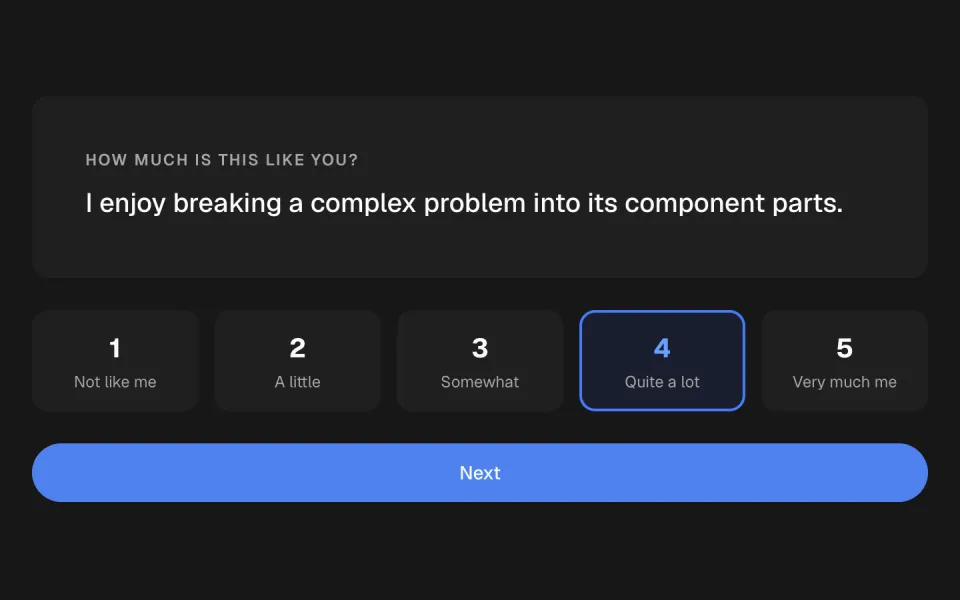
Strengths Profile
Rate 40 work statements from 1 to 5 for how much each is like you, to build a profile across 20 strength areas. Our version counts answers slower than 6 seconds for a little less; Cappfinity says behavioural questions are untimed unless your instructions say they are time recorded. Practice for the statement-rating questions in Cappfinity assessments.
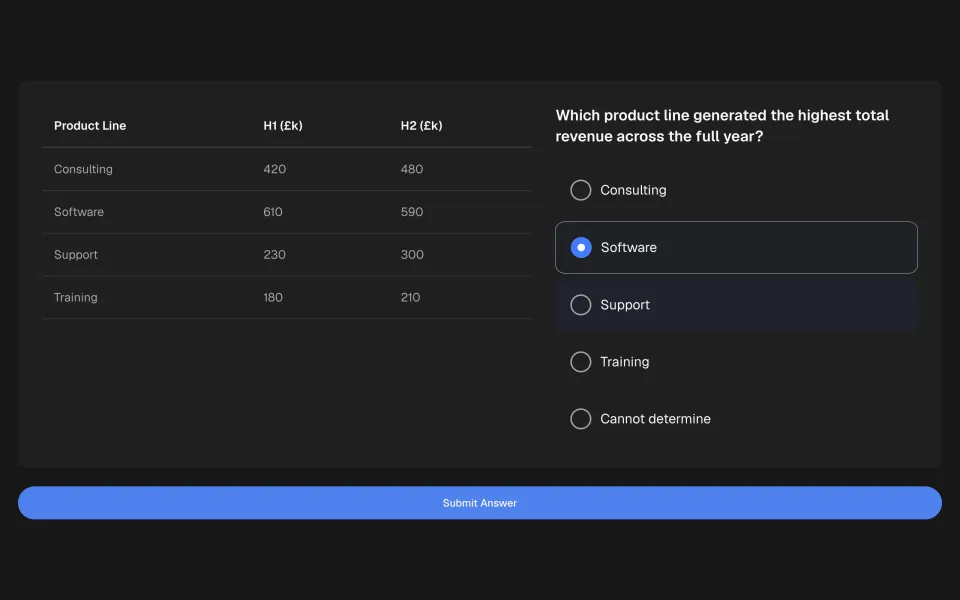
Numerical Reasoning
Interpret data tables and charts to answer arithmetic and trend questions within a contextualised job simulation. Select the correct answer from five options. Mirrors the numerical component included in many Cappfinity assessments.
At a glance
Cappfinity runs strengths-based assessments. Behavioural questions explore how you would handle work scenarios and what you enjoy doing, and are untimed apart from video and written responses. Cognitive tests, chosen to suit the role, can cover critical, numerical, verbal and diagrammatic reasoning and coding potential, and some record how long you take.
- Question formats
- Order responses, pick the most appropriate one, place yourself on a scale, sort responses into categories, rate statements, or give a written or video answer.
- Time limit
- Behavioural assessments are untimed apart from video and written questions. Cognitive tests vary: no limit, a limit for the whole test, or a limit per question.
- Time recorded
- Some questions are time recorded, and on cognitive tests the time you take may count towards your score. Cappfinity says this is stated in advance.
- Equipment
- A calculator, pen and paper for numerical questions.
- Devices
- Most assessments work on desktops and mobile devices, but Cappfinity recommends a desktop and an up-to-date Google Chrome.
- Sittings
- One sitting is recommended. Most untimed assessments let you return later if you are interrupted.
Checked against Cappfinity Preparation Hub, FAQs, Cappfinity Preparation Hub, Explore our assessments and Cappfinity Preparation Hub, Prepare. Updated .
What is Cappfinity?
Strengths-based approach
Cappfinity focuses on what you naturally do well and what energises you, rather than only what you can do. Its assessments are built around your strengths.
Check whether you are timed
Behavioural questions are untimed apart from video and written responses. Some assessments are time recorded, so the time you take may count, and Cappfinity says you are told in advance when that applies.
Job simulations
Tests are delivered as contextualised, employer-specific job simulations, often blending situational judgement, a strengths profile and aptitude questions.
What Each Test Measures
Strengths-Based Situational Judgement
~20 minutesRealistic workplace scenarios with several possible responses. You rate how effective each response would be, scored against an expert strengths key. Some Cappfinity assessments are time recorded, and you are told in advance if so.
Strengths Profile
untimedRate how well a series of work-context statements reflect you on a 1-5 scale, building a profile across your strength themes. Cappfinity says behavioural questions are untimed unless your instructions say they are time recorded.
Numerical Reasoning
~10 minutesInterpret data tables and charts to answer arithmetic and trend questions, choosing from five options. Included in many Cappfinity job simulations alongside the strengths components.
Verbal / Critical Thinking
~10 minutesRead a short passage and judge whether each statement is True, False, or Cannot Say based only on the text. Tests careful reading and disciplined inference.
Frequently Asked Questions
How should I approach a strengths-based SJT?
Read each scenario once, then rate the responses at a natural, confident pace. Because Cappfinity weights quick, genuine answers, over-thinking or trying to game the "ideal" answer can work against you. Focus on what genuinely reflects effective, strengths-led behaviour.
Are there right or wrong answers in the strengths profile?
No. The strengths profile maps your natural preferences and energies, not ability. The best approach is to answer honestly and instinctively so the profile is an accurate reflection of you.
Do the numerical and verbal sections always appear?
Not always. Cappfinity deployments are bespoke per employer. Some include numerical and verbal reasoning as part of the job simulation; others focus purely on the strengths components. Practising all four prepares you whichever mix you face.
Does response time matter?
Only where your instructions say a section is time recorded, in which case the time you take may count towards your score. Otherwise Cappfinity says behavioural questions are untimed, apart from video and written responses. Either way, it tells candidates not to overthink behavioural questions.
How do I improve on the aptitude sections?
For numerical, drill percentages, ratios and reading data from tables and charts. For verbal, practise judging statements strictly against the passage without bringing in outside knowledge. Both improve with focused, timed practice.
Companies That Use Cappfinity
Cappfinity strengths-based assessments are used by professional-services firms, banks, insurers, financial regulators and engineering consultancies that want to hire for potential and strengths rather than academic performance alone.
EY (Ernst & Young)
Professional ServicesStrengths-based assessment and digital job-simulation for early careers.
View EY (Ernst & Young) guide →Aviva
InsuranceStrengths and aptitude tests across graduate, internship and apprenticeship hiring.
Financial Conduct Authority (FCA)
Financial RegulatorOnline strengths-based, situational assessment provided by Cappfinity.
KPMG
Professional ServicesStrengths-based early-careers selection reported to use Cappfinity tests.
View KPMG guide →Barclays
Banking & FinanceCappfinity strengths assessment reported in graduate recruitment.
View Barclays guide →Lloyds Banking Group
Banking & FinanceListed among Cappfinity clients using strengths-based selection.
View Lloyds Banking Group guide →AtkinsRéalis
Engineering ConsultancyGraduate, apprentice and placement applicants are sent to a Cappfinity-operated preparation zone with a practice immersive assessment that AtkinsRéalis says closely reflects the real one.
View AtkinsRéalis guide →Employers change assessment vendors over time, so confirm the current process for your role before preparing.
Guides and Tips
Read up before you practise: what the tests reward, what catches candidates out, and why shortcuts do not work.
Cappfinity Strengths Profile: how it works
Strengths Profile is Cappfinity’s own strengths questionnaire, now called Skills Discovery. Cappfinity suggests its free version as preparation for its assessments.
Can You Cheat the Cappfinity Strengths Test?
Strengths tests punish second-guessing. How Cappfinity reads your answers against each other.
Cappfinity Situational Strengths Test: how it works
Cappfinity’s behavioural assessment: workplace scenarios and self-ratings that look for what you do well and enjoy doing, with no clock unless you are told otherwise.
Group Exercises and Role Plays: What Assessors Actually Write Down
Assessors do not form an impression of you, they run a procedure: observe, record, classify, rate. Knowing the procedure explains why dominating the discussion costs marks and which four contributions reliably earn them.
Cappfinity numerical and verbal reasoning tests: how it works
The cognitive side of a Cappfinity assessment: numerical questions built on job-like data and verbal questions built on passages, with timing that varies by employer.
Cappfinity Tips: How a Strengths Assessment Is Scored Differently
A strengths assessment records not just what you answer but how quickly. That makes constructing the ideal response counterproductive, and it changes how you prepare.
Practice by Test Type
Compare the same format across every provider that uses it, and see what each one is really measuring.
Numerical Reasoning Test Practice
Tables, charts, percentages and ratios against the clock. The most common screening test on graduate schemes and analyst roles.
Verbal Reasoning Test Practice
Short dense passages and true, false or cannot say answers. Judged on what the text supports, never on what you already know.
Situational Judgement Test Practice
Realistic workplace scenarios scored against an employer competency framework. No maths, no time pressure, and a scoring key you can reason about.
Personality Test Practice for Job Applications
No right answers, which is exactly why they unsettle people. Learn the traits, the consistency checks and the formats before you sit one for real.
About CogniPrep Cappfinity Practice
CogniPrep provides authentic simulations of all 4 Cappfinity assessment tests: Strengths-Based Situational Judgement, Strengths Profile, Numerical Reasoning and Verbal Reasoning. Each practice test replicates the real question formats, timing and scoring. Cappfinity (formerly Capp) is a strengths-based assessment provider that focuses on what energises candidates and what they naturally do well, rather than only what they can do. A distinctive feature is that response speed is part of the signal: fast, decisive answers indicate authentic strengths. Deployments are bespoke per employer, typically delivered as contextualised job simulations. Cappfinity is used by Big 4 accountancy firms, law firms and UK graduate schemes including EY, Teach First and Dyson.
- 4 Cappfinity tests available: Strengths SJT, Strengths Profile, Numerical Reasoning, Verbal Reasoning
- Strengths SJT: ~20 minutes, scenarios rated against an expert strengths key
- Strengths Profile: untimed unless stated as time recorded, 1-5 scale ratings
- Numerical Reasoning: ~10 minutes, data tables and charts, arithmetic and trend questions
- Verbal Reasoning: ~10 minutes, True/False/Cannot Say format
- Employers: EY, Teach First, Dyson, Big 4 accountancy firms, UK law firms
- No right or wrong answers in the strengths components; honest, instinctive answers produce the most accurate profile
Ready to Start Practising?
Sign up for free to try 1 test, or unlock all 4 Cappfinity practice tests for unlimited practice sessions.