Balloon Game Strategy: Risk Management and Pattern Recognition
Deep dive into the Arctic Shores Balloon game. Learn optimal pumping strategies, risk assessment techniques, and how to maximize your score.
The Balloon game, which Arctic Shores calls Balloon Burst, is the best-known task in its assessment. This guide explains how it works, what is and is not known about how it is read, and how to approach it without chasing a magic number.
Understanding the Balloon Game
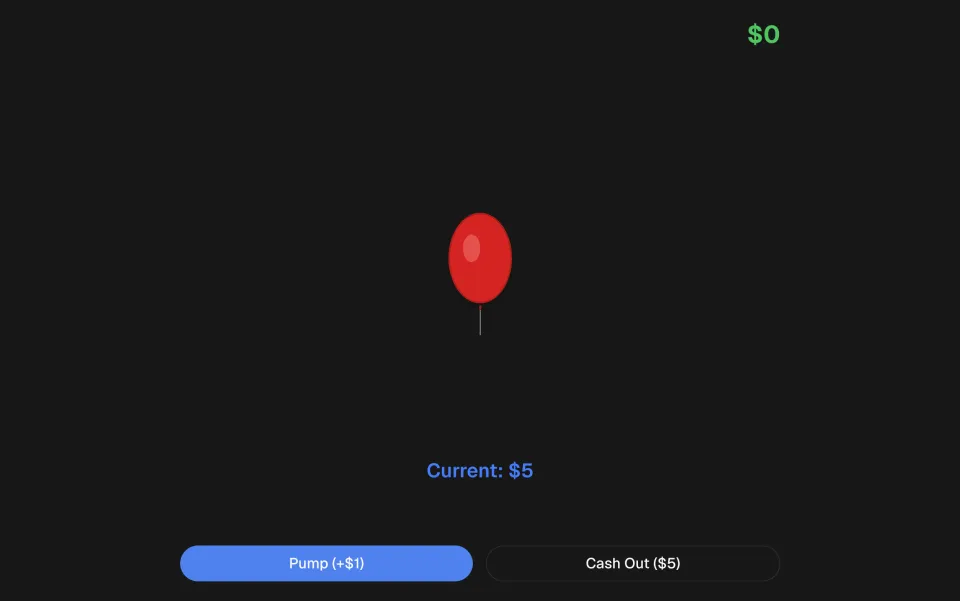
You inflate a balloon to raise what it is worth, and at any point you can exchange it for the money and bank it. If the balloon bursts first, the money in that balloon is lost, but anything you have already banked is safe. Then the next balloon appears. Arctic Shores' own screenshot shows an Inflate control on the Space key, an Exchange control on Enter, a count of balloons remaining and a banked total.
Core Mechanics
- Every inflation raises the balloon's value
- You are not told when a balloon will burst
- You can exchange the balloon for its current value at any time before it bursts
- A burst loses the money in that balloon only, never what you have banked
What the Game Measures
Risk-taking is the obvious answer, and Arctic Shores uses this task as its example of one that measures more than it seems to: it says Balloon Burst measures 20 traits at once. It does not say which, and it does not publish how the task is scored. So treat any list of "what the balloon game really measures" as a guess, including the trait names our own practice report uses.
Is There an Optimal Number of Pumps?
No published one. Arctic Shores says there is no right or wrong way to approach its tasks, that every employer is looking for something different, and that your results are compared with a norm group of similar candidates. A pump count you read online, or a rule such as "always stop at ten", is someone's guess about a task whose burst points and scoring have never been published.
How to Approach It
1. Learn Before You Commit
Use the first few balloons to see what happens. How far did a balloon get before it burst? Did anything about its appearance change? Let what you see shape how you play the rest, rather than deciding your approach before the first balloon appears.
2. Decide Each Balloon on Its Merits
If the task gives you clues, use them. If it does not, make the call you would make with real money: how much are you prepared to risk for the extra gain? There is no answer to look up, so the honest answer is the useful one.
3. Treat a Burst as Information
A burst tells you something about where balloons tend to go. Adjust because of what you learned, not because of how losing felt.
4. Don't Play a Character
It is tempting to play the way you imagine the employer wants, for example very carefully for a finance role. Arctic Shores says trying to fake a profile tends to muddle the data, and that guides promising a right way to play lead to poor or invalid results. Play as you would naturally.
Common Mistakes to Avoid
Practise with CogniPrep
Our Balloon game lets you get comfortable with the inflate-or-bank decision before the real thing. It is our design, not Arctic Shores': you get 45 balloons, and how long each lasts depends on its shape, which the real task may not do. Because there is no right answer, it gives you a profile of how you played rather than a score. Use it to learn the decision, not to learn a number.